### 01 Acoustic Glass for Podcast Booths
**Subheading:** Acoustic Glazing Engineered for Clear, Leak-Free Podcast & Voice Recording — Walls, Doors & Observation Panels
**Key Specs Badge:**
STC 41–50 | Low-Frequency Control (150–500 Hz) | Acoustic Laminated / IGU | Two-Way Speech Privacy | CNC Cut-outs | OEM
**CTA Buttons:**
[Request a Quote] [Send Your Booth Drawing] [Download Acoustic Glass Datasheet]
### 02 – Application Definition(What Is It?)
**H2:** What Is Podcast Booth Acoustic Glass?
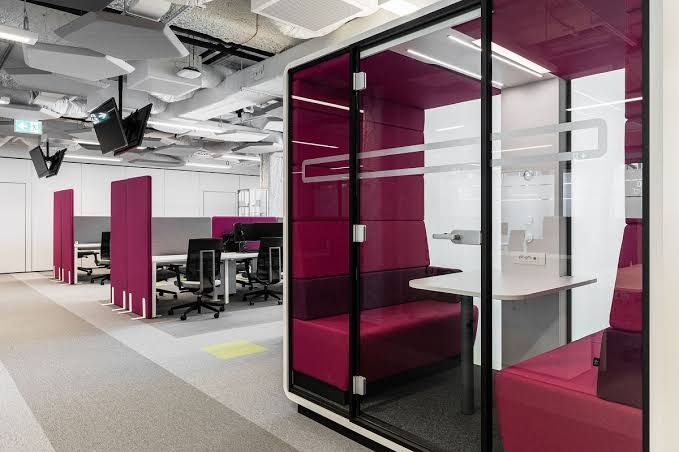
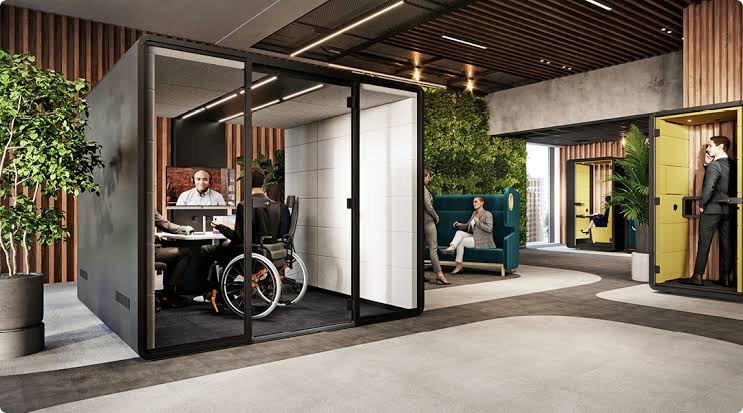
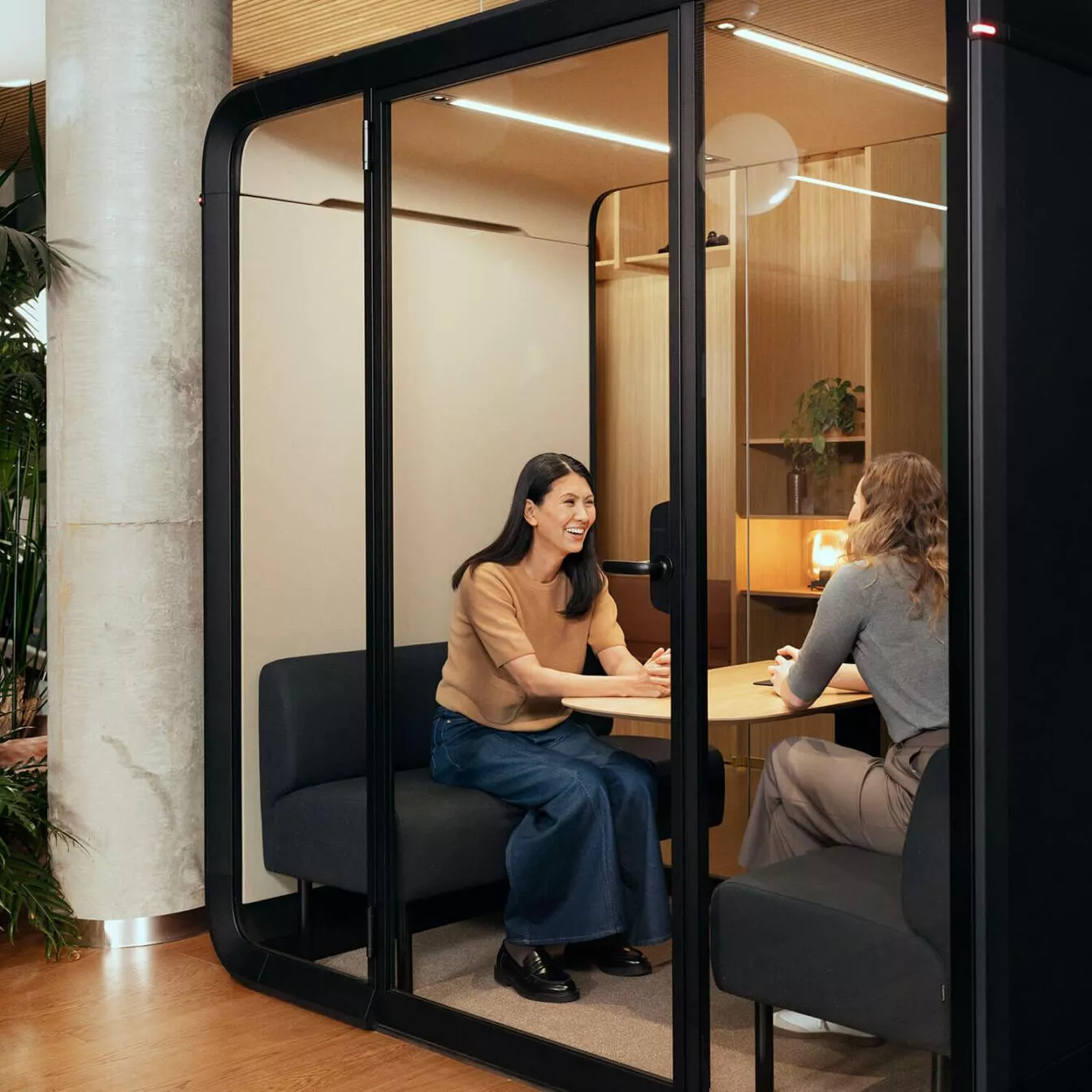
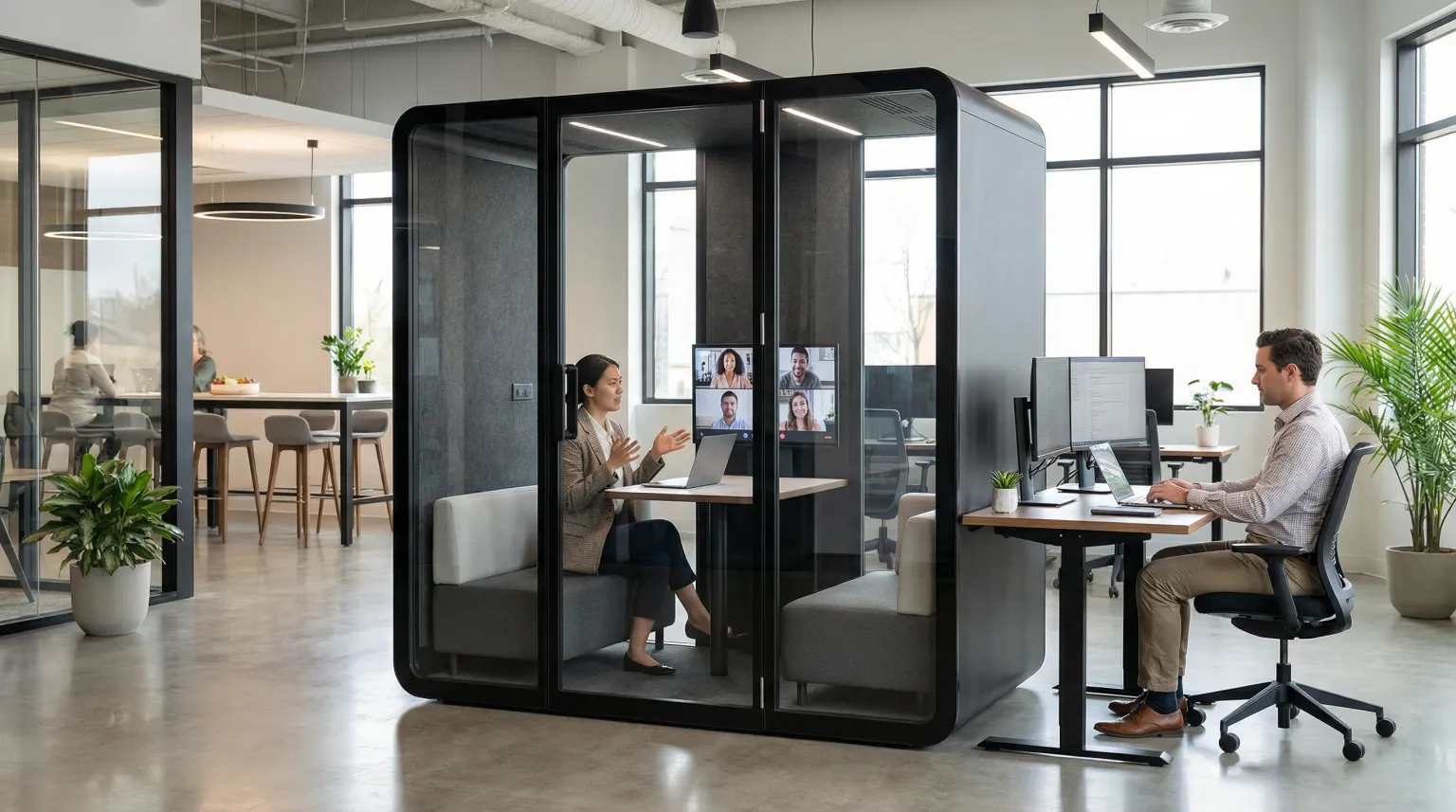
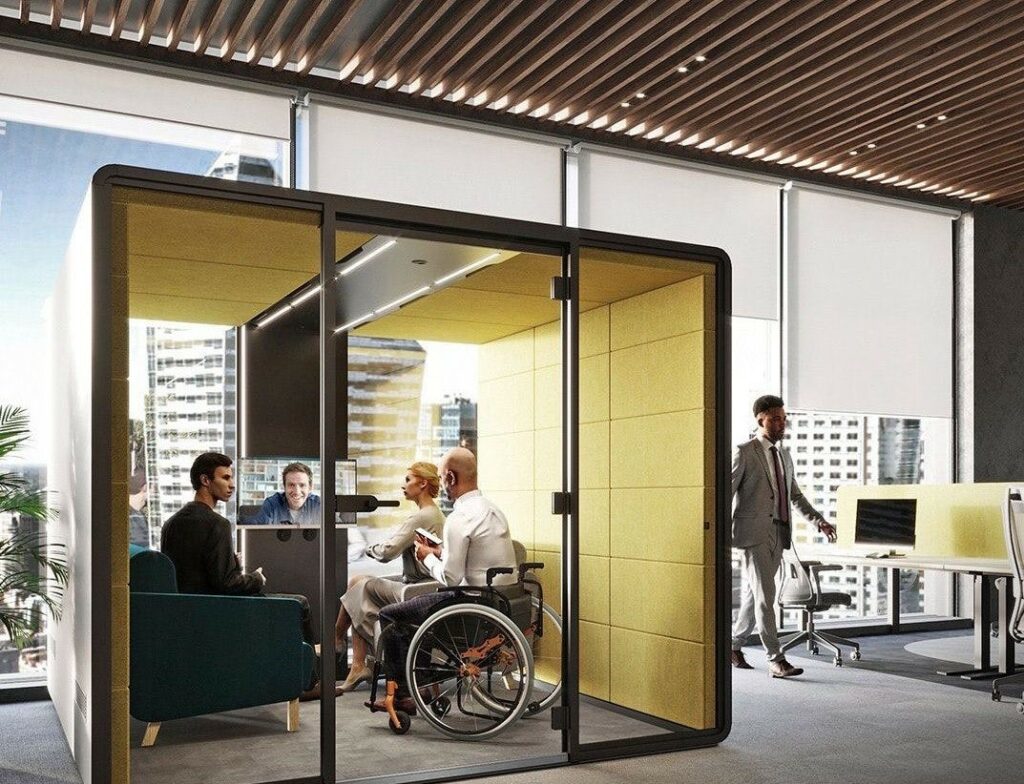
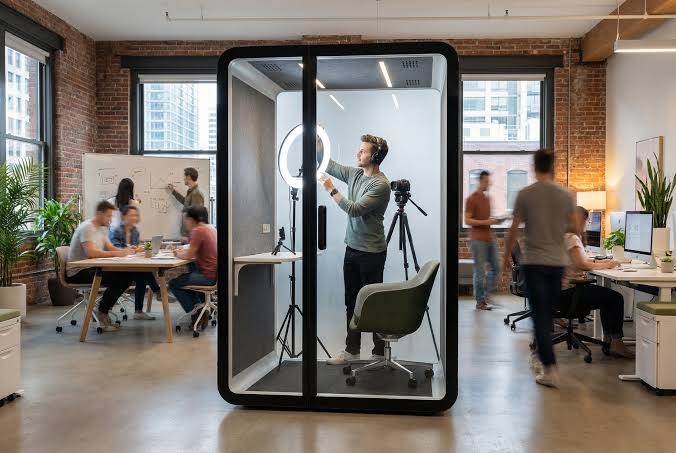
A Podcast Booth is a compact recording enclosure built for spoken-word content — solo shows, two-host discussions, guest interviews, and multi-microphone roundtables. Unlike a phone booth (one occupant, short call) or a meeting pod (conversation leakage is tolerable), a podcast booth has a hard requirement: **the glass must stop a high sound-pressure human voice from reaching neighboring offices *and* prevent outside noise from ruining a take**, while remaining transparent so hosts can maintain eye contact with guests across the table.
Podcast Booth Acoustic Glass is the engineered glazing — wall panels, door leaves, and observation windows — that delivers **two-way speech privacy, controlled low-frequency isolation, and a clean internal acoustic environment** for broadcast-quality recording. It is not "standard office glass with a higher STC sticker"; it is specified around the vocal fundamental range (150–500 Hz) and the realities of close microphone placement.
### 03 – Acoustic Requirements(Why It Matters)
**H2:** Why Glazing Is a Bottleneck in Podcast Booths
| Requirement | Why It Matters in a Podcast Booth |
|-------------|----------------------------------|
| **Two-way speech privacy** | Host voices must stay in; ambient office noise must stay out — both directions matter |
| **Low-frequency control (150–500 Hz)** | Voices, especially male hosts, carry strong energy below 500 Hz; this is where thin glass fails |
| **Door perimeter sealing** | The door is the #1 leak path — jamb, head, threshold, and drop seal must be specified together |
| **Internal reflection / RT60** | Too much hard glass = reverb = boomy recording; glass area and opposing surfaces need balancing |
| **Microphone proximity** | Cardioid mics pick up reflections from the glass surface 60–90 cm from the speaker |
| **Safety** | Tempered + laminated for commercial/studio occupancy; post-breakage retention |
| **Observation transparency** | Hosts and guests face each other across the booth — full-height clear glass is preferred |
### 04 – Recommended Glass Solutions
**H2:** Recommended Acoustic Glass for Podcast Booths
| Glass Solution | Typical Structure | Indicative STC* | Podcast Booth Use |
|---------------|-------------------|-----------------|-------------------|
| Acoustic Laminated Glass | 6T + 1.14 PVB + 6T | STC 41–43 | Standard 1–2 host booth, walls + door |
| Acoustic Laminated Glass | 8T + 1.52 PVB + 8T | STC 43–45 | Multi-host / louder vocal source |
| Acoustic Insulated Glass | 6T + 16Ar + 8T (asymmetric) | STC 44–46 | Walls where cavity adds low-end mass |
| Acoustic Laminated Insulated | 6T+1.14PVB+6T + 16Ar + 8T | STC 47–50 | Premium podcast / broadcast studio |
| Observation Panel (slanted) | 8T + 1.52 PVB + 8T, 5–10° rake | STC 43–45 | External viewing window (kills flutter echo) |
*\*Indicative glass-only rating. Final booth performance depends on frame, seals, door, absorption treatment, and room geometry. Tested per ASTM E90 / ISO 10140 (glass) and evaluated under ISO 23351-1 (complete booth).*
Related Products :
- [Acoustic Laminated Glass](/acouspace/products/acoustic-glass/acoustic-laminated-glass/)
- [Acoustic Insulated Glass](/acouspace/products/acoustic-glass/acoustic-insulated-glass/)
- [Acoustic Laminated Insulated Glass](/acouspace/products/acoustic-glass/acoustic-laminated-insulated-glass/)
- [Low-Iron Acoustic Glass](/acouspace/products/acoustic-glass/low-iron-acoustic-glass/)(premium 观景窗,超白通透)
- [Custom Acoustic Glass](/acouspace/products/acoustic-glass/custom-acoustic-glass/)
---### 05 – Glass Structure Diagram
**H2:** Typical Glass Build-Ups for Podcast Booths
**Standard Wall (Most Common — 1 to 2 hosts):**
6 mm Tempered Glass
↓
Acoustic PVB Interlayer (1.14 mm)
↓
6 mm Tempered Glass
→ STC 41–43, 12.76 mm overall, easy hardware integration
```
**Low-Frequency Optimized Wall (2 to 4 hosts):**
```
6 mm Tempered Glass
↓
16 mm Argon Cavity (warm-edge spacer)
↓
8 mm Tempered Glass ← asymmetric, breaks resonance
→ STC 44–46, mass + cavity targets 150–500 Hz
```
**Premium Broadcast Wall (Composite):**
```
6T + 1.14 Acoustic PVB + 6T
↓
16 mm Argon Cavity
↓
8T
→ STC 47–50, best-in-class two-way privacy
```
**Door Leaf (matched):** 6T + 1.14 PVB + 6T with CNC hinge cut-outs, magnetic latch borehole, and **drop-seal channel at the bottom edge** — the single most important detail for podcast use.
### 06 – Acoustic Performance & Testing
**H2:** Acoustic Performance
- **Glass-only STC:** 41–50 (by configuration)
- **Low-frequency focus:** Asymmetric lites + 16 mm cavity shift the coincidence dip away from the 150–500 Hz vocal fundamental range
- **Rw (EN ISO 717-1):** up to 47 dB
- **Internal acoustics note:** Glass STC addresses *transmission*; for *room sound*, pair glazing with acoustic absorption (wall panels, ceiling baffles, carpet) to control RT60 — we provide layout guidance, not just glass
- **Two-way performance:** Wall + door assembly engineered so inside-out and outside-in transmission remain within 2–3 dB of each other
- **Test standards:** ASTM E90 / E413, EN ISO 10140 (glass transmission loss); ISO 23351-1 (complete booth speech level reduction)
- **Field note:** A bare 12 mm laminated panel can read STC 42 in the lab but still let a loud host through if the door seal is weak. **We calculate the full assembly, not a single pane.**
### 07 – Specifications
**H2:** Podcast Booth Glass Specifications
| Parameter | Available Options |
|-----------|------------------|
| Glass Type | Tempered Laminated / IGU / Composite |
| Pane Thickness | 5 / 6 / 8 / 10 mm per lite |
| Overall Thickness | 12.76 mm – 38 mm |
| Interlayer | Acoustic PVB 0.76 / 1.14 / 1.52 mm, SGP optional |
| Cavity | 12 / 16 / 20 mm, Argon 90% |
| Max Panel Size | Up to 2440 × 5000 mm (Jumbo line) |
| Typical Door Size | 800 × 2100 mm (full-height, single leaf) |
| VLT | 80–90% clear, ~91% Low-Iron |
| Surface | Clear / Frosted lower band / Silk-screen logo |
| CNC Processing | Hinge cut-outs, lock borehole, drop-seal channel, mic/arm mount holes |
| Compliance | EN 12150, EN 14449, EN 14179, ANSI Z97.1, AS/NZS 2208, CE, UKCA, CCC |
### 08 – Integration With Podcast Booth System
**H2:** Acoustic Glass Integration for Podcast Booths
The glazing performs only as well as its weakest junction — and in a podcast booth, those junctions are numerous:
- **Acoustic door kit** — matched laminated door leaf + 3-sided perimeter gasket + **automatic bottom drop seal** (the critical podcast detail)
- **Threshold / airlock** — stepped threshold or mini sound-lock at the door bottom kills the #1 leak path
- **Aluminum / steel frame** — standard studio extrusion profiles with EPDM acoustic gaskets, decoupled from structure where possible
- **Observation window** — slanted 5–10° or fitted with a diffusion layer to prevent flutter echo between parallel glass faces
- **Opposing glass surfaces** — avoid two hard glass walls facing each other; offset or treat one side with absorption
- **Hardware templates** — Assa Abloy, Dormakaba, GEZE cut-outs (±0.5 mm)
- **Service cut-outs** — XLR/USB grommets, mic-arm mounts, power modules; each opening detailed with an acoustic plug so it does not become a leak
- **Glass-to-wall transition** — acoustic sealant + backer rod, no hard flanking path into the frame
---### 09 – Customization for Podcast Booth OEMs
**H2:** Custom Acoustic Glass for Podcast Booth Manufacturers
- **Build-to-target STC** — send your target isolation loss curve; we reverse-engineer the glass build-up
- **Two-way privacy guarantee** — glass + door + seal specified as one assembly, not piecemeal
- **Low-frequency tuning** — asymmetric pane thicknesses and cavity depth selected against the 150–500 Hz range
- **Observation & presentation** — full-height Low-Iron glass, slanted viewing windows, logo silk-screen bands
- **Mic & boom arm integration** — precise CNC cut-outs for mic mounts, XLR grommets, camera shelves
- **Internal acoustic balance** — guidance on glass area vs. absorption so RT60 stays in the 0.3–0.5 s target range
- **Modular sizing** — standard 1.5×1.5 m corner panel, 0.9×2.1 m door, or your DXF
- **Private label** — crate labeling, spec-sheet co-branding, HS code support
- **Prototype lead time** — 10–14 days for sample wall + door panel
### 10 – Manufacturing & Quality
**H2:** Manufactured for Global Podcast Booth Brands
- **Jumbo Glass Group** — manufacturing since 2000, **three production bases**, serving **100+ countries and regions**
- **Dedicated acoustic line** — separate PVB laminating room, humidity-controlled IGU chamber
- **Jumbo tempering** — up to 3300 × 12000 mm master sheet, flatness ≤ 0.3%
- **CNC machining center** — hinge / lock / drop-seal / grommet tolerance **±0.5 mm**
- **In-house acoustic R&D** — STC / TL calculation and modeling support per project
- **QC per batch** — 100% spark test, dimensional laser scan, sample audit
- **Export crating** — fumigated wood, EVA edge guard, vertical dividers, shock label
- **Lead time** — samples 10–14 days; bulk 25–35 days FOB
### 11 – Testing & Compliance
**H2:** Testing & Standards
- **Glass acoustic:** ASTM E90, EN ISO 10140-1/2 (transmission loss)
- **Safety glass:** EN 12150 (tempered), EN 14449 (laminated), EN 14179 (heat soak), ANSI Z97.1, AS/NZS 2208, CCC
- **IGU durability:** EN 1279-1~5, ASTM E2190
- **Coated / Low-E (optional):** EN 1096-4, ASTM C1376
- **Factory:** ISO 9001:2015
- **Third-party:** SGS / Intertek on request
- **Booth-level reference:** Glass solutions evaluated under **ISO 23351-1** (speech level reduction, Class A–D) — accurately stated as a *complete booth* standard, **not** a "glass certificate"
### 12 – FAQ
**H2:** Frequently Asked Questions
1. **What STC does a podcast booth glass need?**
For a 1–2 host booth in a normal office, STC 41–45 glass is the standard. If the booth sits in an open-plan area with nearby desks, target STC 47+ with composite build.
2. **Is higher STC always better for podcasting?**
Not by itself. STC above 45 helps transmission, but **internal reverb (RT60)** is controlled by absorption, not thicker glass. We balance both.
3. **Why does low frequency matter for voice?**
The vocal fundamental sits at 150–500 Hz. Glass that performs well at 1000 Hz but dips here will let a deep male voice straight through.
4. **Can the door reach the same STC as the wall?**
Yes — matched laminated door leaf + 3-sided gasket + automatic bottom drop seal typically stays within 2–3 dB of the wall panel.
5. **Do you machine cut-outs for microphones and cables?**
Yes — CNC hinge cut-outs, lock borehole, drop-seal channel, XLR/USB grommets, and mic-arm mounts per your DXF, ±0.5 mm.
6. **Can glass cause echo inside the booth?**
It can. Parallel hard glass surfaces create flutter echo. We advise slanted observation windows and opposing-wall treatment.
7. **What is the max panel size?**
Up to 2440 × 5000 mm jumbo; typical podcast wall panel 1200 × 2400 mm, door 800–900 × 2100 mm.
8. **Can you guarantee the whole booth's acoustic rating?**
Glass STC is certifiable per ASTM E90. Complete-booth speech level (ISO 23351) depends on your full assembly — we provide calculation support and seal detailing.
9. **Is Low-Iron worth it for a podcast booth?**
For premium brands with a presentation/observation window, yes — Low-Iron acoustic laminated glass reaches ~91% VLT and looks genuinely clear on camera.
10. **Lead time and packaging?**
Samples 10–14 days; bulk 25–35 days FOB. Panels and door leaves crated separately with EVA protection and clear assembly labeling.
### Final CTA
**H2:** Need Acoustic Glass for Your Podcast Booth?
Send us your booth drawing, target STC, or hardware template. Tell us how many hosts and whether you need two-way privacy — our engineering team will recommend the right glass build-up and provide a project-specific quotation.
[Request a Quote] [Send Your Drawing] [Download Acoustic Glass Datasheet]
- 📩 Email: tomron1688@gmail.com
- [Request a Quote] [Download Datasheet]
🔗 Internal Link Cluster
Related Applications
Acoustic Glass for Office Pods | Office Pod Glass Manufacturer – AcouSpace
Phone Booth Glass | Acoustic Glass for Phone Booths – AcouSpace
Acoustic Glass for Meeting Pods | Meeting Pod Glass Manufacturer – AcouSpace
Acoustic Glass for Work Pods | Work Pod Glass Manufacturer – AcouSpace
Acoustic Glass for Office Privacy Booths | Privacy Booth Glass Manufacturer – AcouSpace
Acoustic Glass for Recording Booths | Recording Booth Glass Manufacturer – AcouSpace
Acoustic Glass for Podcast Booths | Podcast Booth Glass Manufacturer – AcouSpace
Related Product
- [Acoustic Laminated Glass](/acouspace/products/acoustic-glass/acoustic-laminated-glass/)
- [Acoustic Insulated Glass](/acouspace/products/acoustic-glass/acoustic-insulated-glass/)
- [Acoustic Laminated Insulated Glass](/acouspace/products/acoustic-glass/acoustic-laminated-insulated-glass/)
- [Low-E Acoustic Glass](/acouspace/products/acoustic-glass/low-e-acoustic-glass/)
- [Low-Iron Acoustic Glass](/acouspace/products/acoustic-glass/low-iron-acoustic-glass/)
- [Acoustic Glass Doors](/acouspace/products/acoustic-glass/acoustic-glass-doors/)
- [Acoustic Glass Panels](/acouspace/products/acoustic-glass/acoustic-glass-panels/)
- [Custom Acoustic Glass](/acouspace/products/acoustic-glass/custom-acoustic-glass/)
Related Technology supporting
- STC Rating & Rw Rating for Acoustic Glass | STC vs Rw Explained – AcouSpace
- Acoustic PVB Interlayer & Acoustic Laminated Glass Technology – How It Works
- Double Glazing for Acoustics – How IGU Works for Sound Insulation | JUMBO AcouSpace
-Acoustic Laminated Glass vs Double Glazing – Which Is Right for Your Project?
Acoustic Glass Performance – How to Read Acoustic Performance Data | JUMBO AcouSpace
- ISO 23351 for Acoustic Office Pods & Meeting Pods – ASTC, SNR & Classification | JUMBO AcouSpace
Acoustic Glass Testing – How Acoustic Glass Is Tested & How to Read Test Reports | JUMBO AcouSpace