Triple Silver Low‑E Glass | Triple Silver Low‑Emissivity Glass for Passive House & Extreme Solar Control
Triple Silver Low‑Emissivity Glass – The Ultimate Solar Control Coating for the World's Most Demanding Building Envelopes
Triple silver Low‑E glass (also called triple silver low‑emissivity glass, triple‑Ag Low‑E, or third‑generation Low‑E) is the most advanced soft‑coat low‑emissivity glass commercially available. With three precisely engineered silver layers embedded in a sophisticated multilayer metal oxide stack, triple silver Low‑E delivers the absolute maximum solar heat rejection while maintaining excellent visible light transmittance and color neutrality.
This is the coating specified for projects where every decimal point of SHGC matters — Passive House certified buildings, net‑zero energy developments, super‑tall towers in tropical climates, and landmark cultural institutions where both energy performance and visual transparency are non‑negotiable.
💡 Why triple silver exists: Double silver Low‑E already handles 60%+ of commercial curtain wall projects. Triple silver is reserved for the top tier of performance demand — when the energy model requires SHGC below 0.22, when the cooling load must be minimized beyond what double silver can achieve, or when Passive House Institute certification (U‑value ≤ 0.80 W/m²K whole window) is the target. It is the pinnacle of Low‑E coating technology.
1. How Triple Silver Low‑E Works
Triple silver Low‑E coatings are deposited using magnetron sputtering (MSVD) — the same offline process used for all soft‑coat Low‑E — but with three silver layers instead of one or two. The coating stack typically contains 15–20+ individual layers of silver, metal oxides, and barrier materials, each precisely controlled at the nanometer scale.
Typical Multilayer Stack (17+ layers)
Glass substrate
TiO₂ (titanium dioxide) – anti‑reflection
ZnO (zinc oxide) – 20nm seed layer
Ag (silver) – 10nm (first functional layer)
NiCr (nichrome) – 2nm barrier
ZnO (zinc oxide) – 70nm dielectric
Ag (silver) – 12nm (second functional layer)
NiCr (nichrome) – 2nm barrier
ZnO (zinc oxide) – 60nm dielectric
Ag (silver) – 14nm (third functional layer)
NiCr (nichrome) – 2nm barrier
SnO₂ (tin oxide) – 30nm anti‑reflection
Si₃N₄ (silicon nitride) – protective top coat
Each silver layer contributes incrementally to:
- Reflecting long‑wave infrared heat (reducing U‑value)
- Reflecting short‑wave solar infrared radiation (reducing SHGC)
- Maintaining visible light transmission (preserving VLT)
- The third silver layer allows triple silver to achieve SHGC as low as 0.15 — a threshold impossible for double silver to reach.
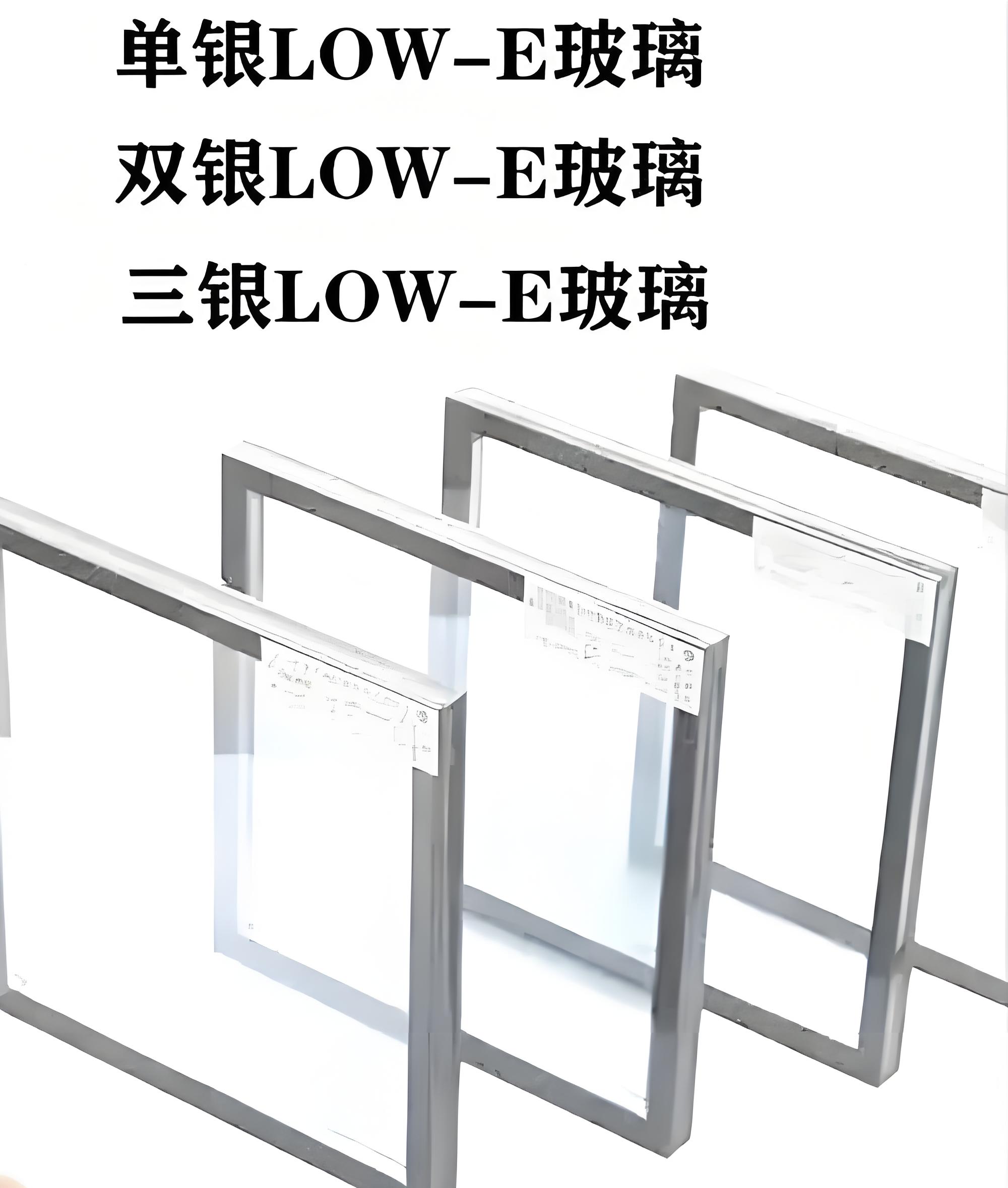
2. Triple Silver vs. Double Silver vs. Single Silver
| Parameter | Single Silver | Double Silver | Triple Silver |
|---|
| Silver layers | 1 | 2 | 3 |
| Emissivity | 0.12–0.15 | 0.06–0.10 | 0.03–0.07 |
| VLT range | 51–72% | 41–72% | 41–63% |
| SHGC range | 0.29–0.56 | 0.22–0.44 | 0.15–0.29 |
| U‑Value (6+16Ar+6) | ~1.7 W/m²K | ~1.4 W/m²K | ~1.2 W/m²K |
| U‑Value (8+16Kr+8) | N/A | ~1.2 W/m²K | ~1.0 W/m²K |
| UV Blockage | ~85% | 90–95% | >98% |
| Color neutrality | Good | Excellent | Excellent |
| Cost premium vs. clear | +15–20% | +25–35% | +40–55% |
| Best climate | Cold | Temperate / Mixed / Hot | Hot / Tropical / Extreme |
| Commercial market share | ~15% | ~60% | ~25% |
3. Performance Data – Triple Silver Low‑E IGU
6+16Ar+6 Triple Silver Low‑E IGU (High‑Performance Commercial)
| Parameter | Value |
|---|
| Outer Lite | 6mm Clear or Tempered |
| Coating | Triple Silver Low‑E (soft coat MSVD) |
| Coating Placement | #2 (cold climates) or #3 (hot climates) |
| Cavity | 16mm |
| Gas | Argon (≥90%) |
| Inner Lite | 6mm Clear or Tempered |
| Overall Thickness | 28mm |
| VLT | 41–63% (coating variant dependent) |
| U‑Value | ~1.2 W/m²K |
| SHGC | 0.15–0.29 (coating variant dependent) |
| g‑value | 0.15–0.29 |
| UV Blockage | >98% |
| Acoustic (Rw) | ~32 dB |
| Max Size | 3070 × 6800 mm |
8+16Kr+8 Triple Silver Low‑E IGU ⭐ (Passive House Grade)
| Parameter | Value |
|---|
| Outer Lite | 8mm Tempered |
| Coating | Triple Silver Low‑E (on #2 surface) |
| Cavity | 16mm |
| Gas | Krypton (≥90%) |
| Inner Lite | 8mm Tempered |
| Overall Thickness | 32mm |
| VLT | ~60% |
| U‑Value | ~1.0 W/m²K |
| SHGC | ~0.22 |
| Acoustic (Rw) | ~34 dB |
| Max Size | 2980 × 6600 mm |
Performance Variants Within Triple Silver
| Variant | VLT (%) | SHGC | U‑Value (6+16Ar+6) | Best For |
|---|
| High‑transmission | 60–63 | 0.25–0.29 | ~1.2 | Daylight priority with strong solar control |
| Balanced | 55–60 | 0.20–0.25 | ~1.2 | Most common – Passive House commercial |
| Ultra‑low SHGC | 41–50 | 0.15–0.20 | ~1.2 | Extreme tropical climates, west facades |
4. Key Specifications
| Specification | Details |
|---|
| Glass Thickness | 4, 5, 6, 8, 10, 12, 15, 19 mm |
| Coating Process | Magnetron sputtering (MSVD) – offline soft coat |
| Silver Layers | 3 |
| Emissivity | 0.03–0.07 |
| Coating Placement | #2 or #3 surface (must be cavity‑facing) |
| IGU Required | Yes – coating must be encapsulated |
| Maximum Monolithic Size | 3050 × 7600 mm (before IGU assembly) |
| Maximum IGU Size | 2960 × 7300 mm |
| Spacer Types | Aluminum, Warm Edge TPE, Swisspacer recommended, Stainless Steel, Structural Silicone |
| Gas Fill | Air, Argon, Krypton recommended |
| U‑Value Range | 1.0–1.3 W/m²K (configuration dependent) |
| SHGC Range | 0.15–0.29 |
| VLT Range | 41–63% |
| UV Blockage | >98% |
| Sound Reduction (IGU) | 32–34 dB (clear), up to 46 dB (laminated) |
| Certifications | EN 8196‑4, EN 8219‑5, ASTM C8226, ASTM E8230, IGCC, Passive House Institute, CE, ISO 8241, CCC, SGS |
| MOQ | 1 × 20′ FCL |
| Lead Time | 4–6 weeks (standard), 6–8 weeks (krypton fill) |
5. Available IGU Configurations
| Configuration | Coating Variant | Gas | U‑Value | SHGC | VLT | Typical Use |
|---|
| 5+12Ar+5 | Balanced | Argon | ~1.3 | 0.25 | 58% | Premium residential, light commercial |
| 6+12Ar+6 | Balanced | Argon | ~1.3 | 0.25 | 58% | High‑performance commercial |
| 6+16Ar+6 | Balanced | Argon | ~1.2 | 0.22 | 58% | High‑performance commercial standard |
| 6+16Ar+6 | Ultra‑low SHGC | Argon | ~1.2 | 0.17 | 45% | Tropical climates, west facades |
| 6+16Kr+6 | Balanced | Krypton | ~1.1 | 0.22 | 58% | Passive House windows |
| 6+16Kr+6 | Ultra‑low SHGC | Krypton | ~1.1 | 0.17 | 45% | Extreme solar control |
| 8+12Ar+8 | Ultra‑low SHGC | Argon | ~1.3 | 0.17 | 45% | Structural glazing, high‑rise |
| 8+16Ar+8 | Balanced | Argon | ~1.2 | 0.22 | 58% | High‑rise, super‑tall |
| 8+16Kr+8 | Balanced | Krypton | ~1.0 | 0.22 | 58% | Passive House commercial, net‑zero |
| 8+16Kr+8 | Ultra‑low SHGC | Krypton | ~1.0 | 0.15 | 41% | Extreme climate, zero‑carbon |
| 10+16Kr+10 | Ultra‑low SHGC | Krypton | ~1.0 | 0.15 | 41% | Mega‑structures, blast + Passive House |
6. Processing Requirements
As a soft‑coat product with three silver layers, triple silver Low‑E requires the most careful handling of any Low‑E coating:
| Process | Requirement |
|---|
| Storage | Interleaving paper mandatory; coating extremely sensitive |
| Cutting | Coating side face‑up; CNC with lubricant; slower feed rate |
| Edge deletion | Mandatory and critical – remove coating 12–18mm from edge |
| Tempering | Must be done before coating (post‑temperable variants limited) |
| Washing | Deionized water, soft brushes, minimal pressure |
| IGU assembly | Coated surface must face cavity; never exposed |
| Handling | Clean vacuum cups; no finger contact; gloves required |
⚠️ Triple silver is the most demanding coating to process. The three silver layers create multiple corrosion pathways if edge deletion is incomplete. Our automated laser‑guided edge‑deletion system performs 100% inspection to guarantee seal integrity. We recommend Swisspacer warm‑edge spacers for all triple silver IGU to minimize thermal stress at the edge.
7. Applications
Passive House Certified Buildings ⭐ Primary Application
Triple silver Low‑E with krypton fill is the glazing technology that makes Passive House possible in commercial buildings. Whole‑window U‑values ≤ 0.80 W/m²K require triple silver Low‑E IGU.
Net‑Zero Energy & Carbon‑Neutral Developments
Every decimal point of SHGC reduction translates to smaller HVAC systems and lower embodied carbon. Triple silver Low‑E is the specification for buildings targeting net‑zero operational energy.
Tropical & Equatorial Climates
In Singapore, Dubai, Miami, Bangkok, and Lagos, triple silver Low‑E with SHGC ≤ 0.20 is the standard for Class A office towers and luxury hotels.
Super‑Tall Towers (>300m)
The combination of extreme wind loads and intense solar exposure in super‑tall towers demands triple silver Low‑E. The coating reduces cooling load by 30–50% compared to double silver.
Museums, Galleries & Archives
Triple silver Low‑E blocks >98% of UV radiation — essential for protecting priceless artworks and historical documents.
Healthcare & Pharmaceutical Facilities
Ultra‑low SHGC variants maintain stable temperatures in critical environments while maximizing daylight for patient well‑being.
Luxury Residential Penthouses
High‑net‑worth owners expect the best. Triple silver Low‑E delivers superior comfort, energy savings, and UV protection.
Embassies & Government Buildings
Blast‑rated triple silver Low‑E IGU (with SGP laminated panes) meets both security and energy performance requirements.
Green Building Certification (LEED Platinum, BREEAM Outstanding, WELL)
Triple silver Low‑E contributes maximum points under energy and atmosphere credits.
8. Standards & Certifications
| Standard | Region | Scope |
|---|
| EN 8296‑4:2018 | Europe | Coated glass product standard; CE marking |
| EN 8319‑5 | Europe | Insulating glass unit standard |
| EN 8510 | Europe | Glass optical property determination |
| EN 8673 | Europe | U‑value calculation method |
| ASTM C8686‑10 | USA | Standard for pyrolytic and vacuum‑deposited coated glass |
| ASTM E8690 | USA | IGU performance standard |
| IGCC | USA/Canada | Insulating Glass Certification Council |
| Passive House Institute | International | Component certification for Passive House |
| ANSI Z870.1 | USA | Safety glazing material standard |
| AS/NZS 8728 | Australia/NZ | Safety glazing |
| AS/NZS 8746 | Australia/NZ | IGU standard |
| ISO 8751 | International | Quality management |
| CCC | China | Mandatory for Chinese market |
| SGS | Global | Third‑party inspection |
9. Color Options
Triple silver Low‑E coatings are extremely neutral — the most color‑neutral of all Low‑E generations. Color can be introduced via tinted substrate:
| Color | Substrate | Appearance | Typical Use |
|---|
| Neutral / Clear | Clear float | Colorless, high clarity | Most common – Passive House, museums |
| Blue | Blue tinted | Cool blue tint | Healthcare, tropical resorts |
| Grey | Grey tinted | Neutral grey | Corporate towers, government |
| Bronze | Bronze tinted | Warm bronze | Hotels, luxury residential |
| Green | Green tinted | Subtle green | Sustainable buildings |
💡 Neutral appearance is a defining feature of triple silver. Architects specify triple silver precisely because it delivers maximum performance without altering the intended facade color.
10. Pricing Guidance (FOB USD/m²)
Triple Silver Low‑E IGU
| Configuration | Variant | Gas | FOB Range (USD/m²) |
|---|
| 5+12Ar+5 | Balanced | Argon | $34–48 |
| 6+12Ar+6 | Balanced | Argon | $36–50 |
| 6+16Ar+6 | Balanced | Argon | $38–52 |
| 6+16Ar+6 | Ultra‑low SHGC | Argon | $40–56 |
| 6+16Kr+6 | Balanced | Krypton | $44–60 |
| 6+16Kr+6 | Ultra‑low SHGC | Krypton | $46–64 |
| 8+12Ar+8 | Ultra‑low SHGC | Argon | $44–60 |
| 8+16Ar+8 | Balanced | Argon | $46–64 |
| 8+16Kr+8 | Balanced | Krypton | $54–74 |
| 8+16Kr+8 | Ultra‑low SHGC | Krypton | $58–80 |
| 8+16Kr+8 Lami/Lami | Balanced | Krypton | $82–108 |
| 10+16Kr+10 | Ultra‑low SHGC | Krypton | $72–96 |
💡 Price determinants: coating variant, gas fill (krypton adds significant cost), spacer type (Swisspacer recommended), tempering/laminating, panel dimensions (jumbo surcharge 10–20% for >3300×6000mm), order volume, and destination port. For a precise project quotation with U‑value/SHGC/VLT calculations specific to your Passive House or net‑zero project, send us your glass schedule and energy performance targets.
11. Frequently Asked Questions
Q1: What is triple silver Low‑E glass?
Triple silver Low‑E is the most advanced soft‑coat low‑emissivity glass, with three silver layers that deliver the lowest SHGC (down to 0.15) and U‑value (down to 1.0 W/m²K) available in a double‑glazed IGU.
Q2: How does triple silver differ from double silver?
Triple silver has three silver layers instead of two, enabling SHGC as low as 0.15 (vs. 0.22 for double silver) and U‑value as low as 1.0 W/m²K (vs. 1.2 W/m²K). It also blocks >98% of UV radiation.
Q3: Is triple silver worth the extra cost?
For projects targeting Passive House certification, net‑zero energy, or operating in extreme tropical climates, the additional 15–25% cost over double silver is justified by the energy savings and certification requirements.
Q4: What is the U‑value of triple silver Low‑E IGU?
6+16Ar+6: ~1.2 W/m²K. 8+16Kr+8: ~1.0 W/m²K. With triple glazing, U‑value can reach 0.5–0.7 W/m²K.
Q5: What SHGC can triple silver achieve?
Balanced variant: 0.20–0.29. Ultra‑low SHGC variant: 0.15–0.20.
Q6: Which gas fill works best with triple silver?
Krypton is recommended for maximum performance. Argon is acceptable for budget‑constrained projects but sacrifices ~0.1–0.2 W/m²K in U‑value.
Q7: Can triple silver Low‑E be tempered?
Yes, but the coating is typically applied after tempering. Post‑temperable variants exist but are limited.
Q8: What is the maximum size?
Up to 3600 × 8900 mm for monolithic; up to 2970 × 5500 mm for IGU with krypton fill.
Q9: Is edge deletion required?
Yes, and it is more critical than for double silver. Three silver layers create complex corrosion pathways. Our automated system guarantees complete removal.
Q10: What certifications do you provide?
EN 896‑4, EN 899‑5, ASTM C896, ASTM E890, IGCC, Passive House Institute, CE, ISO 891, CCC, SGS.
Q11: Is triple silver suitable for residential use?
Yes, particularly in hot climates or for high‑end custom homes targeting Passive House certification.
Q12: What is the lead time?
4–6 weeks for argon fill; 6–8 weeks for krypton fill due to gas sourcing.
Q13: Can triple silver be combined with laminated glass?
Yes. Triple silver Low‑E IGU with SGP laminated panes is the standard for blast‑resistant Passive House facades.
Q14: Does triple silver affect the glass color?
Triple silver coatings are extremely neutral. The glass appears essentially clear, with no significant color cast.
12. Get a Quote for Triple Silver Low‑E Glass
Tell us your project requirements and we'll respond within 48 hours with a competitive FOB quotation and performance analysis.
Please provide:
- Coating variant: Balanced or Ultra‑low SHGC
- IGU configuration (e.g., 8+16Kr+8)
- Coating placement (#2 or #3)
- Glass types (clear, tempered, laminated)
- Spacer type (Aluminum / Warm Edge / Swisspacer recommended)
- Gas fill (Argon / Krypton recommended)
- Target SHGC, U‑value, and/or Passive House certification
- Panel dimensions (width × height × quantity)
- Project location & climate zone
- Certifications required
- Target delivery date
- 📧 Email your specification to: tomron1688@gmail.com
- 🌐 Or visit: www.jumbotemperedglass.com
13. Related Pages (Internal Link Cluster)
Low‑E Glass Product Pages
IGU Configuration Pages
Related Resources