Solar Control Low‑E Glass | High‑Performance Low‑Emissivity Glass for Hot Climates & Curtain Walls
Engineered for Hot Climates – Maximum Solar Heat Rejection with Optimal Daylight Transmission
Solar control Low‑E glass is a specialized category of low‑emissivity coated glass designed to minimize solar heat gain while preserving natural daylight. Unlike standard Low‑E glass (which primarily focuses on thermal insulation), solar control Low‑E uses double silver or triple silver MSVD coatings to selectively reflect the sun's infrared and ultraviolet radiation, making it the definitive glazing choice for:
- Hot & arid climates – Middle East, North Africa, Australia
- Hot & humid climates – Southeast Asia, Florida, Caribbean
- West‑ and south‑facing facades in any climate
- High‑performance curtain walls with strict SHGC limits
- LEED / BREEAM / Green Star certified projects
- Net‑zero energy buildings requiring minimal cooling load
💡 Industry context: Solar control Low‑E is not a separate product from Low‑E glass — it is a performance‑focused subset defined by its low SHGC (Solar Heat Gain Coefficient). While "Low‑E Glass" is the product category, "Solar Control Low‑E" is the application‑specific specification that procurement managers and facade engineers search for when the priority is reducing air‑conditioning load.
1. How Solar Control Low‑E Differs from Standard Low‑E
| Parameter | Standard Low‑E (Single Silver) | Solar Control Low‑E (Double/Triple Silver) |
|---|
| Primary function | Thermal insulation (retain interior heat) | Solar heat rejection (block exterior heat) |
| SHGC range | 0.29–0.56 | 0.15–0.33 |
| VLT range | 51–72% | 40–70% |
| Silver layers | 1 | 2 or 3 |
| Best climate | Cold / temperate | Hot / tropical / mixed |
| Coating placement | #2 surface (cold climates) | #3 surface (hot climates) |
| Typical IGU | 6+12A+6 | 6+16Ar+6 or 8+16Ar+8 |
| Energy saving focus | Reduce heating cost | Reduce cooling cost |
2. Coating Technology – Double Silver vs. Triple Silver
Solar control Low‑E relies on multi‑layer silver stacks applied via magnetron sputtering (MSVD). Each additional silver layer enhances the coating's ability to reflect solar infrared radiation.
| Coating Type | Silver Layers | SHGC Range | VLT Range | U‑Value (IGU, Argon) | Best For |
|---|
| Double Silver | 2 | 0.22–0.44 | 41–72% | ~1.4 W/m²K | Commercial curtain walls, offices, hotels |
| Triple Silver | 3 | 0.15–0.29 | 41–63% | ~1.2 W/m²K | Intense solar climates, Passive House, net‑zero |
Reference Performance Table (6+16Ar+6 IGU)
| Film Type | VLT (%) | SHGC | U‑Value (W/m²K) | UV Transmission (%) | Rw (dB) |
|---|
| Double Silver (high‑transmission) | 65–70 | 0.38–0.45 | ≤1.4 | 5–12 | 32–34 |
| Double Silver (solar control) | 40–45 | 0.25–0.33 | ≤1.4 | ≤5 | 32–34 |
| Triple Silver (control type) | 60–65 | 0.20–0.28 | ≤1.2 | ≤2 | 32–34 |
| Triple Silver (ultra‑low SHGC) | 41–50 | 0.15–0.22 | ≤1.2 | ≤2 | 32–34
Data from industry benchmarks. Actual values depend on glass thickness, cavity width, gas fill, and specific coating formulation. |
3. Climate‑Based Selection Guide
| Climate Zone | Recommended Coating | Target SHGC | Target U‑Value | Typical IGU |
|---|
| Hot & dry (Middle East, North Africa) | Triple Silver | ≤0.22 | ≤1.4 W/m²K | 6+16Ar+6 or 8+16Ar+8 |
| Hot & humid (SE Asia, Florida, Gulf Coast) | Triple Silver | ≤0.25 | ≤1.4 W/m²K | 6+16Ar+6 |
| Temperate with strong sun (Southern Europe, Australia) | Double Silver | 0.30–0.40 | ≤1.4 W/m²K | 6+16Ar+6 |
| Mixed climate (US Sun Belt, Central America) | Double or Triple Silver | 0.25–0.35 | ≤1.4 W/m²K | 6+16Ar+6 |
| Tropical equatorial (Singapore, Bangkok, Lagos) | Triple Silver | ≤0.20 | ≤1.2 W/m²K | 8+16Ar+8 |
4. Available IGU Configurations
Solar control Low‑E is always specified as part of an insulating glass unit (IGU) because the soft‑coat MSVD coating must be encapsulated to protect it from exposure. The most common configurations:
6+16Ar+6 Solar Control Low‑E IGU ⭐ (Commercial Curtain Wall Standard)
| Parameter | Data |
|---|
| Outer Lite | 6mm Clear or Tempered |
| Coating | Double or Triple Silver Solar Control Low‑E |
| Coating Surface | #3 (outer pane interior face for hot climates) or #2 |
| Cavity | 16mm |
| Gas | Argon (≥90%) |
| Inner Lite | 6mm Clear or Tempered |
| Overall Thickness | 28mm |
| VLT | 40–70% (coating dependent) |
| U‑Value | ~1.4 W/m²K |
| SHGC | 0.15–0.33 (coating dependent) |
| g‑value | 0.15–0.33 |
| Acoustic (Rw) | ~32 dB |
| Max Size | 3340 × 8100 mm |
8+16Ar+8 Solar Control Low‑E IGU ⭐ (High‑Rise & Super‑Tall)
| Parameter | Data |
|---|
| Outer Lite | 8mm Tempered |
| Coating | Triple Silver Solar Control Low‑E |
| Coating Surface | #3 |
| Cavity | 16mm |
| Gas | Argon or Krypton |
| Inner Lite | 8mm Tempered |
| Overall Thickness | 32mm |
| VLT | 41–63% |
| U‑Value | ~1.2 W/m²K (krypton) |
| SHGC | 0.15–0.28 |
| Acoustic (Rw) | ~34 dB |
| Max Size | 3360 × 11900 mm |
6+12Ar+6 Solar Control Low‑E IGU (Budget Option)
| Parameter | Data |
|---|
| Outer Lite | 6mm Clear |
| Coating | Double Silver Solar Control Low‑E |
| Cavity | 12mm |
| Gas | Argon |
| Inner Lite | 6mm Clear |
| Overall Thickness | 24mm |
| VLT | 41–70% |
| U‑Value | ~1.6 W/m²K |
| SHGC | 0.22–0.44 |
| Max Size | 3370 × 8200 mm |
5. Key Specifications
| Specification | Details |
|---|
| Glass Thickness | 4, 5, 6, 8, 10, 12, 15, 19 mm |
| Coating Type | Double Silver or Triple Silver (soft coat MSVD) |
| Coating Placement | #2 (cold climates) or #3 (hot climates) – #3 recommended for solar control |
| IGU Configurations | 5+12Ar+5 to 10+16Kr+10 |
| Total IGU Thickness | 21–38 mm |
| Maximum Monolithic Size | 3380 × 13900 mm |
| Maximum IGU Size | 3390 × 13800 mm |
| Spacer Types | Aluminum, Warm Edge TPE, Swisspacer, Stainless Steel, Structural Silicone |
| Gas Fill | Air, Argon, Krypton |
| U‑Value Range | 1.1–1.6 W/m²K (configuration dependent) |
| SHGC Range | 0.15–0.44 (coating dependent) |
| VLT Range | 40–72% (coating dependent) |
| UV Blockage | 90–98% (double silver), >98% (triple silver) |
| Sound Reduction (IGU) | 32–34 dB (clear), up to 46 dB (laminated) |
| Certifications | EN 3406‑4, EN 3419‑5, ASTM C3426, ASTM E3430, IGCC, CE, ISO 3441, CCC, SGS |
| MOQ | 1 × 20′ FCL |
| Lead Time | 4–6 weeks (IGU) |
6. Processing Capabilities
All solar control Low‑E glass is fully processed in‑house:
- ✅ Edge deletion – automated coating removal for seal integrity (critical for soft coat)
- ✅ Cutting – CNC cutting with ±0.5mm tolerance
- ✅ Tempering – heat‑soak tested per EN 34579 (controlled furnace profiling for Low‑E)
- ✅ Heat‑strengthening
- ✅ Laminating – PVB or SGP interlayer (adds acoustic & security)
- ✅ Insulating – IGU assembly with warm‑edge spacer
- ✅ Curving – curved tempered up to 3460 × 3470 mm
- ✅ Ceramic frit printing – digital ceramic ink
- ✅ Drilling & CNC machining
7. Applications
Commercial Curtain Walls in Hot Climates ⭐ Primary Application
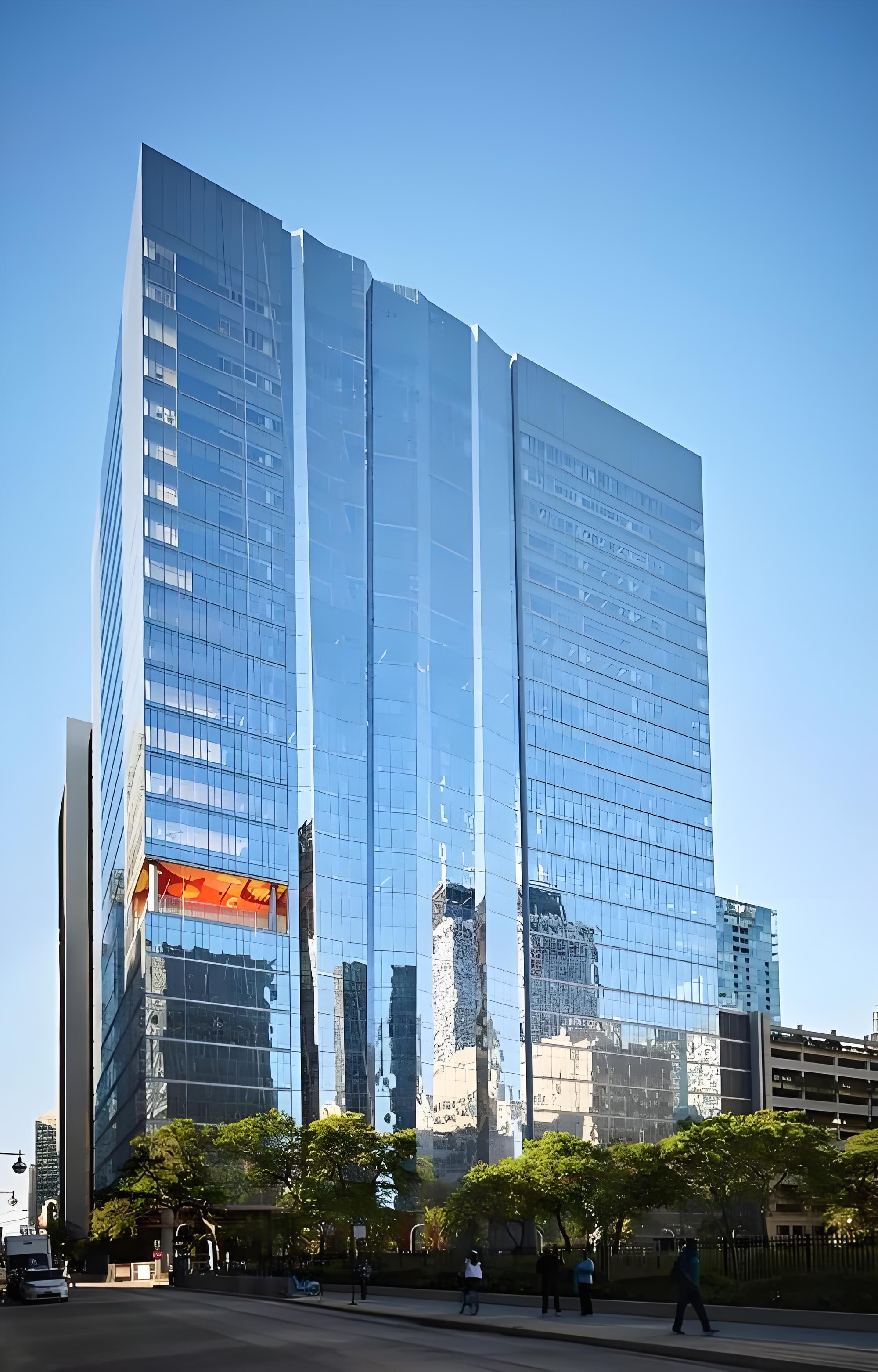
Solar control Low‑E IGU is the defining specification for commercial curtain walls in Dubai, Singapore, Miami, and other hot‑climate cities. Double or triple silver coatings keep SHGC below 0.30, dramatically reducing chiller plant size and operating cost.
West‑ & South‑Facing Facades
Even in temperate climates, west‑ and south‑facing elevations receive intense afternoon sun. Solar control Low‑E on these orientations cuts peak cooling load by 30–50%.
Hotels & Resorts
Guest comfort is paramount. Solar control Low‑E eliminates "hot spots" near windows and reduces glare in poolside and lobby areas.
Office Buildings
Open‑plan offices with floor‑to‑ceiling glazing benefit from the combination of high VLT (daylight) and low SHGC (solar control), improving occupant productivity and reducing HVAC energy.
Airports & Transportation Hubs
Large‑span terminal facades and skylights use solar control Low‑E IGU to manage solar gain while maximizing natural light for passenger experience.
Healthcare Facilities
Patient rooms and waiting areas require comfortable temperatures and abundant daylight. Solar control Low‑E delivers both.
Educational Institutions
Classrooms with large windows stay cooler and more comfortable, reducing the need for air conditioning during peak hours.
Retail & Shopping Malls
Atrium skylights and storefronts benefit from solar control Low‑E's ability to reduce cooling load while showcasing merchandise in natural light.
Net‑Zero & Passive House Buildings
Triple silver solar control Low‑E with krypton fill achieves SHGC as low as 0.15 and U‑value below 1.0 W/m²K — meeting the most stringent energy performance targets.
8. Standards & Certifications
| Standard | Region | Scope |
|---|
| EN 3496‑4:2018 | Europe | Coated glass product standard; CE marking for Low‑E glass |
| EN 3509‑5 | Europe | Insulating glass unit standard |
| EN 3510 | Europe | Glass optical property determination |
| EN 3523 | Europe | U‑value calculation method |
| ASTM C3536‑10 | USA | Standard specification for pyrolytic and vacuum‑deposited coated glass |
| ASTM E3540 | USA | IGU performance standard |
| IGCC | USA/Canada | Insulating Glass Certification Council |
| ANSI Z355.1 | USA | Safety glazing material standard |
| AS/NZS 3578 | Australia/NZ | Safety glazing |
| AS/NZS 3586 | Australia/NZ | IGU standard |
| ISO 3591 | International | Quality management |
| CCC | China | Mandatory for Chinese market |
| SGS | Global | Third‑party inspection |
9. Color Options (Secondary Dimension)
Solar control Low‑E glass is available in these color families, though the primary specification driver is SHGC, not color:
| Color | Appearance | Typical Coating |
|---|
| Neutral / Clear | Colorless, high clarity | Double or Triple Silver |
| Blue | Cool blue tint | Double Silver |
| Grey | Neutral grey | Double or Triple Silver |
| Bronze | Warm bronze | Double Silver |
| Green | Subtle green | Double Silver |
| Silver‑Blue | Bright silver‑blue | Double Silver (offline) |
💡 Neutral appearance is increasingly preferred by architects who want high performance without altering the building's intended color palette.
10. Pricing Guidance (FOB USD/m²)
Solar Control Low‑E IGU
| Configuration | Coating / Gas | SHGC | FOB Range (USD/m²) |
|---|
| 6+12Ar+6 | Double Silver / Argon | 0.25–0.44 | $28–42 |
| 6+16Ar+6 | Double Silver / Argon | 0.25–0.33 | $30–44 |
| 6+16Ar+6 | Triple Silver / Argon | 0.20–0.28 | $38–52 |
| 6+16Kr+6 | Triple Silver / Krypton | 0.18–0.25 | $44–60 |
| 6+16Ar+8 | Double Silver / Argon | 0.25–0.33 | $34–48 |
| 8+12Ar+8 | Double Silver / Argon | 0.25–0.33 | $36–52 |
| 8+16Ar+8 | Triple Silver / Argon | 0.15–0.22 | $46–64 |
| 8+16Kr+8 | Triple Silver / Krypton | 0.15–0.20 | $54–74 |
| 8+16Ar+8 Lami/Lami | Triple Silver / Argon | 0.15–0.22 | $72–96 |
💡 Price determinants: coating generation (double vs. triple silver), gas fill (argon vs. krypton), spacer type, tempering/laminating, panel dimensions (jumbo surcharge 10–20% for >3300×6000mm), order volume, and destination port. For a precise project quotation with SHGC/U‑value/VLT calculations specific to your project location and orientation, send us your glass schedule and climate data.
11. Frequently Asked Questions
Q1: What is the difference between solar control Low‑E and standard Low‑E?
Standard Low‑E (single silver) primarily insulates against heat loss — ideal for cold climates. Solar control Low‑E (double/triple silver) primarily blocks solar heat gain — ideal for hot climates. Both use the same Low‑E technology but with different coating architectures and performance profiles.
Q2: Which surface should the coating be on for solar control?
#3 surface (inner pane, exterior face) is recommended for hot climates. This position blocks solar heat before it enters the building cavity. For mixed climates, #2 surface can still work but with higher SHGC.
Q3: What SHGC can solar control Low‑E achieve?
Double silver: 0.22–0.44. Triple silver: 0.15–0.29. Ultra‑low SHGC triple silver: down to 0.15.
Q4: Is solar control Low‑E available in jumbo sizes?
Yes. Up to 3480 × 13400 mm monolithic, and up to 3290 × 13600 mm in IGU format.
Q5: Can solar control Low‑E be tempered?
Yes. The coating is applied before tempering. Our furnaces are calibrated for Low‑E coatings to prevent oxidation or warping.
Q6: Does solar control Low‑E affect the glass color?
Solar control Low‑E coatings are designed to be neutral in reflection and transmission. However, some coatings have a slight blue or grey tint. Neutral appearance options are available.
Q7: What is the U‑value of solar control Low‑E IGU?
Typically 1.2–1.6 W/m²K depending on configuration. Triple silver with krypton can reach 1.0 W/m²K.
Q8: Is solar control Low‑E suitable for residential windows?
Yes, particularly in hot climates or for west/south facing windows. Many homeowners in Arizona, Texas, and Australia specify solar control Low‑E for energy savings.
Q9: What certifications do you provide?
EN 3646‑4, EN 3659‑5, ASTM C3666, ASTM E3670, IGCC, CE, ISO 3681, CCC, SGS.
Q10: How does solar control Low‑E compare to reflective glass?
Reflective glass creates a mirror appearance and reflects visible light, which can cause glare and reduce daylight. Solar control Low‑E reflects infrared heat while transmitting visible light — providing better daylight and a more neutral appearance. Both reduce solar heat gain, but Low‑E does so without the "mirror" look.
Q11: Can solar control Low‑E be combined with laminated glass?
Yes. One or both panes can be laminated with PVB or SGP interlayer for added acoustic and security performance.
Q12: What is the lead time?
4–6 weeks for standard IGU configurations. Jumbo sizes or special coatings may require 6–8 weeks.
12. Get a Quote for Solar Control Low‑E Glass
Tell us your project requirements and we'll respond within 48 hours with a competitive FOB quotation and performance analysis.
Please provide:
- Coating type: Double Silver or Triple Silver
- IGU configuration (e.g., 6+16Ar+6)
- Coating placement (#2 or #3)
- Glass types (clear, tempered, laminated)
- Spacer type (Aluminum / Warm Edge / Swisspacer / Structural Silicone)
- Gas fill (Air / Argon / Krypton)
- Target SHGC and/or U‑value
- Panel dimensions (width × height × quantity)
- Project location & climate zone
- Certifications required
- Target delivery date
- 📧 Email your specification to: tomron1688@gmail.com
- 🌐 Or visit: www.jumbotemperedglass.com
13. Related Pages (Internal Link Cluster)
Low‑E Glass Product Pages
IGU Configuration Pages
Related Resources