Home › Showerspace › Decorative Shower Glass › Printed Shower Glass
Decorative Shower Glass
Printed Shower Glass for Custom Design & Branding
Colour, Detail and Brand — Fired Into the Glass.
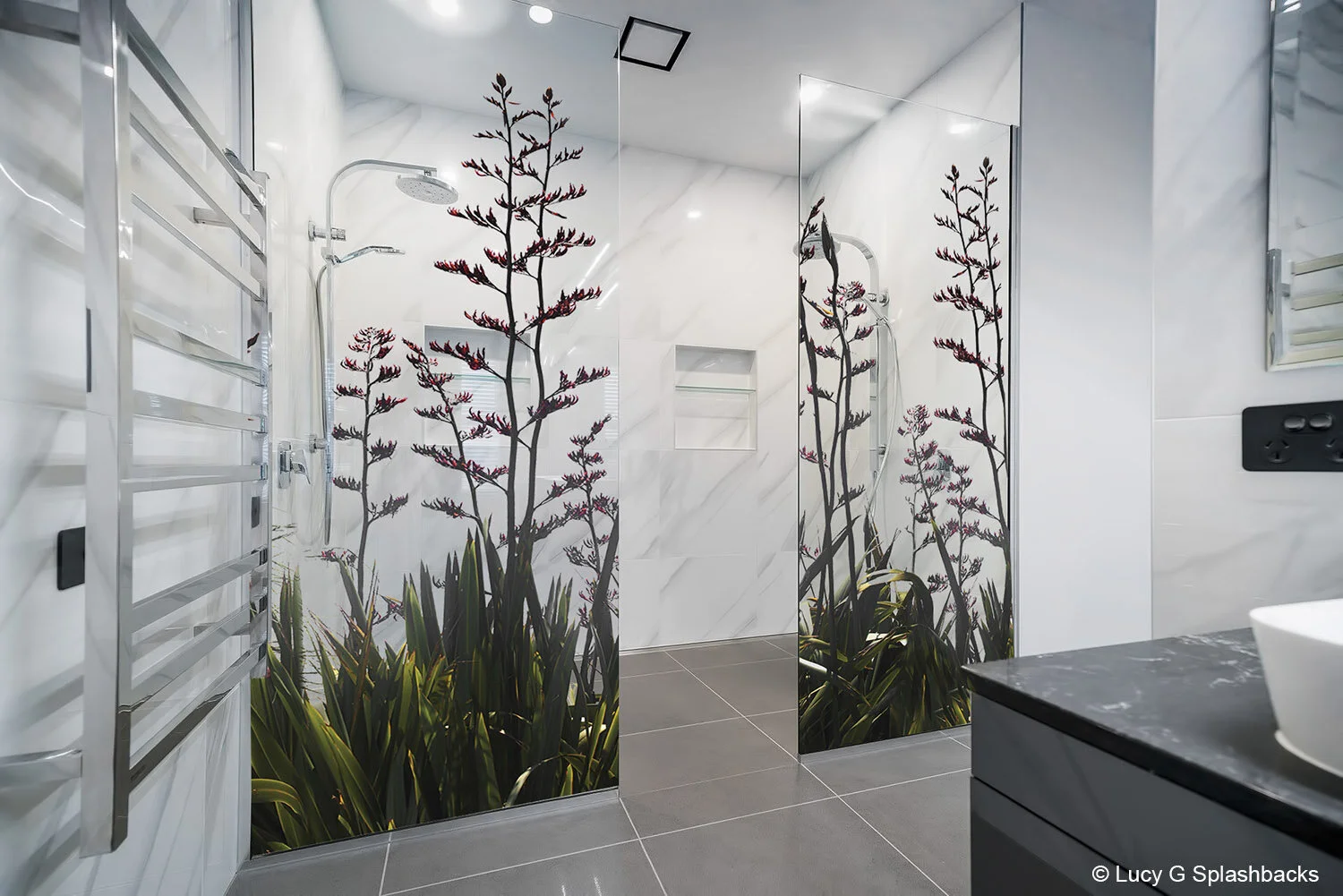
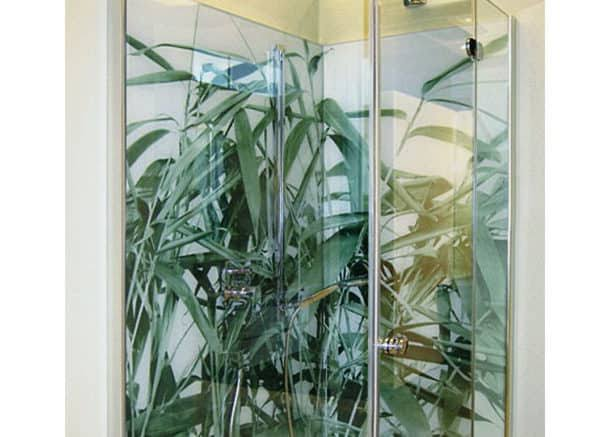
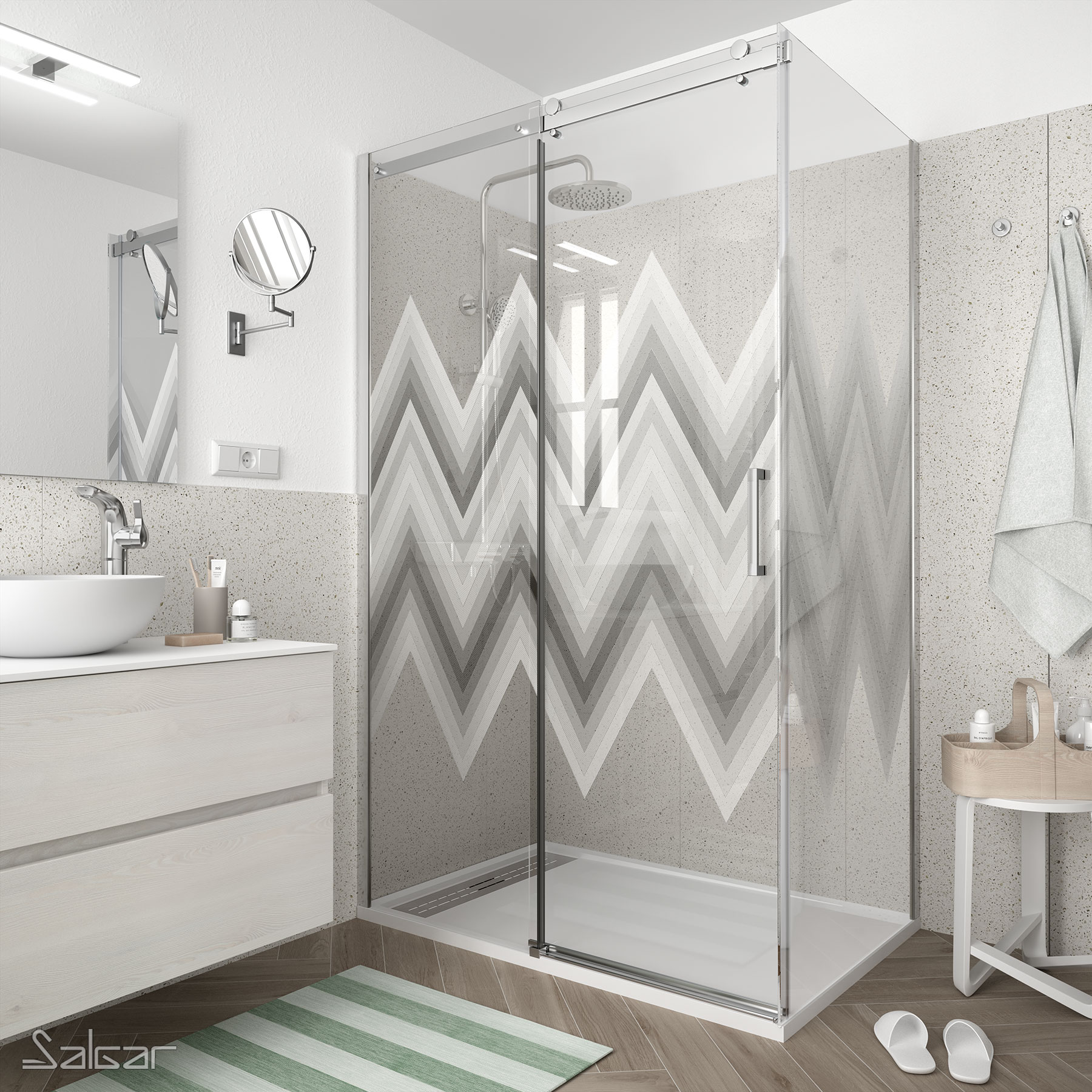
Printed shower glass carries a ceramic design that is fired into the glass surface during tempering — full colour, crisp detail, photographic imagery and brand marks, on a panel that is still a tempered safety glass. Custom artwork, repeat patterns, gradients and logos.
View Print FormatsSend Artwork for Review
What Is Printed Shower Glass?
Printed shower glass is tempered safety glass carrying a design applied in ceramic ink and fused into the glass surface. The ink is printed onto the flat glass, dried, and then fired during the tempering cycle — so the image does not sit on the glass as a film or a coating. It becomes part of the surface.
That distinction is the whole reason to specify printing rather than a film. An applied film has an adhesive layer that can lift, cloud or react with shower cleaning chemicals over time. A fired ceramic print has no such layer: it is highly durable, it tolerates normal bathroom cleaning, and it does not peel.
Printing is also the only process in the range that delivers colour and fine detail. Textured and etched glass work in tone — they can give you a pattern or a frosted graphic, but not a colour image, and not a crisp edge on a small logo. If the brief contains a brand mark, a colour palette or a photographic image, printing is the specification.
Digital Ceramic or Screen Printing?
Both use ceramic ink fired into the glass. The difference is economics, not durability — and the right answer usually depends on volume.
| | Digital ceramic (DC) | Screen printing (SP) |
|---|
| Process | Inkjet-deposited ceramic ink, no screens | Ink pushed through a mesh screen, one per colour |
| Setup | None — print straight from file | Screens and setup required |
| Best at | Short runs, one-offs, photographic and variable designs | Long runs of one identical design |
| Unit cost | Broadly flat regardless of quantity | Higher setup, lower unit cost at volume |
| Detail | High resolution, continuous tone, photographic capable | Flat spot colours, very high opacity |
| Opacity of solid fills | Good; multiple passes where needed | Excellent per pass |
| Design changes | Free — change the file | New screen required |
Most shower programmes use digital ceramic printing: hotel groups and residential ranges tend to run moderate quantities across several designs, which suits a process with no setup cost per design. Screen printing becomes worth considering when one design is repeated at volume.
Print Formats
Six formats cover most briefs. Each is identified by a PT code, so a specification refers to a defined format rather than to a description that reads differently to different suppliers.
10%
30%
50%
70%
90%
100%
Ink coverage runs from a light halftone to full solid. Both privacy and light transmission track coverage — see the notes below.
PT-01 Solid & Full Coverage
Opaque fields, privacy bands and signage blocks. The only printed format that approaches the obscuration of etched glass.
PT-02 Repeat Pattern
Tileable motifs scaled to the panel. The standard format for hotel and residential ranges that need a signature look across many identical bathrooms.
PT-03 Gradient & Fade
Colour transitions, including fades to clear. Unlike an etched gradient, this can carry hue as well as tone.
PT-04 Photographic Imagery
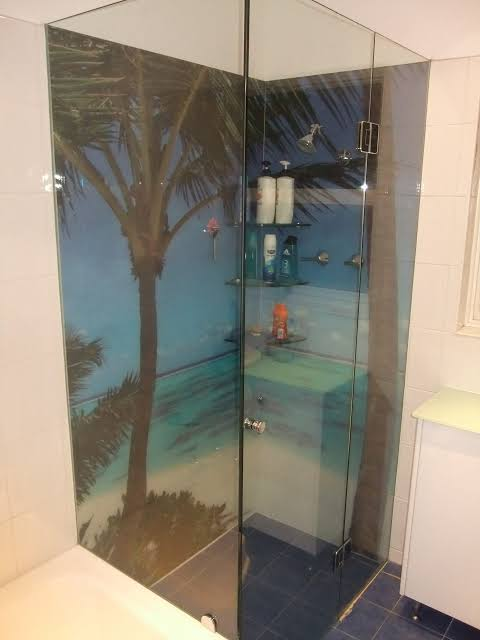
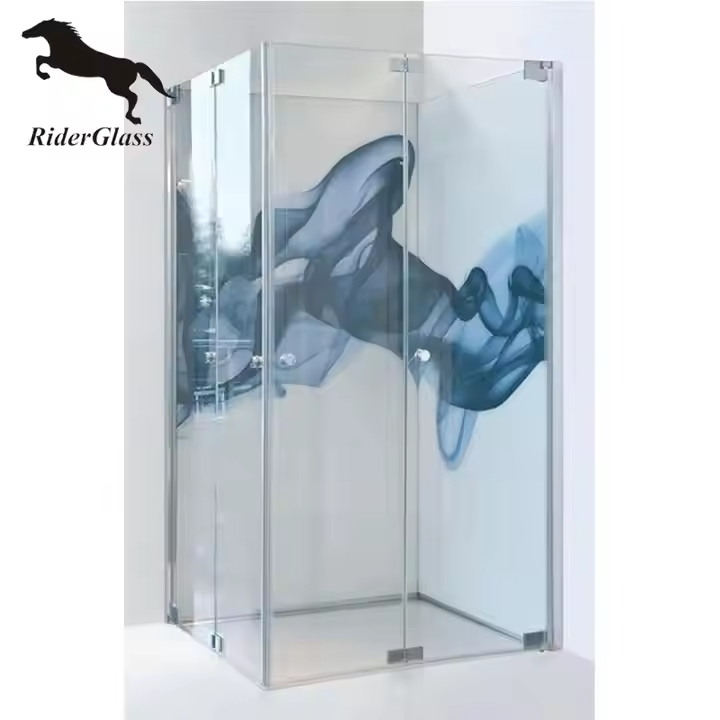
Full-colour continuous-tone images — landscapes, abstracts, large-format graphics. Requires high-resolution source files.
PT-05 Logo & Branding
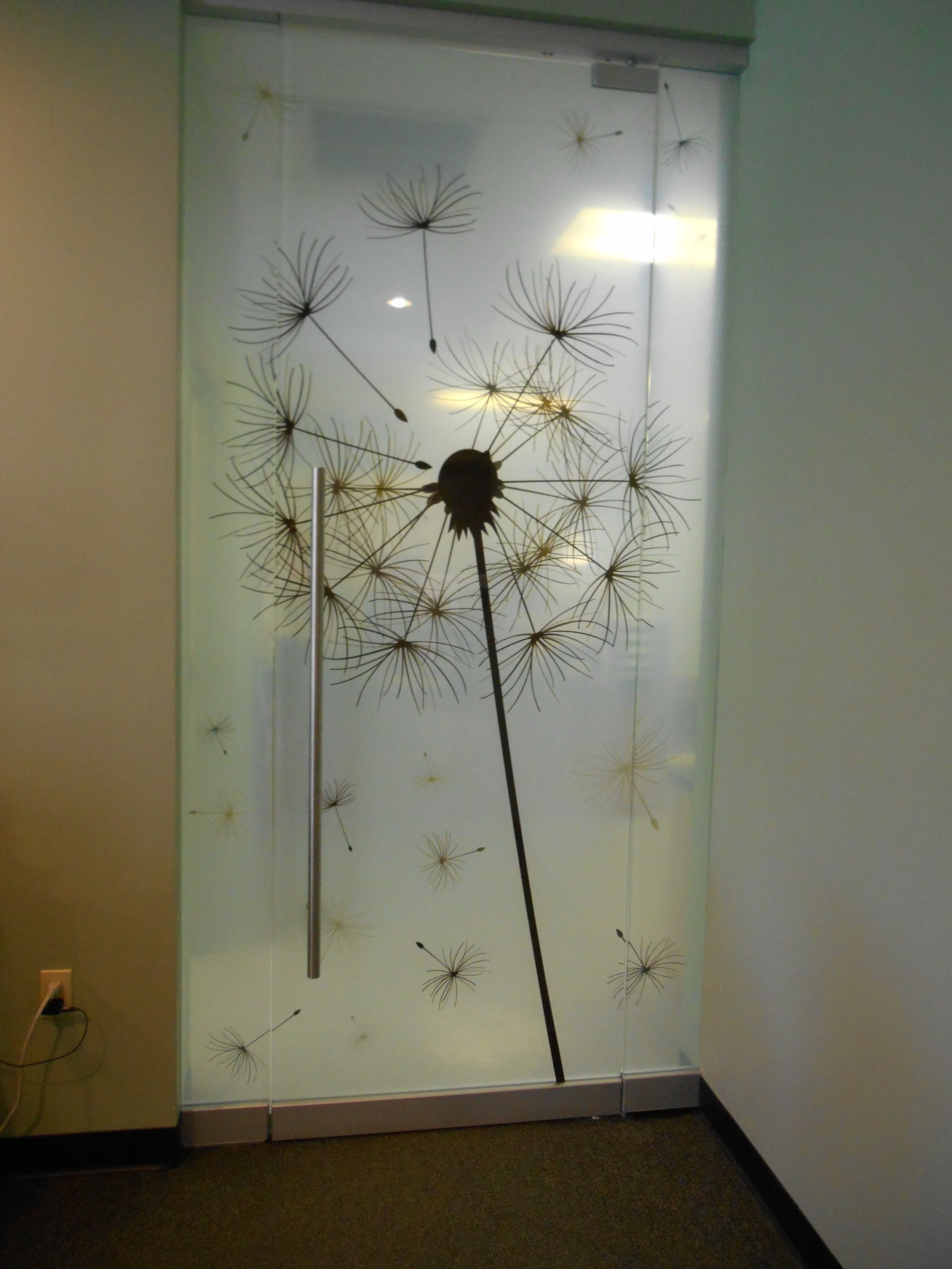
Brand marks, wordmarks and wayfinding. The format that most often replaces an etched logo, because it holds colour and crisp edges.
PT-06 Print on Texture
A printed image over a shallow relief — reeded, fluted or TX texture. Combines surface texture with a colour design.
What Printing Can Do That Etching Cannot
Etched artwork is produced by masking the surface: the result is monochromatic, tonal and soft-edged by nature. That is exactly right for some designs and limiting for others. Printing removes three specific constraints.
- Colour. Ceramic inks can reproduce a brand palette. An etched logo is always a frosted version of the glass colour — usually white or the tint of the glass.
- Crisp detail. Fine strokes, small text and sharp corners hold in a fired print. Masking rounds and softens edges, and small elements tend to break up.
- Continuous tone. Photographic and gradient imagery is possible in print; etching reproduces only hard-edged masked shapes.
Where a design genuinely wants the soft, tonal, in-the-plane quality of an etch, that remains the right choice — see etched shower glass. Many schemes use both: an etched field with a printed logo over it.
Coverage, Light & Colour Accuracy: The Honest Trade-offs
Printed glass is the most flexible product in the range and the one with the most caveats. Buyers who understand these three points at sample stage rarely have problems at delivery.
Coverage drives privacy
A print only obscures to the extent that ink covers the surface. A 30% halftone is decorative, not private; only high coverage or solid fields approach real obscuration. Coverage is specified as part of the design.
Colour shifts when fired
Ceramic inks change during firing, and the fired palette is narrower than CMYK on paper. We match as closely as the process allows and confirm on a fired sample — we cannot guarantee an exact Pantone or brand-colour match.
Large flat areas show structure
Very large solid fills can show faint directional banding, and halftone dot becomes visible up close. Both are normal for the process, and both are easier to resolve in the artwork than after production.
Specifying notes.
- Approve a fired sample, not a screen proof. Colours shift in the furnace. On brand-critical work, budget one strike-off before the production run.
- Which face is printed. Where the design should be protected by the glass, it is printed on the face away from the viewer, which means the artwork is supplied mirrored.
- Low-iron is recommended wherever colour accuracy matters. Standard clear float glass carries a green cast that shifts printed colours, most visibly in greys, greens and pale tones.
- Artwork rights. You must own or license the rights to anything we print. We will ask you to confirm this before production.
Artwork Requirements
Most delays on printed-glass orders come from files that cannot be printed, not from printing. Supplying files to this specification at the outset removes nearly all of it.
| Preferred formats | Vector: AI, EPS, SVG or PDF with fonts outlined |
| Raster files | TIFF or high-quality JPG/PNG, minimum 300 dpi at 1:1 print size |
| Colour | Specify target colours; we will confirm what the fired palette can achieve |
| Scale | State the print dimensions — a file sized for A4 will not hold at 2 m |
| Tiling | Repeat patterns supplied as one tile with the repeat stated |
| What to avoid | Screenshots, web-resolution images, unoutlined fonts, RGB files without a target reference |
If you are unsure whether a file will work, send it as it is. We will tell you what is usable and what needs to be redrawn — it is a faster route than trying to guess the specification.
Glass Colour & Why Low-Iron Matters Here
The base glass sits behind the print, and it affects how the colours read. Standard clear float glass has a slight green cast from its iron content; etched and printed surfaces both make that cast more apparent, and it is most visible in pale tones and greys.
Low-Iron
Recommended for any design where colour accuracy matters. The near-colourless base lets the fired ink read as intended.
View low-iron glass →
Clear
Acceptable for dark, saturated or monochrome designs where the green cast is not noticeable.
Grey
A tinted base shifts the whole design cooler and lowers overall light transmission.
View tinted glass →
Bronze
Warms the design and suits schemes built around brass, timber and stone.
Combining Print with Texture
PT-06 places a printed design over a textured surface, which combines the depth of a relief with the colour of a print. It is the most visually complex product in the range and the one with the tightest constraint.
Relief depth is the limit. Ink has to reach the surface evenly, so printing works on shallow reliefs and breaks down as depth increases — fine detail is lost first, and solid fills can show voids in the recesses. Textured surfaces also mean the artwork is reviewed against the relief before sampling rather than assumed printable.
Reeded and fluted surfaces are the usual starting point for PT-06, and finer reliefs give better results. See the texture range →
Thickness, Size & Production Sequence
Printed shower glass is supplied in 6 mm, 8 mm, 10 mm and 12 mm thicknesses.
Thickness is determined by the application rather than chosen freely: panel dimensions, whether the panel is fixed or forms part of a moving door, the support method, the hardware specified, and the safety-glazing requirements of the destination market all bear on it. We confirm the appropriate thickness against your drawings and target market.
The production sequence is fixed: cutting → drilling and notching → edge work → printing → tempering. Printing and tempering are one scheduled unit, because the ink is fired in the tempering cycle.
That has one consequence worth planning around: the artwork must be approved before the glass reaches the tempering line. On brand-critical work this means budgeting a fired strike-off for approval — which is also the only reliable way to confirm colour, since the fired result differs from the screen proof.
Panels are cut to size from your drawings. Maximum dimensions depend on thickness, handling constraints and access at the installation location, and are confirmed per project.
Processing & Fabrication
Printed shower glass is fabricated to drawing and supplied tempered as safety glass.
Cutting
Cut to size and shape from project drawings, before printing.
Edge Polishing
Flat polish, bevel and other edge finishes. On frameless printed panels the edge stays visible, so edge quality is part of the design.
Drilling
CNC-drilled holes for hinges, clamps, brackets and handles, positioned to drawing and clear of key design elements.
Notches
CNC notches and cut-outs for pivots, channels, stabiliser bars and wall connections.
Printing
Digital ceramic or screen printing, with multiple passes where higher opacity or solid coverage is required.
Tempering
Supplied tempered as safety glass; the ceramic ink is fired during this cycle. Requirements for the destination market are agreed before production.See tempered shower glass.
Printing can be combined with an etched field or a textured relief. See etched shower glass →
Enclosure Compatibility
Printed glass can be specified into the following configurations, using the standard hardware preparation for each.
Frameless
The configuration that shows fluted glass at its best: minimal framing leaves the texture as the feature. View frameless systems →
Semi-Frameless
Perimeter framing with a frameless door, a common format for mid-market ranges. View semi-frameless →
Framed
Full-profile systems where the glass panel sits within an aluminium frame. View framed systems →
Walk-In
Fixed fluted panels for open, barrier-free layouts, often combined with a clear return panel. View walk-in systems →
Hinged
Swing doors prepared for hinge and handle positions to drawing. View hinged systems →
Sliding
Sliding door panels for apartments and hospitality bathrooms. Texture direction is confirmed against the sightline and handle position. View sliding systems →
Because Showerspace develops glass, aluminium profiles and stainless steel hardware together, panel preparation is matched to the profiles and fittings in your system rather than adapted afterwards. Read about the Showerspace system approach →
Hardware Pairings
With a printed panel, the hardware should follow the design rather than compete with it. Pick the finish from the artwork, not from the bathroom fittings alone.
Printed + Matte Black
The strongest frame for a graphic or high-contrast design. Black reads as a border and stops the eye leaving the artwork.
Printed + Brushed Brass
Suits warm, tonal and botanical designs. Avoid it with cool grey or blue artwork, where the metal fights the palette.
Printed + Brushed Nickel
The neutral option that lets the print carry the design. The safe choice when the artwork will change across a range.
View available hardware finishes →
Applications
Hotels & Hospitality
Signature patterns for brand standards, wayfinding on glass, and logo work for spa and gym entries.
Residential
Feature panels and bespoke designs for en-suites and family bathrooms.
Apartments
Repeat patterns applied consistently across multiple units, aligned panel to panel.
Spa & Wellness
Tonal and botanical imagery, and printed privacy bands for changing areas.
Commercial
Branded glass for offices, gyms, retail fit-outs and washroom signage.
Technical Specifications
| Glass type | Tempered safety glass; laminated construction where the application requires it |
| Thickness | 6 mm / 8 mm / 10 mm / 12 mm — subject to panel size, configuration and market requirements |
| Size | Custom, cut to drawing; maximum dimensions confirmed per project |
| Process | DC digital ceramic printing (standard) · SP screen printing (volume repeats) |
| Format | PT-01 to PT-06, as listed above |
| Ink coverage | Defined per design; drives both privacy and light transmission |
| Colour | Ceramic ink palette — matched as closely as firing allows, not an exact Pantone match |
| Glass colour | Low-iron (recommended for colour accuracy), clear, grey, bronze, custom tint |
| Edge | Flat polish, bevel and other edge finishes |
| Holes | CNC drilled to drawing, clear of key design elements |
| Notches | CNC processed to drawing |
| Processing sequence | Cutting → drilling and notching → edge work → printing → tempering |
| Combinations | Print over an etched field; PT-06 print over a shallow textured relief |
| Enclosure compatibility | Frameless, semi-frameless, framed, walk-in, hinged, sliding |
| Hardware | Aluminium profiles and stainless steel hardware, selected by configuration and finish |
| Safety glazing | Applicable requirements for the destination market agreed before production. [[CONFIRM: which standards can be supported and for which markets — replace with verified wording or delete]] |
| Packaging | Export packaging configured for glass panels, with protection for the printed face |
Request printed glass samples →
Printed or Tinted: Which Gives You Colour?
Both deliver colour, and they are sometimes confused. The distinction is where the colour lives.
Tinted glass carries colour throughout the glass body — it is produced that way, it is uniform, and it cannot be patterned. Printed glass carries colour on the surface as a design, which means patterns, gradients, logos and images are possible, and the base glass can be clear, low-iron or tinted underneath.
They are also complementary: a tinted base under a printed design changes the mood of the whole panel without altering the artwork. View tinted shower glass →
If the colour needs to be a design, printing is the answer. If the colour needs to be a uniform field across every panel, tinting is simpler and usually more economical. Back to decorative shower glass →
Related products
Patterned Shower Glass
Fluted Shower Glass
Reeded Shower Glass
Textured Shower Glass
Frosted Shower Glass
Etched Shower Glass
Tinted Shower Glass
Low-Iron Shower Glass
Printed Shower Glass
Back-Painted Shower Glass
Reflective Shower Glass
RelatedTechnical
Shower Glass Thickness
Tempered Shower Glass
Laminated Shower Glass
How to Choose Shower Enclosure Glass
How to Care for Shower Glass
Hardware Finishes
Request a Quote
We use your details to respond to this enquiry only.
See the Fired Colour Before You Commit
Ceramic ink changes in the furnace, so the artwork on your screen is not the colour that comes off the line. On brand-critical work we recommend a fired strike-off for approval — it is the only reliable way to confirm the result, and it is inexpensive next to a reprint.
Request a Printed SampleDiscuss Your Project
© Jumbo Glass Group · Showerspace — decorative shower glass and custom shower enclosure systems