Home › Showerspace › Decorative Shower Glass › Low-Iron Shower Glass
Decorative Shower Glass
Low-Iron Shower Glass for Maximum Clarity & True Colour
Glass You Don’t Notice. Colour You Can Trust.
Low-iron glass has a reduced iron oxide content, which removes the green cast carried by ordinary clear float glass. The result is a brighter, more neutral panel and a near-colourless polished edge — the specification that matters whenever the glass is meant to be seen, or seen through.
Is It Worth the Premium?Request a Quote
What Is Low-Iron Shower Glass?
Standard clear float glass is not colourless. It contains iron oxide, which gives it a faint green cast — barely noticeable looking straight through a single pane, but obvious the moment you look at the polished edge or see thick glass in strong daylight.
Low-iron glass is made with a reduced iron oxide content. It is the same material, manufactured to a tighter specification: it transmits more light, it carries almost no colour of its own, and its polished edge reads as near-colourless rather than green.
You will see it sold under a number of trade names — ultra-clear, extra-clear, optiwhite and others — and suppliers use those names inconsistently, sometimes as a quality tier and sometimes as a specific product. The specification that actually matters is the reduced iron content and the resulting clarity and edge colour, and that is what we confirm rather than the name on the packing list.
Two properties carry over unchanged: low-iron glass is tempered to the same safety standards as any other panel, and it is no stronger or more durable than standard clear glass. The difference is entirely optical.
The Green Edge: Why Standard Glass Isn’t Clear
Almost every decision about low-iron comes down to one question — whether anyone will see the edge.
The green cast is a volume effect. Light travelling through the glass passes iron oxide the whole way, so the more glass it crosses, the more colour it picks up. Looking straight through a 6 mm panel, the effect is small. Look at the polished edge of that same panel, where you are seeing the accumulated colour of its full width, and the green is clear.
That is why low-iron matters most where the edge is exposed: frameless enclosures, thick glass, and any panel that catches daylight from the side.
6 mm
8 mm
10 mm
12 mm
The green cast of standard clear glass deepens as thickness increases — which means the thicker the panel, the more difference low-iron makes.
This is the same mechanism that makes tinted glass read deeper at greater thickness, working in the opposite direction. Standard clear gets greener as it gets thicker; low-iron stays neutral.
Why Low-Iron Gets Recommended Across This Range
Several products in the decorative range specify low-iron as the recommended base glass, and the reason is the same in every case: those treatments do not hide the colour of the glass underneath — they bring it forward.
Under etched and frosted glass
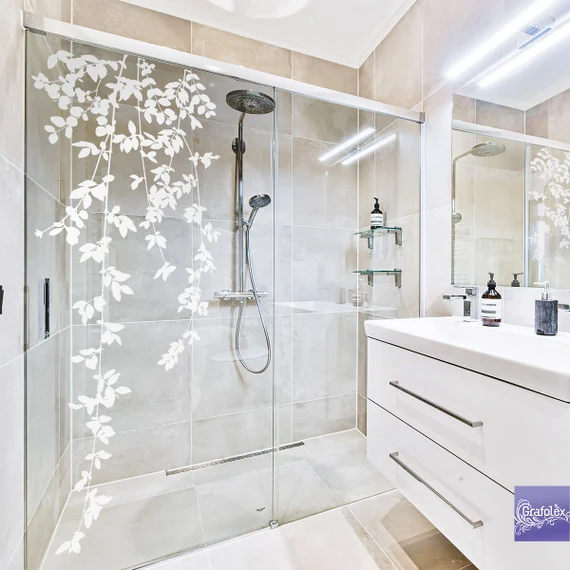
Etching scatters light rather than blocking it, so the base glass colour stays visible in the finish. On standard clear glass a frost reads faintly green; on low-iron it reads as a clean, neutral white. See frosted glass →
Under printed designs
A green base shifts printed colour, most visibly in greys, greens and pale tones — the colours most brand palettes are built from. Low-iron is the difference between a print that matches and one that is nearly right. See printed glass →
With tile and stone schemes
Anything seen through the panel takes on the glass colour. White tile, pale marble and cool greys are the materials most obviously affected, and they are also the ones most often specified alongside frameless glass.
Behind thick frameless panels
A 10 mm or 12 mm frameless door in standard clear glass has an unmistakably green edge. Low-iron removes the thing that makes heavy glass look cheap.
When Low-Iron Is Worth It — and When It Isn’t
Low-iron costs more per square metre than standard clear glass. It is worth it in some specifications and wasted in others, and the dividing line is usually visible in a single question: will the polished edge be seen?
| | Specify low-iron | Standard clear is fine |
|---|
| Enclosure type | Frameless, where the polished edge is exposed | Framed, where the profile conceals the edge |
| Thickness | 10 mm and 12 mm panels | 6 mm panels in a small room |
| Daylight | Strong daylight, or a window beside the enclosure | A room with little or no natural light |
| Finish on the glass | Etched, frosted or printed — where the base colour shows | Opaque coated glass, where the base is not visible at all |
| Colour | Clear, pale or neutral schemes | Deep tints, where the colourant overwhelms the difference
|
Four cases where the premium genuinely buys nothing. A framed enclosure, where the aluminium profile covers the edge. Opaque colour coated glass, where the base glass is never seen. Deep tints, where the colourant dominates. And bathrooms with no daylight, where the cast is rarely visible at all. In each of those, standard clear glass performs identically and costs less — and we will say so at quotation rather than upsell it.
Clarity, Light & Colour: What Actually Changes
Three things improve, and one gets worse. All four are worth knowing before specifying.
Higher light transmission
Less iron means less light absorbed in the glass, so more daylight reaches the room. The difference is most noticeable in bathrooms that need every bit of light they can get.
A neutral edge
The polished edge reads near-colourless rather than green. On a frameless panel this is usually the single most visible improvement.
True colour through the panel
Tile, stone and finishes seen through the glass keep their own colour instead of picking up a green cast — the reason it is specified under printed and etched work.
It costs more
The one honest downside. Low-iron carries a price premium over standard clear glass, and in the four cases listed above it delivers nothing for that premium.
What it does not change. Low-iron is an optical property only. It is not stronger, safer or more durable than standard clear glass — it is tempered to the same requirements and performs identically in service. It also gives no privacy whatsoever: it is the clearest glass in the range, and where obscuration is needed the answer lies in frosted, etched or textured glass, not in a change of base glass.
Where Low-Iron Sits on the Clarity Scale
Across the decorative range, the base glass runs from maximum clarity to no transmission at all. Low-iron sits at one end of that axis, and it is worth knowing what the other end looks like before choosing.
| | Transmission | Colour of its own |
|---|
| Low-iron | Very high | None — near-colourless |
| Standard clear | High | Faint green cast |
| Tinted | Reduced | Grey, bronze, green or blue |
| Frosted / etched | Reduced, scattered | Takes the base glass colour |
| Colour coated | None | Any RAL shade, opaque |
Low-iron and tinted glass are opposite specifications for opposite briefs — one when the glass should disappear, one when it should carry colour. View tinted shower glass →
Thickness & Size
Low-iron shower glass is supplied in 6 mm, 8 mm, 10 mm and 12 mm thicknesses.
Thickness is determined by the application rather than chosen freely: panel dimensions, whether the panel is fixed or forms part of a moving door, the support method, the hardware specified, and the safety-glazing requirements of the destination market all bear on it. We confirm the appropriate thickness against your drawings and target market rather than leaving it to be resolved on site.
On this product thickness carries a second meaning. Because the green cast of standard clear glass accumulates with thickness, the thicker the panel, the more difference low-iron makes. At 6 mm in a framed enclosure it is a marginal upgrade; at 12 mm in a frameless one it is the difference between a panel that looks premium and one that does not.
Panels are cut to size from your drawings. Maximum dimensions depend on thickness, handling constraints and access at the installation location, and are confirmed per project.
Processing & Fabrication
Low-iron shower glass is fabricated to drawing and supplied tempered as safety glass. It takes the same processing as any other glass in the range.
Cutting
Cut to size and shape from project drawings.
Edge Polishing
Flat polish, bevel and other edge finishes. On low-iron frameless panels the polished edge is the point of the specification — it is the surface the upgrade is bought for, so edge quality matters more here than anywhere else.
Drilling
CNC-drilled holes for hinges, clamps, brackets and handles, positioned to drawing.
Notches
CNC notches and cut-outs for pivots, channels, stabiliser bars and wall connections.
Tempering
Supplied tempered as safety glass. Requirements for the destination market are agreed before production.
Etching & Printing
Low-iron is the recommended base for both, because neither treatment masks the colour of the glass underneath.
Enclosure Compatibility
Low-iron glass can be specified into the following configurations. It is most often chosen for frameless work, where the edge is on show.
Frameless
The primary application — an exposed polished edge and uninterrupted clarity. View frameless systems →
Semi-Frameless
Worth specifying for the frameless door, less critical on the framed sections. View semi-frameless →
Framed
Rarely worth the premium, since the profile conceals the edge. View framed systems →
Walk-In
Fixed panels in open layouts, where the edge often catches daylight from the side. View walk-in systems →
Hinged
Heavy frameless doors, where thickness makes the edge most visible. View hinged systems →
Sliding
Where panels overlap, the doubled glass makes any cast more apparent. View sliding systems →
Because Showerspace develops glass, aluminium profiles and stainless steel hardware together, panel preparation is matched to the profiles and fittings in your system rather than adapted afterwards. Read about the Showerspace system approach →
Hardware Pairings
Neutral glass makes metal finishes read truer. Against a green-tinted panel, warm metals in particular can look slightly off — which is the practical reason to specify low-iron when the hardware is brass.
Low-iron + Brushed Brass
The pairing that benefits most. Brass against standard clear glass can read faintly muddy; against neutral glass it reads as the warm metal it is.
Low-iron + Polished Chrome
Cool and precise, and the most demanding combination: any cast in the glass shows up against a mirror finish.
Low-iron + Brushed Nickel
Quiet and tonal. Suited to schemes where the glass is meant to disappear and the fittings should not draw attention.
View available hardware finishes →
Applications
Residential
Premium frameless enclosures and en-suites, where the edge is visible and the tile is a design feature. View residential →
Hotels & Hospitality
Specified where room standards call for heavy frameless glass, or where a printed or etched design must hold its colour. View hospitality →
Apartments
Consistent clarity across multiple units, most valuable on the thicker panels used in sliding formats. View apartments →
Spa & Wellness
Where stone, planting and pale finishes are seen through the glass. View spa applications →
Commercial
Project-specific fabrication for offices, retail and premium fit-outs. View commercial →
Technical Specifications
| Glass type | Tempered safety glass with reduced iron oxide content; laminated construction where the application requires it |
| Thickness | 6 mm / 8 mm / 10 mm / 12 mm — subject to panel size, configuration and market requirements |
| Size | Custom, cut to drawing; maximum dimensions confirmed per project |
| Appearance | Near-colourless edge; no green cast. Reduced iron content, not zero |
| Light transmission | Very high, higher than standard clear float glass |
| Privacy | None — the clearest glass in the range |
| Strength | Identical to standard clear glass; tempered to the same requirements |
| Also known as | Ultra-clear, extra-clear, optiwhite and other trade names — specified by iron content and clarity, not by name |
| Edge | Flat polish, bevel and other edge finishes |
| Holes | CNC drilled to drawing |
| Notches | CNC processed to drawing |
| Processing | Cutting, edge polishing, drilling, notching, tempering, acid etching, digital ceramic printing |
| Recommended as a base for | Etched, frosted and printed glass |
| Enclosure compatibility | Frameless, semi-frameless, framed, walk-in, hinged, sliding |
| Hardware | Aluminium profiles and stainless steel hardware, selected by configuration and finish |
| Safety glazing | Applicable requirements for the destination market agreed before production. [[CONFIRM: which standards can be supported and for which markets — use the identical wording as the other product pages]] |
| Packaging | Export packaging configured for glass panels and system components |
Request low-iron glass samples →
Choosing Between Low-Iron and Standard Clear
Three questions settle it in almost every case, and none of them needs a technical answer.
- Will the polished edge be visible? If the enclosure is frameless, yes — and low-iron is usually worth it. If a profile covers the edge, the premium is largely wasted.
- How thick is the glass? The green cast in standard clear deepens with thickness, so the benefit of low-iron grows from 6 mm to 12 mm. On a thin framed panel it is marginal; on a heavy frameless door it is obvious.
- Is anything being etched, frosted or printed on it? Those treatments bring the base glass colour forward rather than hiding it. If so, specify low-iron so the finish reads the way the design intends.
If the answer to all three points the other way, standard clear glass will perform identically and cost less — and we will tell you that at quotation rather than quote low-iron by default. Ask us to check your specification →
Back to decorative shower glass →
Request Low-Iron Shower Glass
Tell us whether the polished edge will be visible and what is being applied to the glass, and we will tell you plainly whether low-iron is worth specifying on your project — or whether standard clear will do the same job.
Name
Business email
Company
Will the polished edge be visible?
Please select…
Yes — frameless enclosure
Partly — semi-frameless
No — the profile covers it
Not yet decided
The single question that decides whether low-iron is worth specifying.
Thickness
Please select…
6 mm
8 mm
10 mm
12 mm
Advise me
The thicker the glass, the more difference low-iron makes.
Applied to the glass
Nothing — clear glass
Etched or frosted finish
Printed design
Not sure yet
Quantity
Shower type
Please select…
Frameless
Semi-frameless
Framed
Walk-in
Hinged door
Sliding door
Corner
Other
Hardware requirement
Please select…
Brushed brass
Polished chrome
Brushed nickel / stainless
Matte black
Gunmetal
Other finish
Glass only, no hardware
Destination country
Used to confirm applicable safety-glazing requirements before quotation.
Drawing upload (optional)
DWG, DXF, PDF, SKP, JPG or PNG. A photo of the scheme helps when advising on clarity and edge visibility.
Project notesRequest a Quote
We use your details to respond to this enquiry only. See our privacy policy.
See the Edge Before You Decide
The difference between low-iron and standard clear glass is not visible looking through a panel — it is visible on the polished edge, and it grows with thickness. We can send both so you can compare them side by side, in daylight, against your own tile.
Request Comparison SamplesDiscuss Your Project
© Jumbo Glass Group · Showerspace — decorative shower glass and custom shower enclosure systems