Low‑E Glass | Low‑Emissivity Coated Glass & Low‑E IGU – Double/Triple Silver, Soft Coat, Solar Control
Low‑Emissivity Coated Glass & Low‑E Insulating Glass Units – Engineered by Performance Configuration, Not Just Thickness
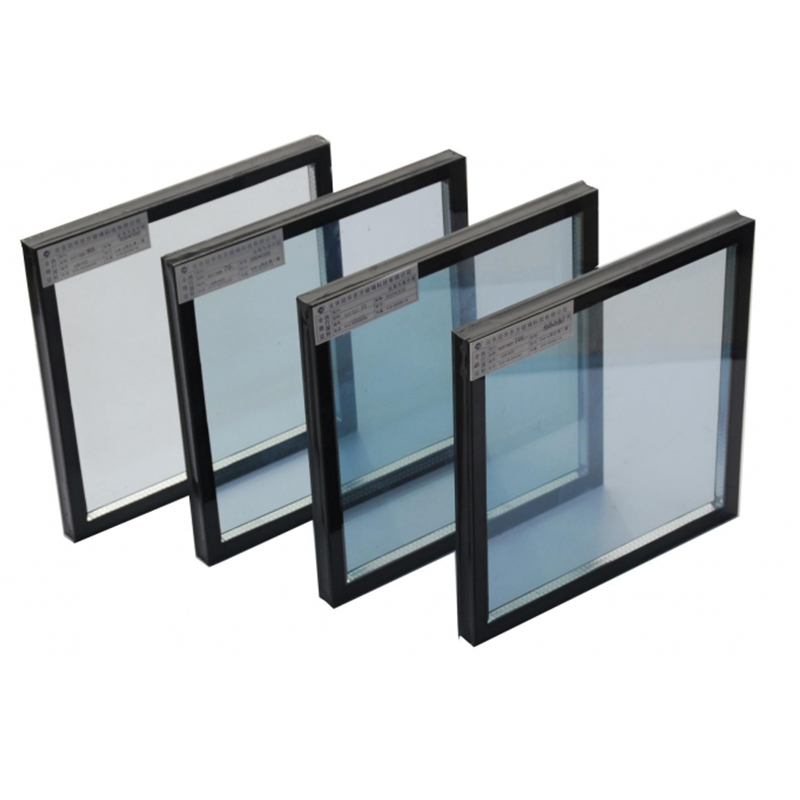
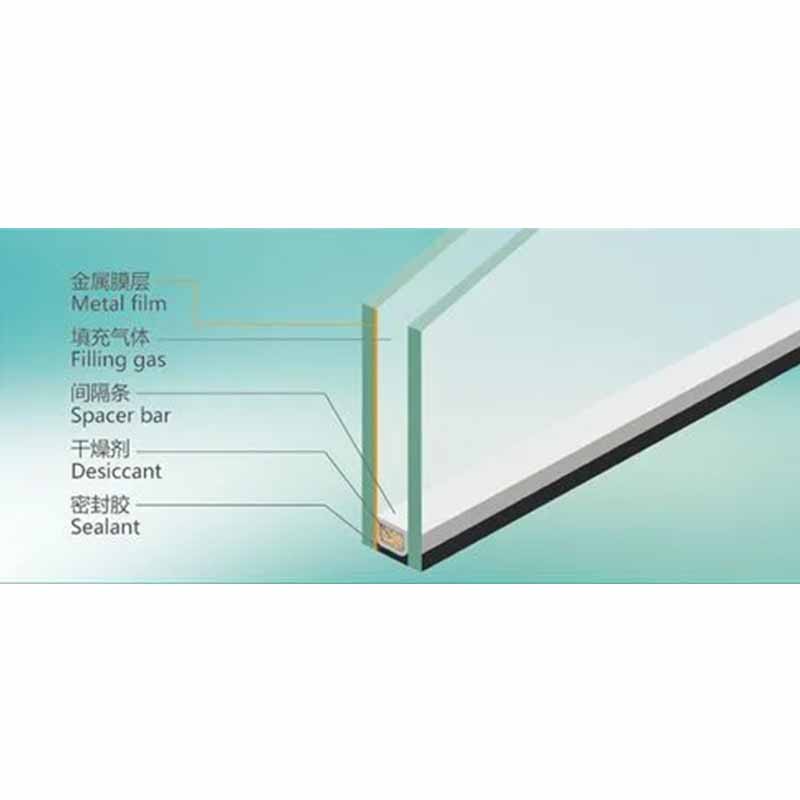
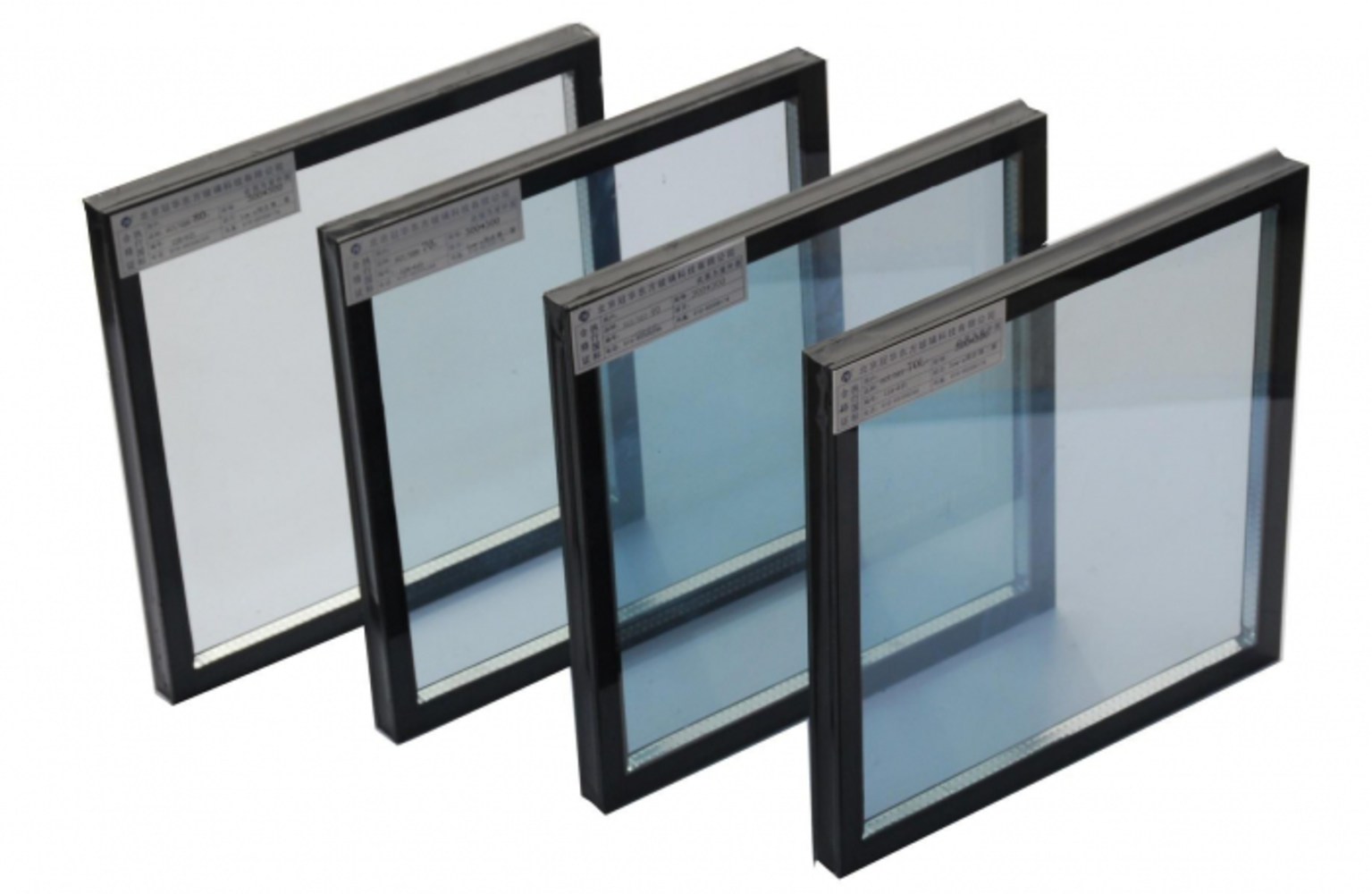
Low‑E glass (low‑emissivity glass, Low E glass, low emissivity glass) is a coated glass product with a microscopically thin, transparent layer of metal oxide — typically silver — applied to one or more glass surfaces. This coating selectively reflects long‑wave infrared heat while transmitting visible light, delivering the thermal control required by modern energy codes without sacrificing daylight or views.
1. How Low‑E Coatings Work
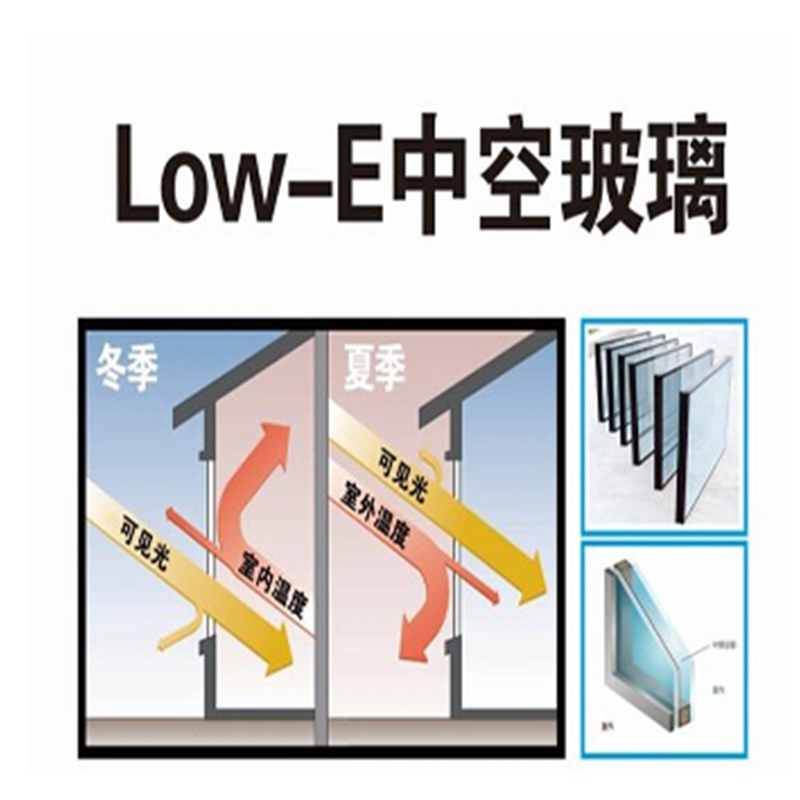
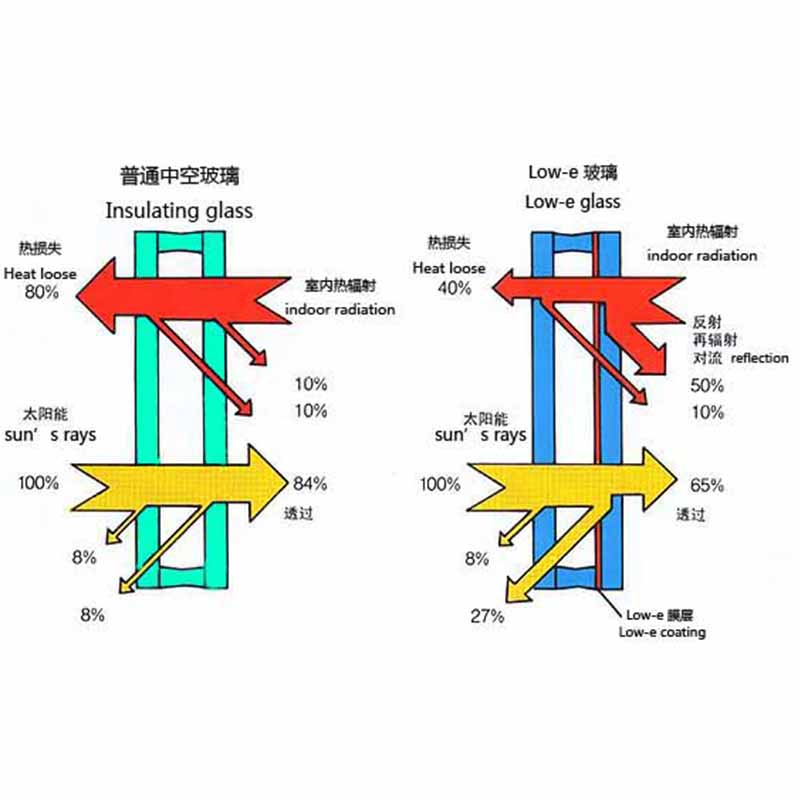
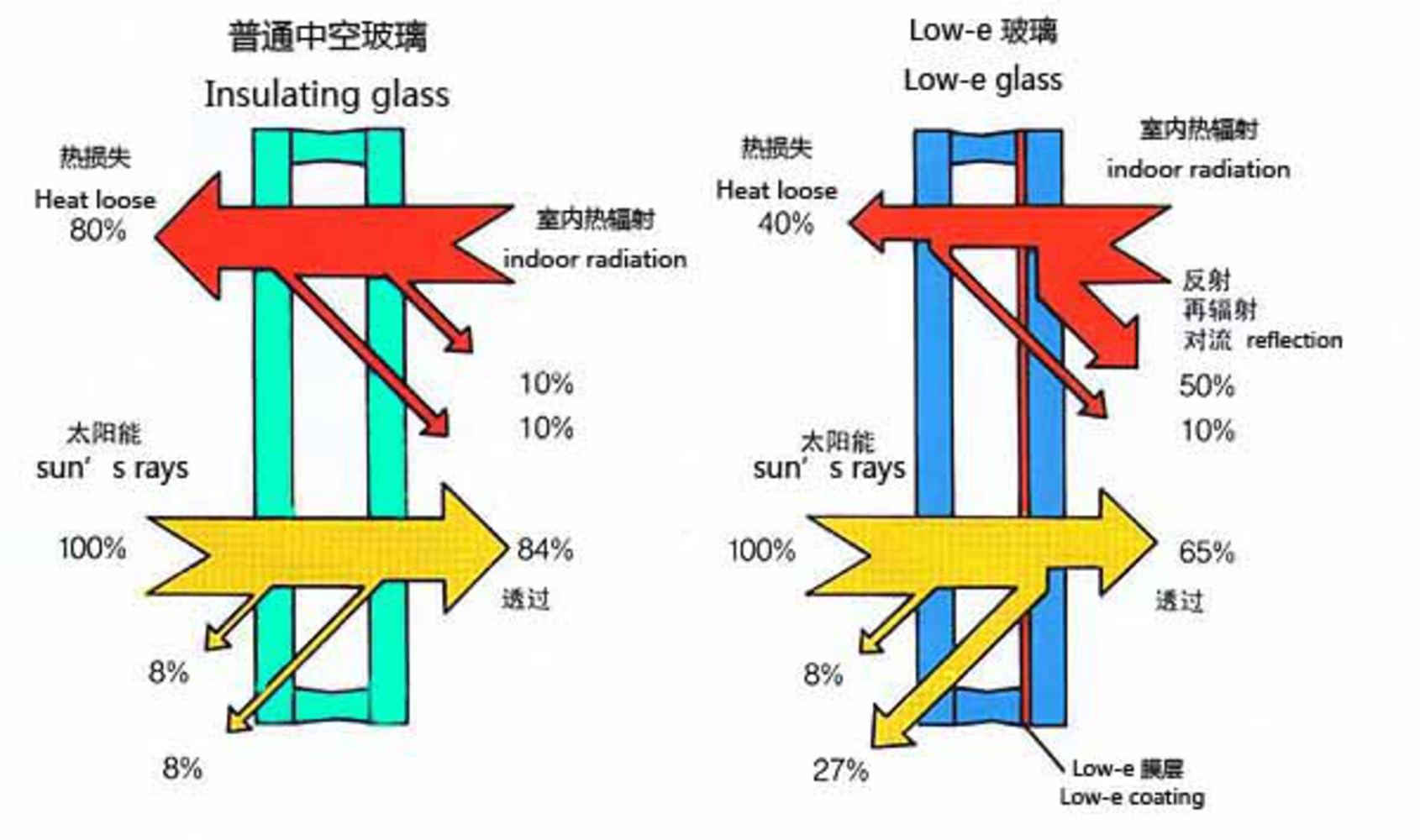
Low‑E coatings are engineered to be selective:
- Visible light (380–780 nm) passes through → daylight and views
- Infrared radiation (heat) is reflected away → reduced solar heat gain
- Ultraviolet radiation is largely blocked → UV protection
- The emissivity of ordinary clear glass is ~0.84. Low‑E glass reduces this to below 0.15, with high‑performance triple silver coatings achieving emissivity as low as ~0.10.
Soft Coat vs. Hard Coat — The Two Processes
| Parameter | Soft Coat (MSVD / Sputtered) | Hard Coat (Pyrolytic) |
|---|
| Application | Offline, after glass production | Online, during float glass manufacturing |
| Performance | Higher performance, lower emissivity | Moderate performance, higher emissivity |
| Typical use | Double/triple silver, IGU‑encapsulated | Single silver, can be used monolithically |
| Exposure | Must be sealed inside IGU (coating is delicate) | Can be exposed (more durable) |
| Markets | Commercial curtain walls, high‑performance facades | Residential, some commercial |
| Generations available | Single, double, triple silver | Primarily single silver |
| Cost | Higher | Lower |
💡 Most commercial projects specify soft coat Low‑E for its superior performance. Hard coat is chosen for budget‐sensitive projects or where monolithic use is required.
Low-Emissivity coating with 8-15 nanolayers (※microscope image) enables:
- 90% infrared reflection
- 99% UV blocking
- 40-80% visible light transmission
![]()
![]()
Certified to EN 410 & ISO 9050
2.Classification Low‑E Glass
Low-E glass is classified according to performance configuration → coating process → insulated glass unit structure → application → color:
Low‑E Glass (hub — this page)
│
├── By Coating Generation
│   ├── Single Silver Low‑E Glass
│   ├── Double Silver Low‑E Glass ⭐ (highest commercial intent)
│   └── Triple Silver Low‑E Glass ⭐ (high‑performance facade)
│
├── By Coat Process
│   ├── Soft Coat Low‑E Glass (MSVD / sputtered)
│   └── Hard Coat Low‑E Glass (pyrolytic)
│
├── By Performance Type
│   ├── Solar Control Low‑E Glass ⭐
│   ├── High VLT Low‑E Glass
│   └── Low SHGC Low‑E Glass
│
├── By IGU Configuration (Configuration SEO)
│   ├── 5+12Ar+5 Low‑E IGU
│   ├── 6+12Ar+6 Low‑E IGU
│   ├── 6+16Ar+6 Low‑E IGU ⭐ (commercial curtain wall standard)
│   ├── 6+16Ar+8 Low‑E IGU
│   ├── 8+12Ar+8 Low‑E IGU
│   └── 8+16Ar+8 Low‑E IGU ⭐ (high‑rise & structural glazing)
│
├── By Application
│   ├── Low‑E Glass for Curtain Walls
│   ├── Low‑E Glass for Passive House
│   └── Low‑E IGU for Commercial Buildings
│
└── By Color
    ├── Neutral Low‑E Glass
    ├── Blue Low‑E Glass
    ├── Grey Low‑E Glass
    ├── Bronze Low‑E Glass
    └── Green Low‑E Glass
    Each sub‑page follows the same template: Exact Configuration → Performance Data → Available Sizes → Processing → Applications → Standards → Price Guide → FAQ → RFQ.
3. Coating Generations — Performance Comparison
Based on industry benchmark data:
| Coating Type | VLT Range | U‑Value (W/m²K)* | SHGC Range | Best For |
|---|
| Single Silver Low‑E | 35–71% | 1.73–1.81 | 0.29–0.56 | Standard energy‑saving windows, cold climates, maximum daylight |
| Double Silver Low‑E | 41–72% | 1.61–1.64 | 0.22–0.44 | Office façades, commercial curtain walls, larger glazed areas |
| Triple Silver Low‑E | 41–63% | 1.61–1.66 | 0.21–0.29 | Projects with strongest solar control needs, tropical climates, Passive House
* Center‑of‑glass U‑value for typical IGU with argon fill. Whole‑window U‑value depends on frame. |
Single Silver Low‑E — Maximum Daylight
First‑generation coating with one silver layer. Excels at thermal insulation while delivering the highest visible light transmittance among all Low‑E types (up to 72%).
- Best for: Cold climates, offices, schools, healthcare, residential windows
- Typical IGU: 6mm Single‑Ag Low‑E + 12A Argon + 6mm Clear
- Performance: U‑value 1.75–1.89 W/m²K, SHGC 0.24–0.58, VLT up to 72%
Double Silver Low‑E — The Commercial Standard ⭐
Second‑generation coating with two silver layers in a 13+ layer film structure. The most specified Low‑E product for commercial curtain walls globally.
- Best for: Hot climates, commercial towers, hotels, west‑facing façades
- Typical IGU: 6mm Double‑Ag Low‑E + 12A Argon + 6mm Clear
- Performance: U‑value 1.57–1.68 W/m²K, SHGC 0.20–0.42, VLT 21–69%
- Key advantage: Dramatically lower SHGC than single silver while maintaining good VLT — enabling significant HVAC equipment downsizing
Triple Silver Low‑E — The Performance Pinnacle ⭐
Third‑generation coating with three silver layers. The absolute maximum solar heat filtering capability available today.
- Best for: Tropical zones, high‑performance facades, green building certification (LEED Platinum, Passive House)
- Typical IGU: 8mm Triple‑Ag Low‑E + 16A Argon + 6mm Clear
- Performance: U‑value 1.50–1.60 W/m²K, SHGC 0.15–0.30, VLT 40–60%
- Key advantage: Blocks up to 80%+ of solar heat energy with neutral color appearance
Reference Performance Table (6+12A+6 baseline)
| Film Type | VLT (%) | SHGC | U‑Value (Air/Argon) W/m²K | UV Transmission (%) | Rw (dB) |
|---|
| Single Silver (high‑transmission) | 68–72 | 0.48–0.55 | ≤1.8 / ≤1.5 | 15–25 | 32–34 |
| Single Silver (solar control) | 50–55 | 0.35–0.42 | ≤1.8 / ≤1.5 | 10–18 | 32–34 |
| Double Silver (high‑transmission) | 65–70 | 0.38–0.45 | ≤1.6 / ≤1.3 | 5–12 | 32–34 |
| Double Silver (solar control) | 40–45 | 0.25–0.33 | ≤1.6 / ≤1.3 | ≤5 | 32–34 |
| Triple Silver (control type) | 60–65 | 0.20–0.28 | ≤1.5 / ≤1.2 | ≤2 | 32–34
Data from industry benchmark. Actual values vary by glass thickness, cavity width, gas fill ratio, and specific coating formulation. |
4. Solar Control Low‑E Glass — For Hot Climates
Solar control Low‑E glass combines Low‑E coating technology with solar control properties, making it the definitive glazing choice for:
- Middle East (Dubai, Riyadh, Doha)
- Southeast Asia (Singapore, Bangkok, Jakarta)
- Australia (Perth, Brisbane, Sydney)
- Southern USA (Miami, Phoenix, Houston)
- India (Bangalore, Delhi, Mumbai)
Climate‑Based Selection Guide
| Climate Zone | Recommended Coating | Target SHGC | Target U‑Value | Typical IGU |
|---|
| Hot & dry (Middle East, N. Africa) | Triple Silver | ≤0.22 | ≤1.4 W/m²K | 6+16Ar+6 or 8+16Ar+8 |
| Hot & humid (SE Asia, Florida) | Triple Silver | ≤0.25 | ≤1.4 W/m²K | 6+16Ar+6 |
| Temperate (Europe, US Mid‑Atlantic) | Double Silver | 0.30–0.40 | ≤1.4 W/m²K | 6+16Ar+6 |
| Cold (Northern Europe, Canada) | Double Silver (high VLT) | 0.40–0.60 | ≤1.0 W/m²K | 6+16Ar+6 or triple glazing |
| Tropical (equatorial cities) | Triple Silver | ≤0.20 | ≤1.2 W/m²K | 8+16Ar+8 |
5. Low‑E IGU Configurations
These are the highest commercial‑intent pages in our Low‑E cluster. Each configuration has a dedicated page with exact performance data:
6+12Ar+6 Low‑E IGU
| Parameter | Data |
|---|
| Outer Lite | 6mm Clear |
| Coating | Double Silver Low‑E (on #2 surface) |
| Cavity | 12mm |
| Gas | Argon (≥90%) |
| Inner Lite | 6mm Clear |
| Overall Thickness | 24mm |
| VLT | ~68% |
| U‑Value | ~1.6 W/m²K |
| SHGC | ~0.40 |
| g‑value | ~0.40 |
| Acoustic (Rw) | ~32 dB |
| Max Size | 3300 × 8000 mm |
| Glass Tempered | Optional |
6+16Ar+6 Low‑E IGU ⭐ (Commercial Curtain Wall Standard)
| Parameter | Data |
|---|
| Outer Lite | 6mm Clear |
| Coating | Double Silver Low‑E (on #2 surface) |
| Cavity | 16mm |
| Gas | Argon (≥90%) |
| Inner Lite | 6mm Clear |
| Overall Thickness | 28mm |
| VLT | ~70% |
| U‑Value | ~1.4 W/m²K |
| SHGC | ~0.35 |
| g‑value | ~0.35 |
| Acoustic (Rw) | ~32 dB |
| Max Size | 3300 × 8000 mm |
| Glass Tempered | Recommended for heights >10 stories |
6+16Ar+8 Low‑E IGU
| Parameter | Data |
|---|
| Outer Lite | 6mm Clear |
| Coating | Double Silver Low‑E (on #2 surface) |
| Cavity | 16mm |
| Gas | Argon (≥90%) |
| Inner Lite | 8mm Clear |
| Overall Thickness | 30mm |
| VLT | ~68% |
| U‑Value | ~1.4 W/m²K |
| SHGC | ~0.35 |
| Acoustic (Rw) | ~33 dB |
| Max Size | 3300 × 9000 mm |
8+16Ar+8 Low‑E IGU ⭐ (High‑Rise & Structural Glazing)
| Parameter | Data |
|---|
| Outer Lite | 8mm Clear |
| Coating | Double or Triple Silver Low‑E (on #2 surface) |
| Cavity | 16mm |
| Gas | Argon or Krypton |
| Inner Lite | 8mm Clear |
| Overall Thickness | 32mm |
| VLT | ~65% |
| U‑Value | ~1.3 W/m²K |
| SHGC | ~0.30 |
| Acoustic (Rw) | ~34 dB |
| Max Size | 3300 × 11000 mm |
| Glass Tempered | Required for high‑rise |
Triple Silver Example: 6+16Ar+6 Triple Silver Low‑E IGU
A documented industry configuration:
- 6mm Triple Silver Low‑E + 16mm Argon + 6mm Clear Tempered
- U‑value: ~1.5 W/m²K
- VLT: ~70%
- SHGC: ~0.25
- Applied in windows, doors, skylights, and curtain wall systems
6. Key Specifications
| Specification | Details |
|---|
| Glass Thickness | 4, 5, 6, 8, 10, 12, 15, 19 mm |
| Coating Type | Single Silver, Double Silver, Triple Silver (soft coat MSVD) |
| Single Silver (hard coat pyrolytic) |
| Coating Placement | #2 surface (cold climates), #3 surface (hot climates), dual Low‑E |
| IGU Configurations | 5+12Ar+5 to 10+16Kr+10 |
| Total IGU Thickness | 21–38 mm |
| Maximum Monolithic Size | 3300 × 13000 mm |
| Maximum IGU Size | 3300 × 11000 mm |
| Spacer Types | Aluminum, Warm Edge TPE, Swisspacer, Stainless Steel, Structural Silicone |
| Gas Fill | Air, Argon, Krypton |
| U‑Value Range | 1.1–1.8 W/m²K (configuration dependent) |
| SHGC Range | 0.15–0.58 (coating dependent) |
| VLT Range | 21–72% (coating dependent) |
| Emissivity | <0.15 (soft coat), <0.20 (hard coat) |
| UV Blockage | 85–99% |
| Sound Reduction (IGU) | 32–34 dB (clear), up to 46 dB (laminated) |
| Certifications | EN 1096‑4 (coated glass), EN 1279‑5 (IGU), ASTM C1376 (coated glass), ASTM E2190, IGCC, ISO 9001, CE, CCC, SGS |
| MOQ | 1 × 20′ FCL |
| Lead Time | 2–4 weeks (monolithic), 4–6 weeks (IGU)
|
7. Processing Capabilities
All Low‑E glass is fully processed in‑house:
- ✅ Edge deletion — automated coating removal (critical for soft coat Low‑E seal integrity)
- ✅ Cutting — CNC cutting with ±0.5mm tolerance
- ✅ Tempering — heat‑soak tested per EN 14179 (note: coating requires controlled furnace profiling)
- ✅ Heat‑strengthening
- ✅ Laminating — PVB or SGP interlayer
- ✅ Insulating — IGU assembly with warm‑edge spacer
- ✅ Curving — curved tempered up to 2800 × 7500 mm
- ✅ Ceramic frit printing
- ✅ Smart film integration (PDLC electronic dimming)
- ✅ Drilling & CNC machining
⚠️ Critical for soft coat Low‑E: Edge deletion must be 100% precise. If the silver layer is not completely removed at the perimeter, moisture will corrode the film and cause seal failure. Our automated edge‑deletion line guarantees zero coating at the seal interface.
8. Applications
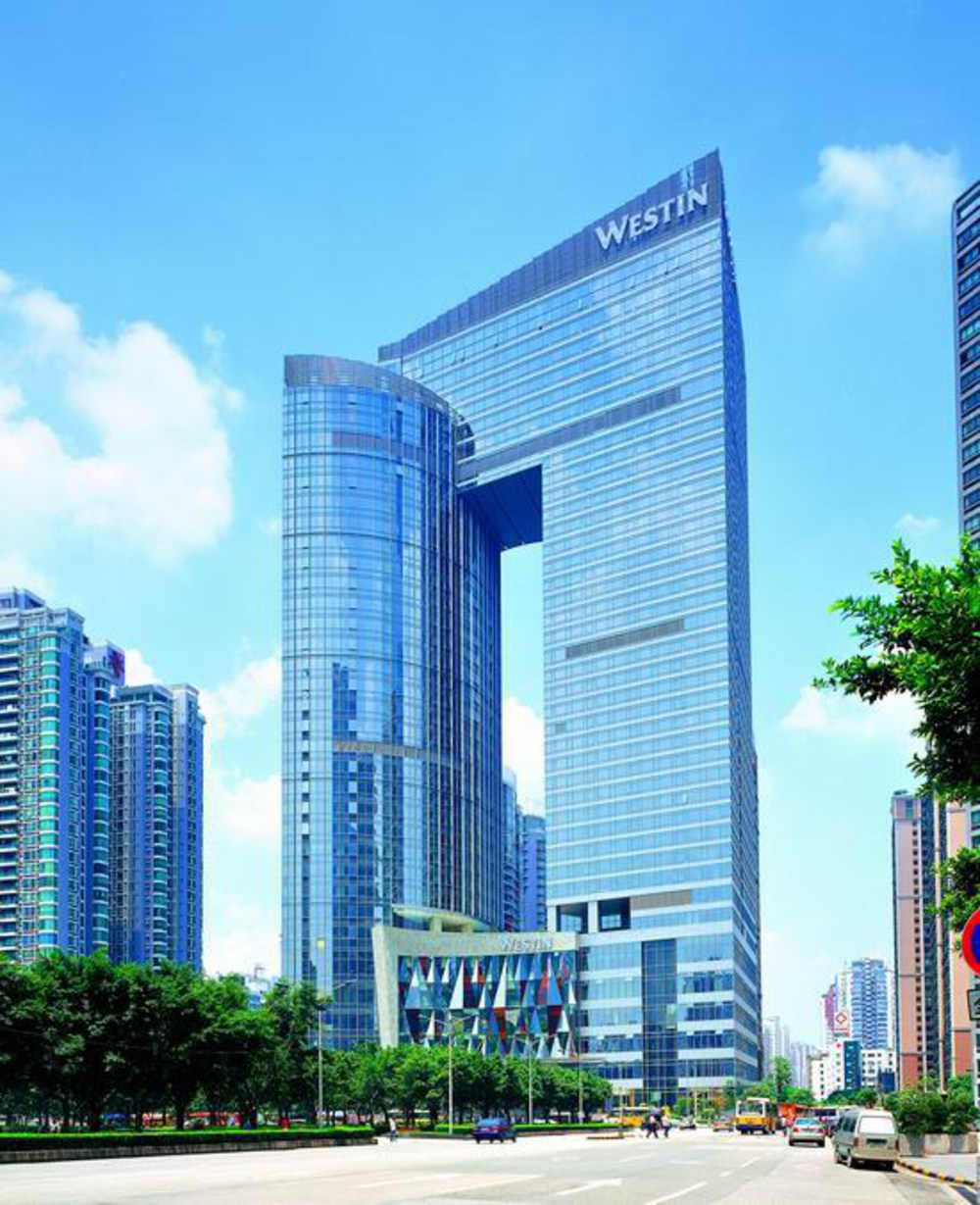
Commercial Curtain Walls ⭐ Primary Application
Double silver Low‑E in 6+16Ar+6 configuration is the global standard for commercial curtain walls. It balances daylight (VLT ~70%), solar control (SHGC ~0.35), and thermal performance (U‑value ~1.4 W/m²K) — meeting ASHRAE 90.1, California Title 24, EU EPBD, and LEED requirements.
High‑Rise & Super‑Tall Towers
8+16Ar+8 with double or triple silver Low‑E provides the structural integrity and thermal performance required for buildings above 30 stories. Wind load resistance up to 2400 Pa (ASTM E2190).
Hotels & Hospitality
Double silver Low‑E reduces solar heat gain on west and south elevations — the most demanding orientations. Guestroom comfort and reduced HVAC load are the primary benefits.
Office Buildings & Corporate Campuses
Double silver Low‑E on #2 surface (cold climates) or #3 surface (hot climates) optimizes energy performance. Open‑plan offices benefit from high VLT (daylight) combined with low SHGC (solar control).
Passive House & Net‑Zero Buildings
Triple silver Low‑E with krypton fill in 8+16Kr+8 configuration achieves U‑values ≤1.0 W/m²K and SHGC ≤0.22 — meeting Passive House Institute requirements.
Healthcare & Laboratories
High VLT single silver Low‑E maximizes daylight for patient recovery while controlling UV and heat. Laminated Low‑E IGU adds acoustic and security benefits.
Airports & Transit Hubs
Large‐span curtain walls and skylights use jumbo Low‑E IGU (up to 3300 × 11000 mm) for both thermal performance and acoustic control.
Educational Facilities
Schools and universities specify double silver Low‑E for energy efficiency, daylight harvesting, and reduced operating costs.
Retail & Shopping Centers
Mall atriums and storefronts use Low‑E IGU with ceramic frit spandrel panels for a seamless, energy‑efficient facade.
Museums & Art Galleries
Triple silver Low‑E with >95% UV blockage protects priceless collections while maintaining neutral color appearance and high VLT.
9. Standards & Certifications
| Standard | Region | Scope |
|---|
| EN 1096‑4:2018 | Europe | Coated glass product standard; CE marking for Low‑E glass |
| EN 1279‑5 | Europe | Insulating glass unit standard |
| EN 410 | Europe | Glass optical property determination |
| EN 673 | Europe | U‑value calculation method |
| ASTM C1376‑10 | USA | Standard specification for pyrolytic and vacuum‐deposited coated glass |
| ASTM E2190 | USA | IGU performance standard |
| IGCC | USA/Canada | Insulating Glass Certification Council |
| ANSI Z97.1 | USA | Safety glazing material standard |
| AS/NZS 2208 | Australia/NZ | Safety glazing |
| AS/NZS 4666 | Australia/NZ | IGU standard |
| ISO 9001 | International | Quality management |
| CCC | China | Mandatory for Chinese market |
| SGS | Global | Third‐party inspection
|
10. Color Options (Secondary Dimension)
While configuration is primary, Low‑E glass is available in these color families:
| Color | Appearance | Typical Coating |
|---|
| Neutral / Clear | Colorless, high clarity | Double or Triple Silver |
| Blue | Cool blue tint | Double Silver |
| Grey | Neutral grey | Double or Triple Silver |
| Bronze | Warm bronze | Double Silver |
| Green | Subtle green | Single or Double Silver |
| Champagne Gold | Warm gold | Double Silver (offline) |
| Silver‑Blue | Bright silver‐blue | Double Silver (offline) |
💡 Neutral Low‑E Glass is increasingly specified by Western architects who want "neutral appearance" — high performance without color distortion.
11. Pricing Guidance (FOB USD/m²)
Low‑E Monolithic Glass
| Thickness | Coating | FOB Range (USD/m²) |
|---|
| 6mm | Single Silver (soft coat) | $18–26 |
| 6mm | Double Silver (soft coat) | $22–32 |
| 6mm | Triple Silver (soft coat) | $28–40 |
| 6mm | Single Silver (hard coat) | $14–20 |
| 8mm | Double Silver (soft coat) | $26–38 |
| 8mm | Triple Silver (soft coat) | $32–46 |
| 10mm | Double Silver (soft coat) | $30–44 |
Low‑E IGU
| Configuration | Coating / Gas | FOB Range (USD/m²) |
|---|
| 5+12Ar+5 | Single Silver / Argon | $24–36 |
| 6+12Ar+6 | Single Silver / Argon | $26–38 |
| 6+16Ar+6 | Double Silver / Argon | $30–44 |
| 6+16Ar+6 | Triple Silver / Argon | $38–52 |
| 6+16Kr+6 | Double Silver / Krypton | $36–50 |
| 6+16Ar+8 | Double Silver / Argon | $34–48 |
| 8+12Ar+8 | Double Silver / Argon | $36–52 |
| 8+16Ar+8 | Double Silver / Argon | $40–56 |
| 8+16Kr+8 | Triple Silver / Krypton | $52–70 |
| 8+16Ar+8 Lami/Lami | Triple Silver / Argon | $72–96 |
| 10+16Ar+10 | Double Silver / Argon | $48–66 |
💡 Price determinants: glass thickness, coating generation (single/double/triple silver), gas fill (air/argon/krypton), spacer type (aluminum/warm edge/Swisspacer), tempering/laminating, panel dimensions (jumbo surcharge 10–20% for >3300×6000mm), order volume, and destination port. For a precise project quotation with U‑value/SHGC/VLT calculations specific to your climate zone and orientation, send us your glass schedule and project location.
12. Frequently Asked Questions
Q1: What is the difference between Low‑E glass and reflective glass?
Reflective glass uses a coating to reflect visible solar radiation, creating a mirror appearance. Low‑E glass uses a silver‐based coating to selectively reflect infrared heat while remaining visually transparent. Reflective glass is specified by color; Low‑E glass is specified by performance configuration. Both are sub‐categories of Coated Glass.
Q2: What does "Low‑E" mean?
Low‐E stands for "low emissivity." Emissivity measures how much heat a surface radiates. Low‐E glass has emissivity below 0.15 (vs. ~0.84 for clear glass), meaning it reflects heat rather than absorbing and re‐radiating it.
Q3: Which is better — single, double, or triple silver Low‑E?
Single silver: maximum daylight (VLT up to 72%), best for cold climates. Double silver: balanced performance, the commercial curtain wall standard. Triple silver: lowest SHGC (down to 0.15), best for hot/tropical climates and Passive House.
Q4: What is soft coat vs. hard coat Low‐E?
Soft coat (MSVD/sputtered) is applied offline after glass production — higher performance, must be sealed inside IGU. Hard coat (pyrolytic) is applied online during manufacturing — more durable, can be used monolithically, moderate performance. Most commercial projects use soft coat.
Q5: What does 6+16Ar+6 mean?
6mm glass + 16mm argon‐filled cavity + 6mm glass. "Ar" indicates argon gas fill. Total thickness = 28mm. This is the commercial curtain wall standard configuration.
Q6: What U‑value can Low‐E IGU achieve?
Typical double silver 6+16Ar+6: ~1.4 W/m²K. Triple silver 8+16Kr+8: down to 1.0 W/m²K. Whole‐window U‐value depends on frame type.
Q7: Can Low‐E glass be tempered?
Yes, but the coating requires controlled furnace profiling to avoid oxidation, warping, or uneven heating. Our tempering lines are specifically calibrated for Low‐E coatings.
Q8: Which surface should the Low‐E coating face?
2 surface (outer pane, interior face) for cold climates — retains interior heat. #3 surface (inner pane, exterior face) for hot climates — blocks solar heat gain. Dual Low‐E for extreme climates.
Q9: What is the maximum size for Low‐E IGU?
Up to 3300 × 12000 mm. Jumbo monolithic Low‐E glass: up to 3300 × 13000 mm.
Q10: How long does the coating last?
Soft coat Low‐E sealed inside an IGU lasts 20+ years — the lifetime of the IGU itself. Hard coat Low‐E can last 30+ years even in monolithic applications.
Q11: What certifications do you provide?
EN 1096‐4 (coated glass), EN 1279‐5 (IGU), ASTM C1376, ASTM E2190, IGCC, CE, ISO 9001, CCC, SGS.
Q12: Do you provide performance simulations?
Yes. For your specific project location, orientation, and climate zone, we provide U‐value, SHGC, VLT, and annual energy calculations per ASHRAE 90.1, Title 24, or PHPP methodology.
Q13: How do I choose between 12A and 16A cavity?
12A is the budget‐standard; 16A provides ~4% better U‐value, better argon retention, and room for krypton fill. For most commercial curtain walls, 16A is recommended.
Q14: Is Low‐E glass worth the cost premium?
In climate zones with significant heating or cooling loads, Low‐E IGU typically pays for itself within 3–7 years through energy savings. It is also mandated by most current energy codes (ASHRAE 90.1, Title 24, EPBD).
Q15: Can Low‐E be combined with reflective coating?
Yes. "Solar control reflective Low‐E" combines a reflective outer coating with a Low‐E inner coating for maximum solar control. Popular in Middle Eastern and Southeast Asian projects.
13. Get a Quote for Low‑E Glass / Low‐E IGU
Tell us your project requirements and we'll respond within 48 hours with a competitive FOB quotation and performance analysis.
Please provide:
- Coating type: Single / Double / Triple Silver; Soft Coat or Hard Coat
- IGU configuration (e.g., 6+16Ar+6) or monolithic thickness
- Coating placement (#2, #3, or dual)
- Glass types (clear, tinted, tempered, laminated)
- Spacer type (Aluminum / Warm Edge / Swisspacer / Structural Silicone)
- Gas fill (Air / Argon / Krypton)
- Panel dimensions (width × height × quantity)
- Target performance (U‐value, SHGC, VLT)
- Project location & climate zone
- Certifications required
- Target delivery date
- 📧 Email your specification to: tomron1688@gmail.com
- 🌐 Or visit: www.jumbotemperedglass.com
14.Related Pages (Internal Link Cluster)
Low‑E Glass Product Pages
IGU Configuration Pages
Related Resources
![]()
![]()
![]()