Home › Showerspace › Decorative Shower Glass ›Reeded Shower Glass
Decorative Shower Glass
Reeded Shower Glass for Privacy & Modern Bathroom Design
Reeded Texture. Natural Light. Designed Privacy.
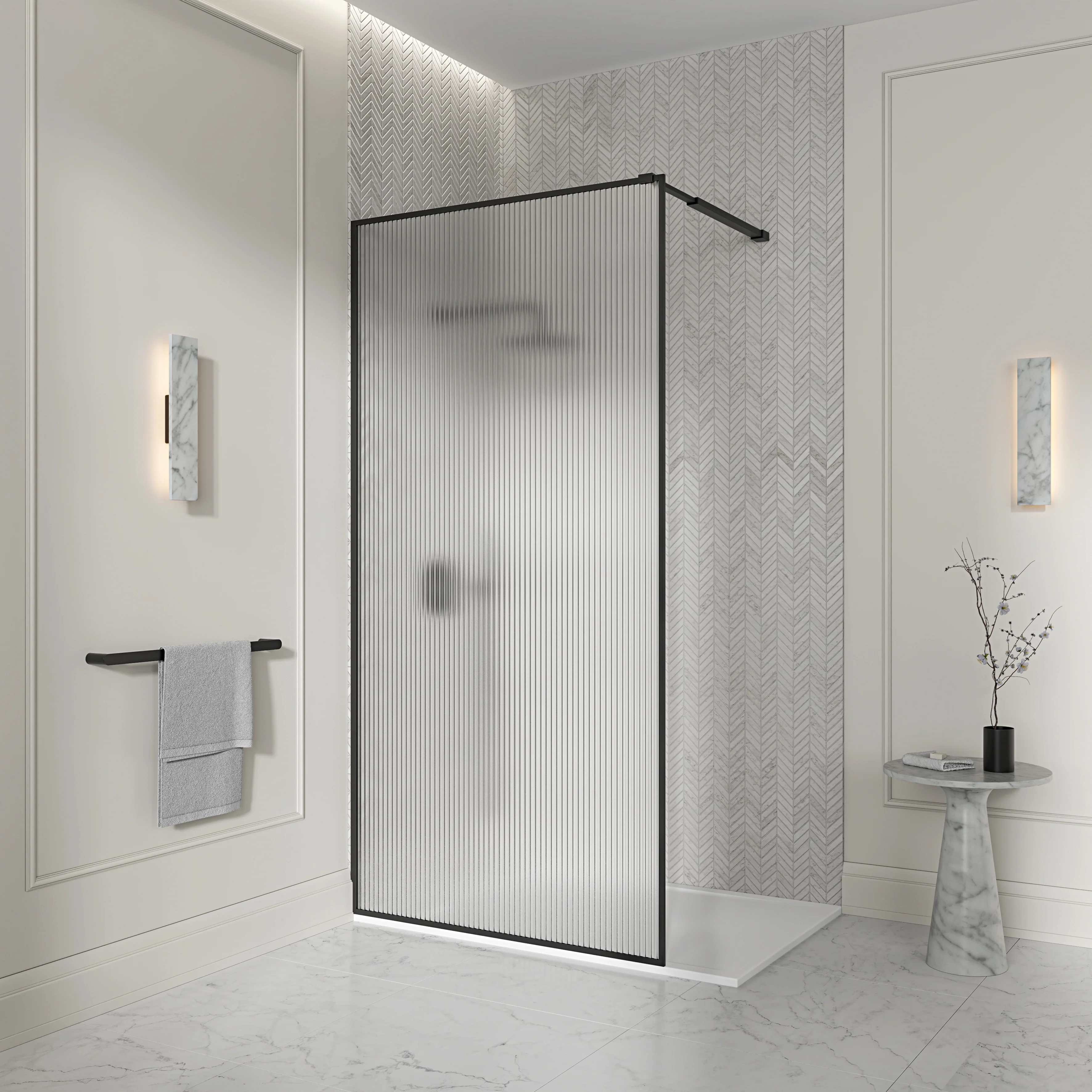
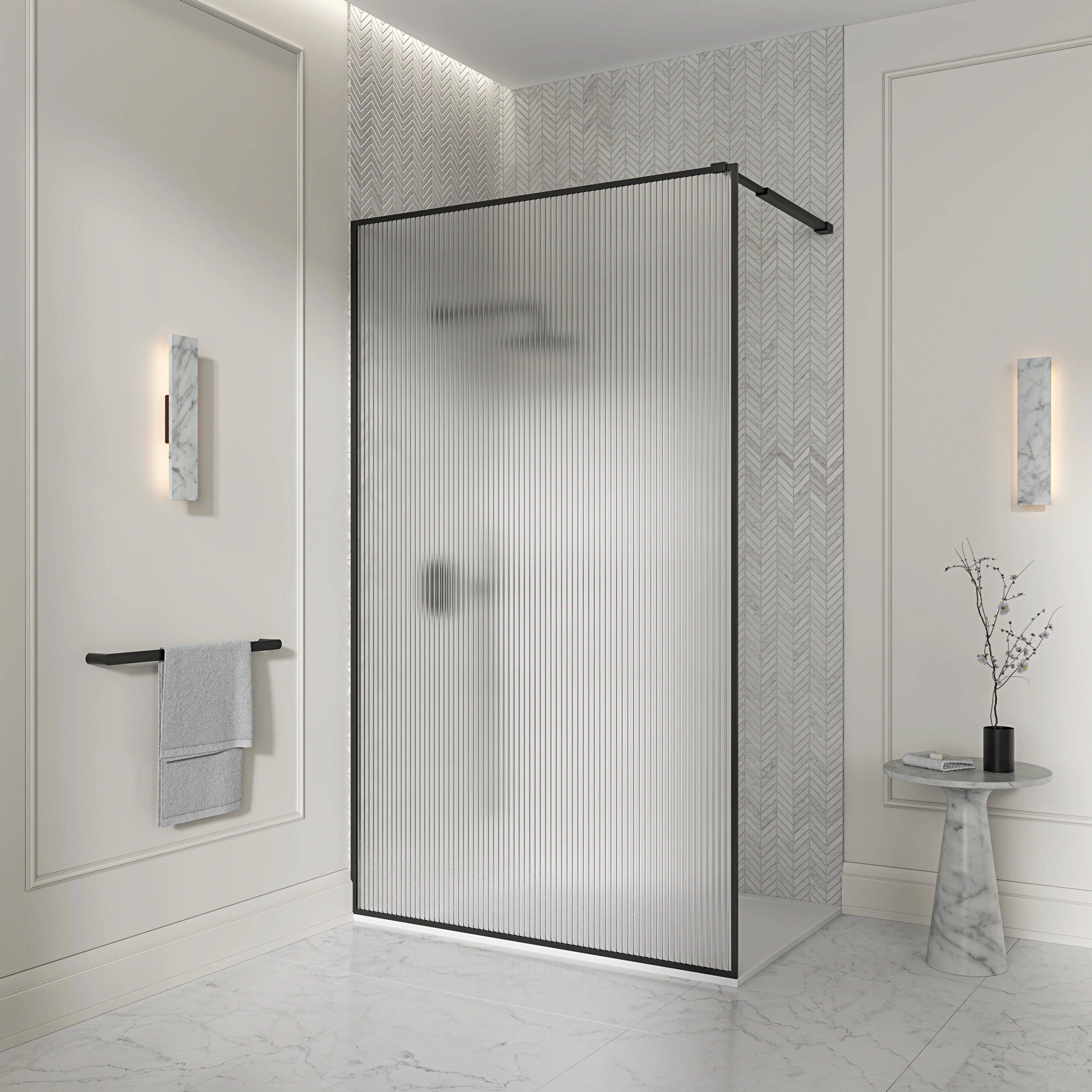
Fine, closely spaced ribs that turn a shower panel into a soft rippled surface. Reeded glass carries daylight into the bathroom while spreading the view evenly, giving privacy without the flat look of full frosting.
What Is Reeded Shower Glass?
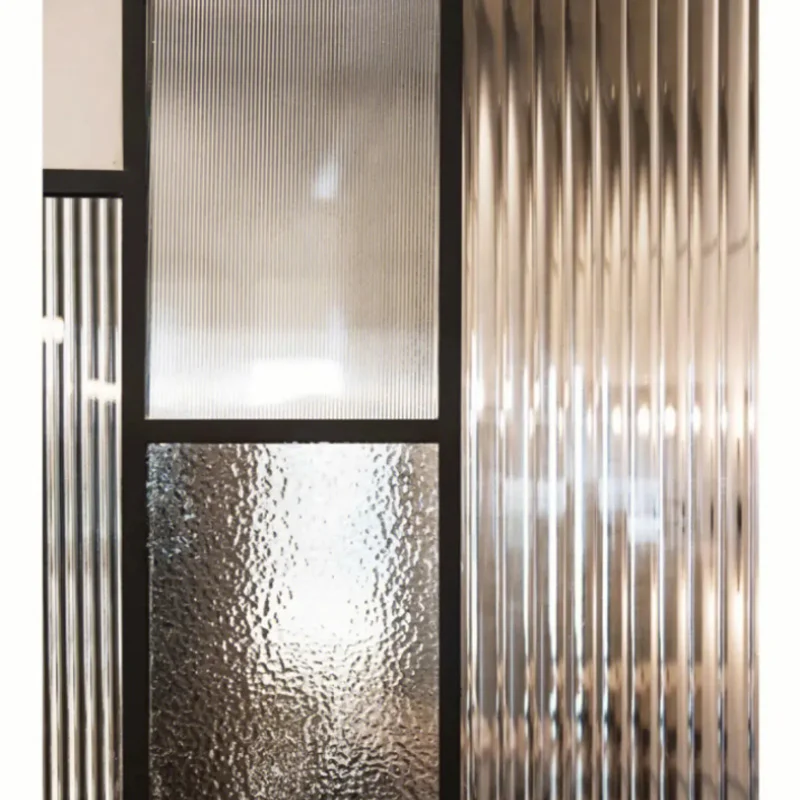
Reeded shower glass is tempered safety glass with a series of fine, closely spaced ribs formed into one face of the panel. The ribs sit shoulder to shoulder along the full width of the glass, so the surface reads as a continuous ripple rather than a set of individual grooves.
Because the ribs run edge to edge without flat glass between them, reeded glass treats light differently from a widely spaced flute. Instead of producing a pronounced light-and-shadow stripe, it diffuses more evenly across the panel. The practical effect is a privacy glass that still looks bright and open: the bathroom keeps its daylight, the outline behind the panel is broken up, and the surface has a satin quality that changes as the light moves through the day.
Reeded glass is also referred to as ribbed glass, and the wording varies considerably between suppliers. We handle that by giving every pattern a fixed ID tied to a groove drawing rather than relying on the name — see Reeded vs Fluted below.
It is supplied tempered for shower use, in clear, low-iron, grey and bronze glass, and in the thicknesses and panel sizes defined by your enclosure configuration and project drawings.
Why Choose Reeded Glass for Shower Enclosures?
Reeded glass earns its place in a shower range for reasons that are as practical as they are visual.
- Even privacy across the whole panel. With no flat intervals between ribs, there are no clearer bands for the eye to find. This makes reeded a dependable choice where consistent coverage matters more than a strong graphic effect.
- Brightness without exposure. The ribs transmit a high proportion of incident light, so enclosures that sit close to the room do not darken it — a common objection to full frosting in apartment and hotel bathrooms.
- Softens the hard edges of a bathroom. Glass, tile and metal are all reflective and planar. A rippled surface introduces movement and depth without adding colour or pattern, which is why reeded works in schemes that would otherwise feel cold.
- Forgiving between cleans. The ripple disperses the appearance of water spotting and fingerprints, which matters in hospitality bathrooms serviced on tight turnaround.
- Drop-in for existing systems. Reeded panels are prepared for hinges, clamps and channels exactly as flat glass is, so an existing enclosure format can be offered with a reeded option without re-engineering the frame.
Reeded vs Fluted: The Practical Difference
“Reeded”, “fluted” and “ribbed” are used almost interchangeably across the market, and some suppliers treat them as a single product. Rather than argue over words, Showerspace defines each pattern by pattern ID and groove profile, and the FL and RD series refer to different groove geometries in our range.
| | Fluted — FL series | Reeded — RD series |
|---|
| Rib spacing | Wider ribs with flat glass visible between them | Fine ribs that meet without flat intervals |
| Profile shape | Flatter-bottomed groove with a more defined edge | Rounded crown |
| Shadow line | Higher contrast; reads as a distinct vertical stripe | Softer; reads as a continuous ripple |
| Light behaviour | More directional, stronger sparkle on the rib edges | Diffuses more evenly across the panel |
| Privacy at equal density | Slightly less even, as the flat intervals stay clearer | Slightly more even blur |
| Character | Architectural, graphic, contemporary | Satin, softer, classic and art-deco influenced |
| Typical specification | Frameless feature panels and wide doors where the texture is meant to be seen | Full-height enclosures and hospitality bathrooms where uniform privacy is the priority |
Neither is a better product — they are different surfaces for different briefs. If you are matching an existing panel, the reliable route is a physical sample or a profile drawing rather than the name on a supplier’s website. Compare fluted shower glass →
Light, Privacy & Texture: How Reeded Glass Performs
Four variables decide whether a reeded panel works in a given shower. They are fixed before sampling, not discovered after installation.
Light Transmission
Reeded glass transmits light generously because the ribs bend rather than block it. Glass colour is the main lever: low-iron and clear carry the most light, grey and bronze reduce it while deepening the ripple.
Privacy
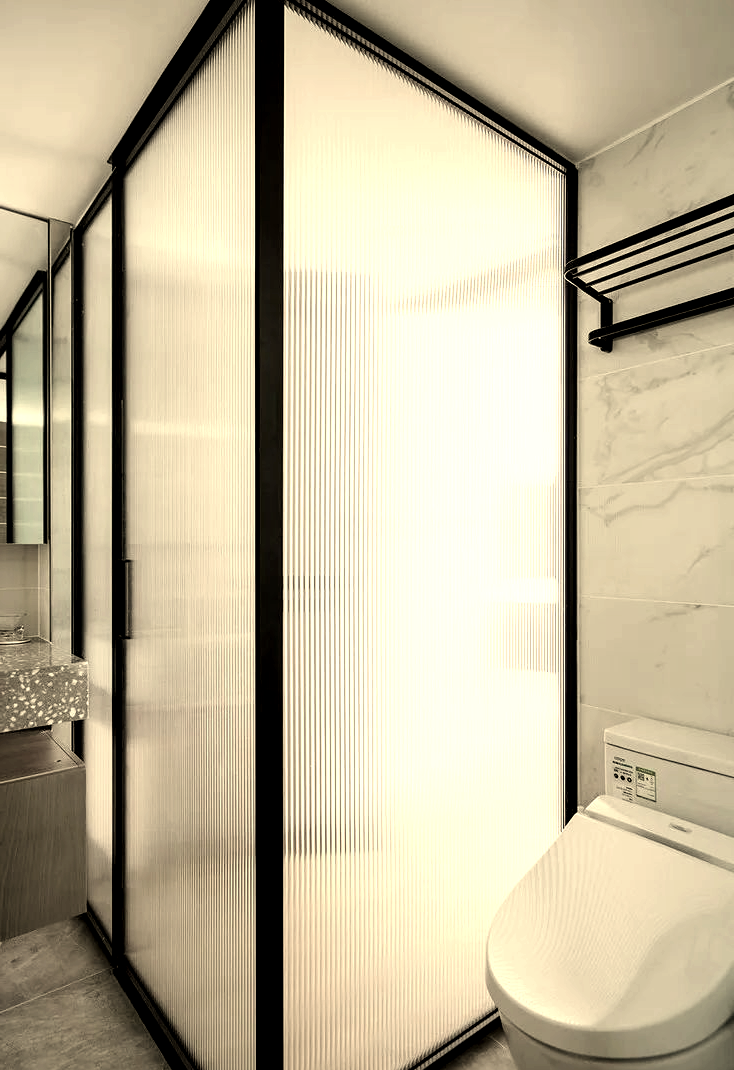
Reeded glass gives visual privacy, not opacity — it breaks up the outline behind the panel rather than hiding it. Privacy increases with rib density, with tinted glass, and markedly when the reeded face is combined with an acid-etched finish.
Texture
Rib pitch and crown radius set the scale of the ripple. A fine pitch reads almost as satin from across a room; a wider pitch gives a more pronounced, wave-like surface.
Visual Effect
Because the ribs run edge to edge, a reeded panel reads as a single continuous surface rather than a pattern of stripes — which is what allows it to sit quietly next to bold tile or stone.
Specifying notes.
- Direction. Vertical ribs are standard; horizontal ribs can be produced on request and are worth considering on wide walk-in panels. Direction is stated on the drawing.
- Face placement. On single-sided reeded glass the texture is normally placed on the outer (dry) face for easier cleaning. Confirm per configuration.
- Adjacent materials. Reeded glass competes least with matte and honed finishes, and can look busy against strongly veined stone. Worth reviewing both together before specifying.
- Easy-clean coating.
Reeded Glass Pattern Collection
The RD series is defined by rib pitch and crown profile. Each ID corresponds to a drawing, so a specification refers to a physical geometry rather than to a word whose meaning shifts between suppliers.
RD-01 Fine Reeded
A fine pitch with a small crown radius. Reads as a satin sheen across the room and only resolves into individual ribs up close. The choice where the texture should be felt rather than seen.
RD-02 Classic Reeded
Medium-pitch rounded ribs in the proportion most people picture as reeded glass. Balanced privacy and light transmission, and the sensible starting point for a hospitality or apartment specification.
RD-03 Wide Reeded
Broader ribs with a larger crown radius, producing a pronounced wave and stronger movement across the panel. Used where the enclosure is intended to carry the bathroom visually.
RD-04 Reeded & Etched
Reeded geometry combined with an acid-etched surface on the opposite face. Keeps the ripple while lifting privacy to a level suited to shared bathrooms, spa areas and family enclosures.
Custom rib profiles can be developed for OEM programmes. Matching an existing panel starts from a physical sample or a profile drawing; send either and we will identify the closest pattern ID or develop a new one. Discuss a custom pattern →
Glass Options & Tints
Reeded texture can be produced on the following glass types. Colour selection affects light transmission, the depth of the ripple and the perceived privacy level.
Clear
Standard float glass with the reeded profile. The neutral base for most shower enclosure ranges and the brightest option.
Low-Iron
Reduced iron content for higher clarity and a cleaner edge colour, which keeps the ripple crisp on frameless panels with a visible edge.
Grey
A neutral tint that lowers transmission and deepens the shadow within the ribs. Widely used in hotel bathroom schemes.
Bronze
A warmer tint that suits brass, timber and stone schemes. Pairs well with RD-03 wide reeded, where the larger crown carries the colour.
Custom Tint
Other tinted and coloured options can be discussed against your target colour and transmission level. Enquire about a custom tint →
Thickness, Size & Panel Handling
Reeded shower glass is supplied in 6 mm, 8 mm, 10 mm and 12 mm thicknesses.
Thickness is not a free choice. It depends on panel dimensions, whether the panel is fixed or forms part of a moving door, the support method, the hardware specified, and the safety-glazing requirements of the destination market. Not every thickness suits every configuration, and we confirm the appropriate thickness against your drawings and target market rather than leaving it to be resolved on site.
Two points are specific to reeded panels. First, the rib geometry is formed on one face, so the panel has a defined orientation that must be carried through cutting, drilling and installation — this is marked on the drawing. Second, the ribbed face is more exposed to handling damage than a flat face, which affects packing and site handling as much as it affects production.
Panels are cut to size from your drawings. Maximum dimensions depend on thickness, handling constraints and access at the installation location, and are confirmed per project.
Processing & Fabrication
Reeded shower glass is fabricated to drawing. Available processing includes:
Cutting
Cut to size and shape from project drawings, with rib direction held to the specified axis.
Edge Polishing
Flat polished, beveled and other edge finishes. On frameless reeded panels the edge stays visible, so edge quality is part of the design rather than a detail.
Drilling
CNC-drilled holes for hinges, clamps, brackets and handles, positioned to drawing and clear of the rib geometry.
Notches
CNC notches and cut-outs for pivots, channels, stabiliser bars and wall connections.
Tempering
Supplied tempered as safety glass. Requirements for the destination market are agreed before production.See tempered shower glass.
Acid Etching
The etched finish used on RD-04, applied to the face opposite the ribs. The combination of ripple and etch is what raises privacy without resorting to full frosting.
Digital ceramic printing is also possible on reeded glass, though the rib surface limits fine detail; feasibility is confirmed against your artwork before sampling. View printed shower glass →
Enclosure Compatibility
Fluted glass is not limited to one system type. It can be specified into the following shower enclosure configurations, using the standard hardware preparation for each.
Frameless
The configuration that shows fluted glass at its best: minimal framing leaves the texture as the feature. View frameless systems →
Semi-Frameless
Perimeter framing with a frameless door, a common format for mid-market ranges. View semi-frameless →
Framed
Full-profile systems where the glass panel sits within an aluminium frame. View framed systems →
Walk-In
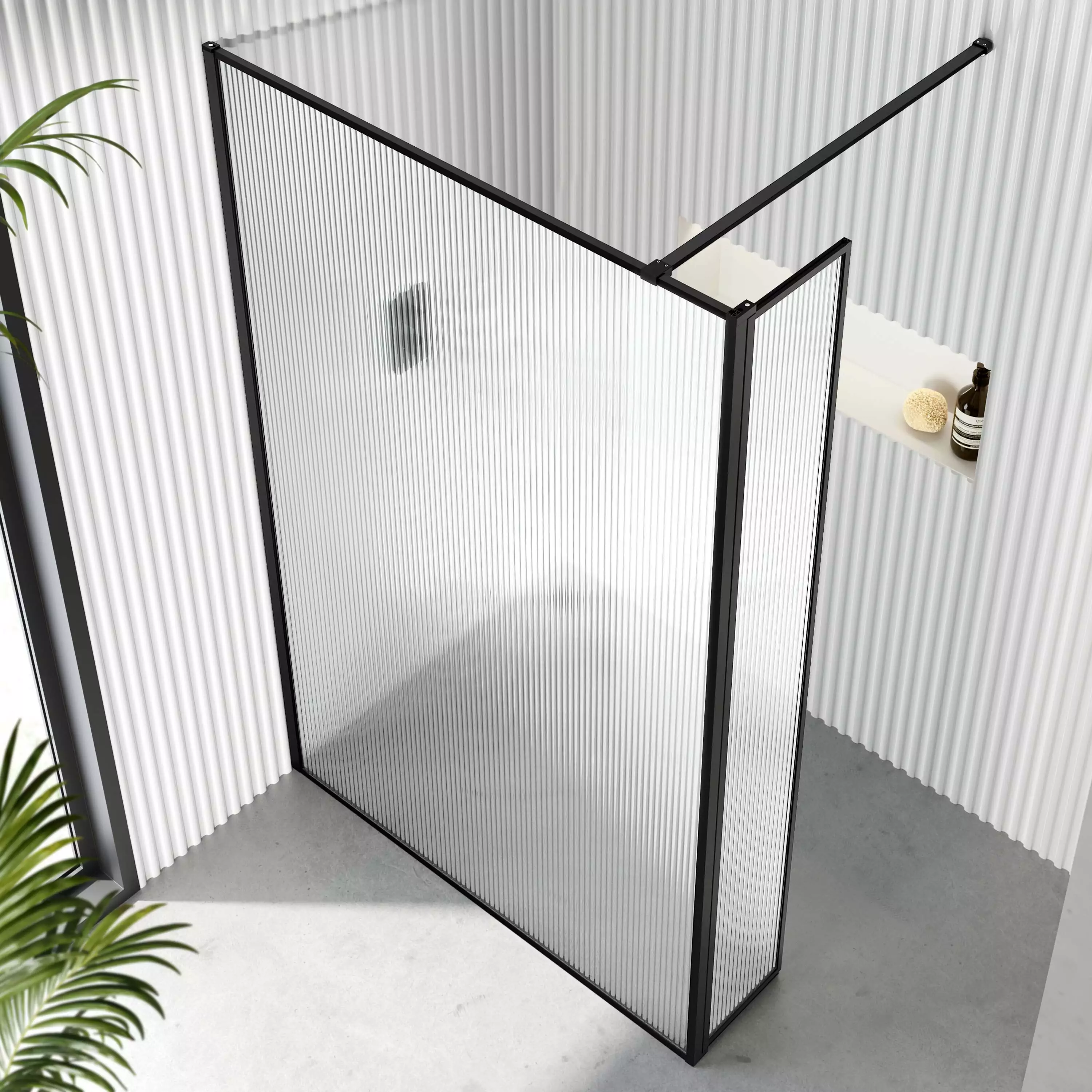
Fixed fluted panels for open, barrier-free layouts, often combined with a clear return panel. View walk-in systems →
Hinged
Swing doors prepared for hinge and handle positions to drawing. View hinged systems →
Sliding
Sliding door panels for apartments and hospitality bathrooms. Texture direction is confirmed against the sightline and handle position. View sliding systems →
Because Showerspace develops glass, aluminium profiles and stainless steel hardware together, panel preparation is matched to the profiles and fittings in your system rather than adapted afterwards.Read about the Showerspace system approach →
Hardware Pairings
Reeded glass already carries surface movement, so the general rule is to pair it with metals that do not compete: satin and low-gloss finishes flatter the ripple, while a mirror polish tends to fight it.
Reeded + Brushed Nickel
The most natural match. Satin metal against satin glass keeps the whole enclosure calm and is the safest choice for standards repeated across many hotel rooms.
Reeded + Gunmetal
A darker, slightly cooler finish that adds definition without the hard contrast of pure black. Works particularly well with grey-tinted reeded glass.
Reeded + Polished Chrome
The classic pairing for art-deco influenced schemes, where the mirror finish is meant to echo the rib highlight rather than sit quietly beside it.
View available hardware finishes →
Applications
Hotels & Hospitality
Reeded glass is specified repeatedly in hotel work because it delivers consistent privacy, stays bright, and disguises water spotting between housekeeping cycles.
Residential
Family bathrooms and en-suites where the enclosure sits close to the room and full frosting would feel closed in.
Apartments
Consistent specification across multiple units, typically sliding or walk-in formats with RD-02 as the standard pattern.
Spa & Wellness
RD-04 reeded and etched is the usual choice where privacy requirements are higher and the atmosphere matters.
Commercial
Project-specific fabrication and coordinated supply for offices, gyms, retail and changing facilities.
Technical Specifications
| Glass type | Tempered safety glass; laminated construction where the application requires it |
| Thickness | 6 mm / 8 mm / 10 mm / 12 mm — subject to panel size, configuration and market requirements |
| Size | Custom, cut to drawing; maximum dimensions confirmed per project |
| Pattern | RD-01, RD-02, RD-03, RD-04 or custom rib profile |
| Rib direction | Vertical standard; horizontal available on request |
| Glass colour | Clear, low-iron, grey, bronze, custom tint |
| Edge | Flat polish, bevel and other edge finishes |
| Holes | CNC drilled to drawing, positioned clear of the rib geometry |
| Notches | CNC processed to drawing |
| Processing | Cutting, edge polishing, drilling, notching, tempering, acid etching (RD-04), digital ceramic printing where artwork permits |
| Enclosure compatibility | Frameless, semi-frameless, framed, walk-in, hinged, sliding |
| Hardware | Aluminium profiles and stainless steel hardware, selected by configuration and finish |
| Safety glazing | Applicable requirements for the destination market agreed before production. |
| Packaging | Export packaging configured for glass panels, with protection for the ribbed face |
Request reeded glass samples →
Still Deciding Between Reeded and Fluted?
The honest answer is that both are privacy glass with a vertical grain, and the difference is in how each one handles light and how strong you want the texture to read. Reeded gives an even, satin diffusion; fluted gives a more defined shadow and a more architectural stripe.
The fastest way to settle it is to hold both. We can send sample panels from each series so you can compare them under your own bathroom lighting and alongside your actual tile and hardware finishes — which is where the decision is really made.
Compare fluted shower glass → · Request both samples → · View the full textured glass collection →
Related products
Patterned Shower Glass
Fluted Shower Glass
Reeded Shower Glass
Textured Shower Glass
Frosted Shower Glass
Etched Shower Glass
Tinted Shower Glass
Low-Iron Shower Glass
Printed Shower Glass
Back-Painted Shower Glass
Reflective Shower Glass
RelatedTechnical
Shower Glass Thickness
Tempered Shower Glass
Laminated Shower Glass
How to Choose Shower Enclosure Glass
How to Care for Shower Glass
Hardware Finishes
Request a Quote
We use your details to respond to this enquiry only.
© Jumbo Glass Group · Showerspace — decorative shower glass and custom shower enclosure systems