Home › Showerspace › Decorative Shower Glass ›Etched Shower Glass
Decorative Shower Glass
Etched Shower Glass for Privacy & Light Control
One Surface. Six Levels of Privacy.
Etched shower glass is tempered safety glass whose surface has been treated to diffuse light — by acid etching or sandblasting. From a light satin sheen to near-full obscuration, in uniform, gradient, zoned and masked-artwork formats.
What Is Etched Shower Glass?
Etching works by treating the surface of the glass so that light passing through it is scattered rather than transmitted cleanly. The glass stays fully transparent in the physical sense — it is not opaque, not coated, not filmed — but what is behind the panel is no longer legible. That is what produces privacy while still allowing the bathroom to receive light.
Because the effect is created by modifying the glass surface itself, it cannot peel, delaminate or wear off in the way an applied film or a sprayed coating can. There is also no added layer to react with shower cleaning chemicals, which is the usual failure mode for film-based privacy solutions in a wet environment.
Two processes are used, and they are not interchangeable:
- Acid etching is a chemical treatment that dissolves a thin, uniform layer of the glass surface, leaving a smooth micro-roughness. It produces a consistent satin finish, holds its appearance evenly across large panels, and is the standard choice for shower applications.
- Sandblasting abrades the surface mechanically. It produces a coarser, more porous finish and reaches higher obscuration per pass, but it is harder to hold uniform across a large panel and it is more demanding to keep clean.
Etching is carried out after cutting, drilling and edge work, and before tempering. The production sequence is fixed, and we confirm it during production planning rather than at quotation stage.
Acid-Etched or Sandblasted?
The choice is not about appearance alone — it determines how the panel behaves in daily service.
| | Acid-etched (AC) | Sandblasted (SB) |
|---|
| Process | Chemical surface treatment | Mechanical abrasion |
| Surface | Smooth micro-roughness | Coarser and more porous |
| Uniformity | Highly consistent, repeatable across large panels | Harder to hold even over large areas |
| Obscuration per pass | Built up gradually and controllably | Higher per pass |
| Fingerprints & grease | Less prone | More prone |
| Cleaning | Routine; no special products required | Needs more care; avoid abrasive pads |
| Typical use | Standard for shower enclosures, doors and screens | Deeper decorative effects where maintenance is a lower priority |
For the majority of shower applications — and for any hospitality scheme with a defined cleaning regime — acid etching is the specification we recommend. Sandblasting is available where a deeper, coarser effect is wanted and the maintenance implications are understood.
Etch Grades: From Satin to Opaque
Etch depth is the variable that sets the privacy level. Showerspace defines six orderable finishes, so a specification refers to a grade rather than to a description like “light frosted”, which means different things to different suppliers.
light opaque
ET-01 Light Satin
Softens outlines and reflections while the enclosure still reads as open glass. Specified where privacy is secondary to keeping the bathroom bright.
ET-02 Standard Frost
Obscures the outline at normal viewing distance. The default grade for shared family bathrooms and most hospitality room standards.
ET-03 Deep Etch
Approaching full obscuration, while still transmitting light. Used for accessible bathrooms, changing areas and anywhere coverage is non-negotiable.
ET-04 Gradient
Fades from clear to etched over a defined distance on the panel. Keeps sightlines open at the top while providing coverage where it is actually needed.
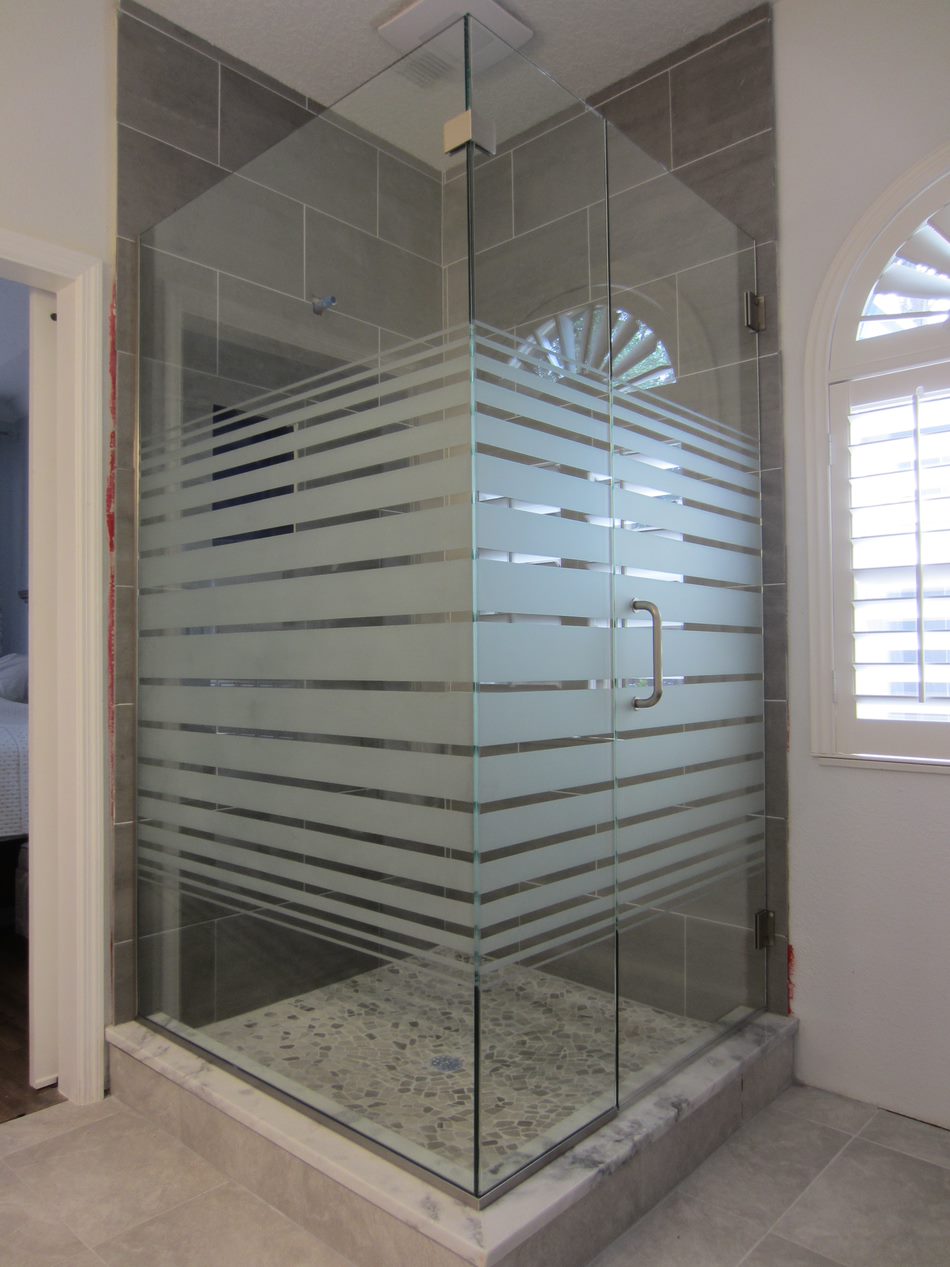
ET-05 Zoned / Banded
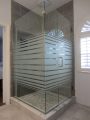
Masked bands etched at a specified height or area, with the remainder of the panel left clear. Common in hotel bathrooms and accessible facilities.
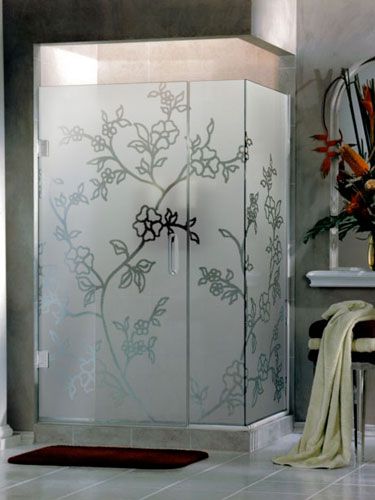
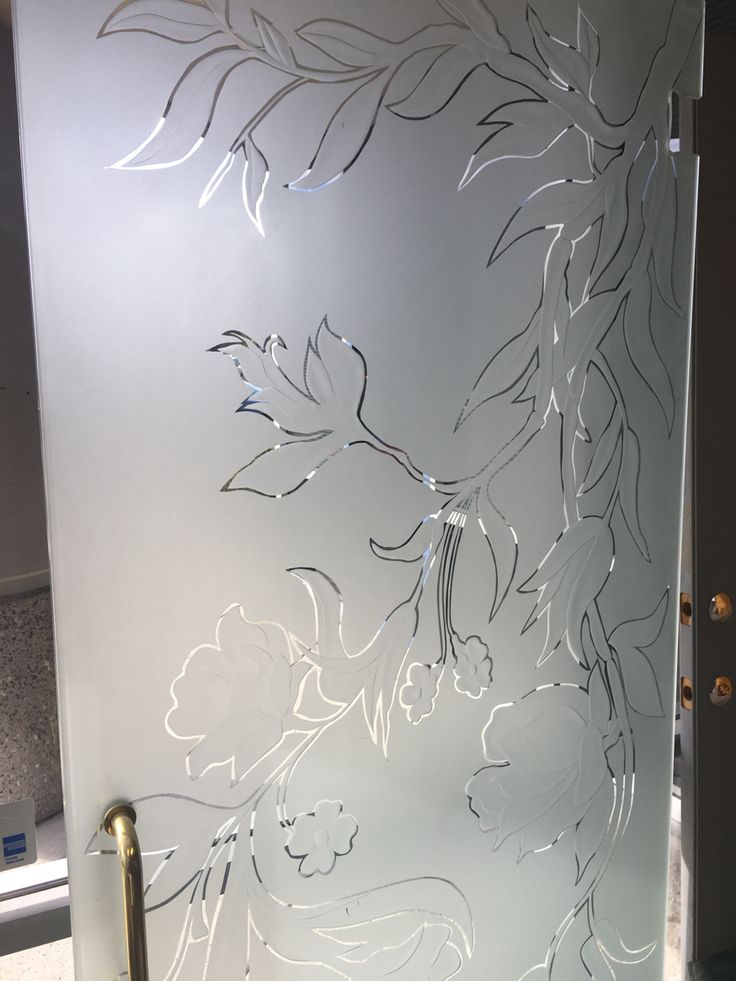
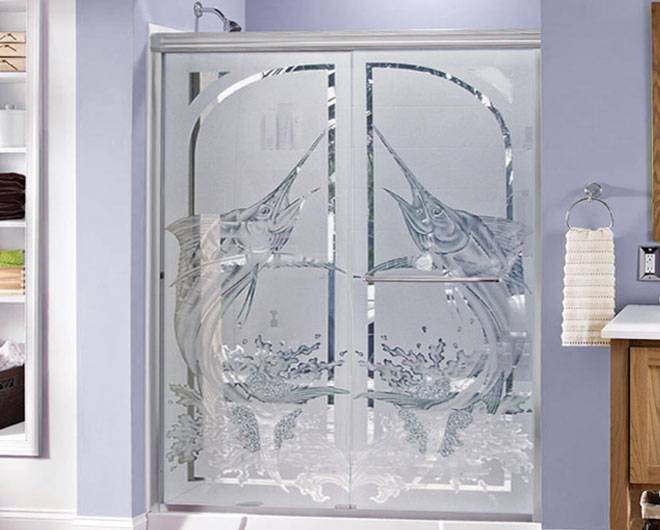
ET-06 Artwork & Logo
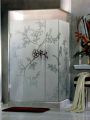
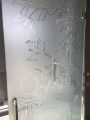
Masked graphics, patterns or branding etched into the surface as a frosted design. Produces a tonal, frosted graphic rather than a printed one.
Design Options Beyond Full Frosting
Full-panel frosting is the standard case, but most of the design value in etched glass sits in the other three formats.
Gradient Etching (ET-04)
The etch fades across the panel, from fully clear to fully etched, over a distance defined on the drawing. In practice it keeps the upper part of an enclosure visually open — so the bathroom does not feel boxed in — while providing coverage through the middle and lower zones. It is the format most often specified in hotel bathrooms where the enclosure is visible from the bedroom.
Zoned and Banded Etching (ET-05)
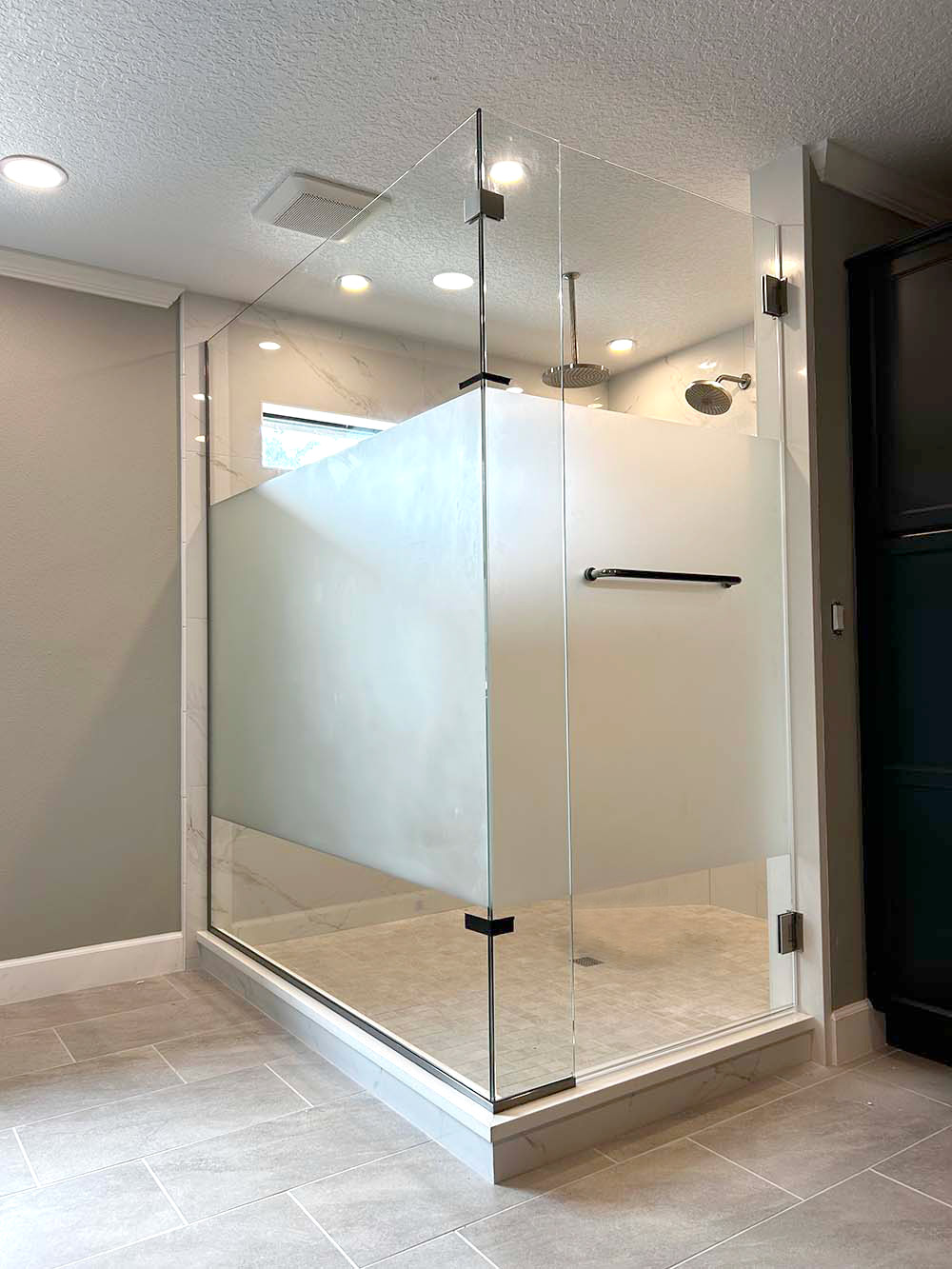
Masked areas are etched to a defined height or footprint, leaving the rest of the panel clear. This is how privacy is delivered where it is functionally required without obscuring the whole enclosure, and it is the standard approach for accessible and assisted-use bathrooms.
Artwork and Logo Etching (ET-06)
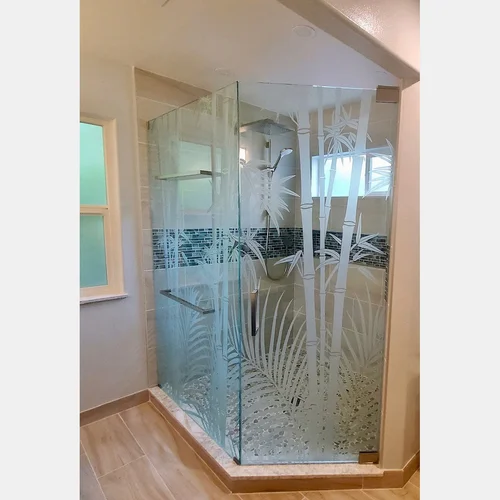
Masked designs — brand marks, repeat patterns, signage — etched into the surface. The result is a tonal, frosted graphic in the same plane as the glass, with no applied layer and nothing to degrade.
Where to use printing instead. Etched artwork is monochromatic and soft-edged by nature. If the design needs crisp edges, fine detail or colour, digital ceramic printing is the correct process — see printed shower glass. Many schemes use both: an etched field with a printed logo.
How Etching Is Developed
Grades ET-01 to ET-03 are standard — they are specified by name, and a sample confirms which one is being supplied. The three design formats above are different. ET-04, ET-05 and ET-06 are developed to a drawing, which means they run through a production sequence with a setup stage at the front of it.
That sequence is worth knowing, because it is what determines the two things buyers ask about most: the minimum quantity and the lead time.
| Stage | What happens |
|---|
| 1. Screen | A screen is made from the approved artwork — the same first step that screen printing begins with. |
| 2. Resist ink | Protective ink is screen-printed onto the glass, covering everything that is not to be etched. |
| 3. Etch | The glass is etched. Exposed areas are worked by the acid; covered areas stay clear. |
| 4. Wash off | The resist is removed, leaving the design worked into the surface. |
| 5. Temper | The panel is tempered. Like all decorative work, etching happens before this, never after. |
Why Etching and Screen Printing Share a Minimum
Both processes begin with the same thing — a screen. That screen is a fixed cost incurred before the first panel is produced, and it is what sets the threshold.
| Minimum quantity | 300 m² |
| Cycle | 20–30 days in total, covering screen, sampling and production |
| Cost behaviour | The screen is a fixed cost, so unit cost falls as quantity rises |
This is a structural similarity rather than a coincidence. Etching is a chemical process and printing is a printing process, but both are gated on the same setup step — which is why they share both the threshold and the way cost behaves. Where a project is comparing the two, the minimum is not the deciding factor; the design is.
The consequence that catches people out. Artwork is signed off, and then the screen is made. So a change requested after approval does not adjust a file — it restarts the sequence, and the cycle moves out by a day for every day the revision takes. This is the most common cause of delay in an etched order, and it is entirely avoidable: approve the artwork once, properly, at sampling.
Where the aim is a proprietary patterned panel rather than a proprietary graphic, the usual route is a standard rolled pattern with etched artwork on top — see custom pattern shower glass.
Light, Privacy & Maintenance: The Honest Trade-offs
Etched glass is the most effective privacy option in the range, and it is the one with the most misunderstood maintenance profile. Three points decide whether it is the right specification.
Light transmission
Etching scatters light rather than blocking it, so a bathroom stays bright even at ET-03. Transmission falls as the grade deepens; the drop is most noticeable in bathrooms that have little daylight to start with.
Privacy
Etched glass is the closest thing in the range to genuine obscuration. At ET-02 and above, the outline behind the panel is no longer legible at normal distance — which is why it replaces textured glass wherever privacy, not texture, is the brief.
Fingerprints & cleaning
Etched surfaces show skin oils more readily than clear glass, particularly in raking light and on sandblasted finishes. Acid-etched glass handles this better than sandblasted, and it is the main reason we recommend AC for shower use.
Specifying notes.
- Which face is etched. The etched face is normally placed on the outer (dry) side, so the smooth face is what soap and water contact. Confirm per configuration.
- Protective coating.
- Cleaning products. Avoid abrasive pads and aggressive descalers on etched surfaces; they are the usual cause of permanent marking. This should appear in the handover documentation for any hospitality scheme.
- Sequence is fixed. Etching happens after cutting, drilling and edge work, and before tempering. Design changes after tempering are not possible.
Glass Colour & Why Low-Iron Matters Here
Etched glass is unusual in the range because the base glass colour is more visible after treatment, not less. Standard clear float glass carries a slight green cast from its iron content, and etching tends to bring that cast forward — it is most obvious on the panel edge and in strong daylight.
For that reason, low-iron glass is recommended for etched shower panels wherever a neutral white is part of the design intent. It costs more per square metre and is worth specifying on frameless panels where the edge is visible.
Low-Iron
Recommended. Higher clarity and a near-colourless edge, so the etch reads as a clean, neutral white.
View low-iron glass →
Clear
Standard float glass. Acceptable at lighter grades, particularly on framed panels where the edge is concealed by the profile.
Grey
Etch over grey tint for a cooler, more architectural result with lower transmission.
View tinted glass →
Bronze
A warmer combination for schemes built around brass, timber and stone.
Thickness, Size & Production Sequence
Etched shower glass is supplied in 6 mm, 8 mm, 10 mm and 12 mm thicknesses.
Thickness is determined by the application rather than chosen freely. It depends on panel dimensions, whether the panel is fixed or forms part of a moving door, the support method, the hardware specified, and the safety-glazing requirements of the destination market. We confirm the appropriate thickness against your drawings and target market rather than leaving it to be resolved on site.
One point is specific to this product and worth fixing early in the programme: etching is performed before tempering, as part of a fixed sequence — cutting, drilling and edge work, then etching, then tempering. The consequence for a buyer is that the etch design must be signed off before the glass reaches the tempering line. Approving artwork late is the most common cause of delay on etched-glass orders, and it is entirely avoidable if the sample stage is used properly.
Panels are cut to size from your drawings. Maximum dimensions depend on thickness, handling constraints and access at the installation location, and are confirmed per project.
Processing & Fabrication
Etched shower glass is fabricated to drawing and supplied tempered as safety glass.
Cutting
Cut to size and shape from project drawings, before surface treatment.
Edge Polishing
Flat polish, bevel and other edge finishes. On frameless etched panels the edge stays visible, so edge quality is part of the design.
Drilling
CNC-drilled holes for hinges, clamps, brackets and handles, positioned to drawing and clear of masked design areas.
Notches
CNC notches and cut-outs for pivots, channels, stabiliser bars and wall connections.
Etching & Masking
Acid etching or sandblasting, uniform or masked to drawing for gradient, zoned and artwork formats.
Tempering
Supplied tempered as safety glass. Requirements for the destination market are agreed before production.See tempered shower glass.
Etching can also be combined with a textured surface on the opposite face — reeded or fluted relief outside, etched privacy inside. See reeded & etched →
Enclosure Compatibility
Etched glass can be specified into the following configurations, using the standard hardware preparation for each.
Frameless
The configuration that shows fluted glass at its best: minimal framing leaves the texture as the feature. View frameless systems →
Semi-Frameless
Perimeter framing with a frameless door, a common format for mid-market ranges. View semi-frameless →
Framed
Full-profile systems where the glass panel sits within an aluminium frame. View framed systems →
Walk-In
Fixed fluted panels for open, barrier-free layouts, often combined with a clear return panel. View walk-in systems →
Hinged
Swing doors prepared for hinge and handle positions to drawing. View hinged systems →
Sliding
Sliding door panels for apartments and hospitality bathrooms. Texture direction is confirmed against the sightline and handle position. View sliding systems →
Because Showerspace develops glass, aluminium profiles and stainless steel hardware together, panel preparation is matched to the profiles and fittings in your system rather than adapted afterwards. Read about the Showerspace system approach →
Hardware Pairings
Etched surfaces are matte by definition, which gives more freedom with metal finishes than a textured panel would.
Etched + Polished Chrome
The most common pairing. Mirror-bright hardware is the only element that will read as reflective, so it provides the contrast the panel itself cannot.
Etched + Brushed Nickel
A quieter, tonal combination — satin on satin. The safest choice for hotel standards repeated across many rooms.
Etched + Matte Black
Strong, contemporary contrast that works particularly well with gradient etching, where the black frame reads against both the clear and the etched zone.
View available hardware finishes →
Applications
Hotels & Hospitality
Gradient and zoned etching for room standards, with artwork etching for signature suites and spa entries.
Residential
Shared family bathrooms and en-suites where privacy is the brief rather than texture.
Apartments
Repeatable privacy specification across multiple units, typically sliding or walk-in formats.
Spa & Wellness
Deep etch and zoned formats for changing areas, treatment rooms and wet zones.
Commercial
Project-specific fabrication, including branded artwork etching for offices, gyms and retail.
Technical Specifications
| Glass type | Tempered safety glass; laminated construction where the application requires it |
| Thickness | 6 mm / 8 mm / 10 mm / 12 mm — subject to panel size, configuration and market requirements |
| Size | Custom, cut to drawing; maximum dimensions confirmed per project |
| Process | AC acid-etched (standard) · SB sandblasted (on request) |
| Grade / format | ET-01 to ET-06, as listed above |
| Standard or developed | ET-01 to ET-03 are standard, specified by name. ET-04 to ET-06 are developed to the customer's drawing |
| Development sequence | Screen → resist ink → etch → wash off → temper |
| Minimum (developed formats) | 300 m² — shared with screen printing, because both begin with a screen |
| Cycle (developed formats) | 20–30 days in total, covering screen, sampling and production |
| Glass colour | Low-iron (recommended), clear, grey, bronze, custom tint |
| Edge | Flat polish, bevel and other edge finishes |
| Holes | CNC drilled to drawing, clear of masked design areas |
| Notches | CNC processed to drawing |
| Processing sequence | Cutting → drilling and notching → edge work → etching → tempering |
| Combinations | Etch on the opposite face to reeded or fluted relief; etch field with printed logo |
| Enclosure compatibility | Frameless, semi-frameless, framed, walk-in, hinged, sliding |
| Hardware | Aluminium profiles and stainless steel hardware, selected by configuration and finish |
| Safety glazing | Applicable requirements for the destination market agreed before production. [[CONFIRM: which standards can be supported and for which markets — replace with verified wording or delete]] |
| Packaging | Export packaging configured for glass panels, with protection for the etched face |
Request etched glass samples →
Etched or Frosted: Which Term Do You Need?
The two words overlap, and the distinction is practical rather than semantic. “Frosted” describes how the glass looks — the satin-to-opaque appearance family. “Etched” describes how that appearance is produced, and it is the term used when the finish is being specified: which process, which grade, which format.
If you are choosing by appearance and room type, the frosted shower glass page is the faster route. If you already know you need a gradient, a zoned band or a masked logo, you are in the right place.
Where the brief is genuinely about privacy level rather than surface character, etched glass will outperform textured glass every time — the trade-off is that it gives you less visual texture. Compare textured shower glass → · Back to decorative shower glass →
Related products
Patterned Shower Glass
Fluted Shower Glass
Reeded Shower Glass
Textured Shower Glass
Frosted Shower Glass
Etched Shower Glass
Tinted Shower Glass
Low-Iron Shower Glass
Printed Shower Glass
Back-Painted Shower Glass
Reflective Shower Glass
RelatedTechnical
Shower Glass Thickness
Tempered Shower Glass
Laminated Shower Glass
How to Choose Shower Enclosure Glass
How to Care for Shower Glass
Hardware Finishes
Request a Quote
We use your details to respond to this enquiry only. .
Approve the Grade Before It Reaches the Line
Etch depth is hard to judge from a photograph, and because etching happens before tempering, the grade needs to be signed off at sample stage. We can send panels at two or three grades so you can compare privacy under your own bathroom lighting and confirm the level before production.
Request Grade SamplesDiscuss Your Project
© Jumbo Glass Group · Showerspace — decorative shower glass and custom shower enclosure systems