Home › Showerspace › Shower Enclosure Systems › Hardware
Shower Enclosure Systems
Shower Door & Enclosure Hardware — Hinges, Clamps, Rollers and Handles
Fittings carry the glass, and glass cannot be drilled after tempering. That is the whole discipline.
Hardware is the part a user touches every day, and the part that decides what the glass has to be drilled for. Those two facts make it the most consequential set of components in an enclosure — and the ones where a late decision costs the most, because a change of fitting after the glass is made means a new panel rather than a new part.
Why the Drawing Has to Be FinalThe Fitting Types
What Hardware Does
Four jobs, and only one of them is visible.
Carries the glass
On a frameless door, the hinges take the full weight of the panel and pass it into the wall or the adjacent panel. Nothing else is holding it up.
Decides what the glass is drilled for
Each fitting has a hole pattern. The pattern is machined into the glass before tempering, so the fitting choice is a glass specification, not an accessory choice.Those are cut into the panel before it is tempered, because tempered
glass cannot be drilled, notched or re-cut afterwards. Attempting it breaks the panel. The rule, and the production sequence it imposes, are set out on the tempered shower glass page.
Moves, and wears
Hinges and rollers are the only moving parts in an enclosure. They are working in a wet, soapy environment, and they are the parts most likely to need attention first.
Is what the hand touches
A handle is felt every single day. It is also the fitting most likely to be chosen for appearance and regretted for ergonomics.
The finish these parts come in — matte black, brushed brass, brushed nickel, gunmetal, polished chrome — is covered separately on the hardware finishes page. This page is about what the fittings do.
The Fitting Types
Six families cover essentially every shower enclosure. Most units use three or four of them at once.
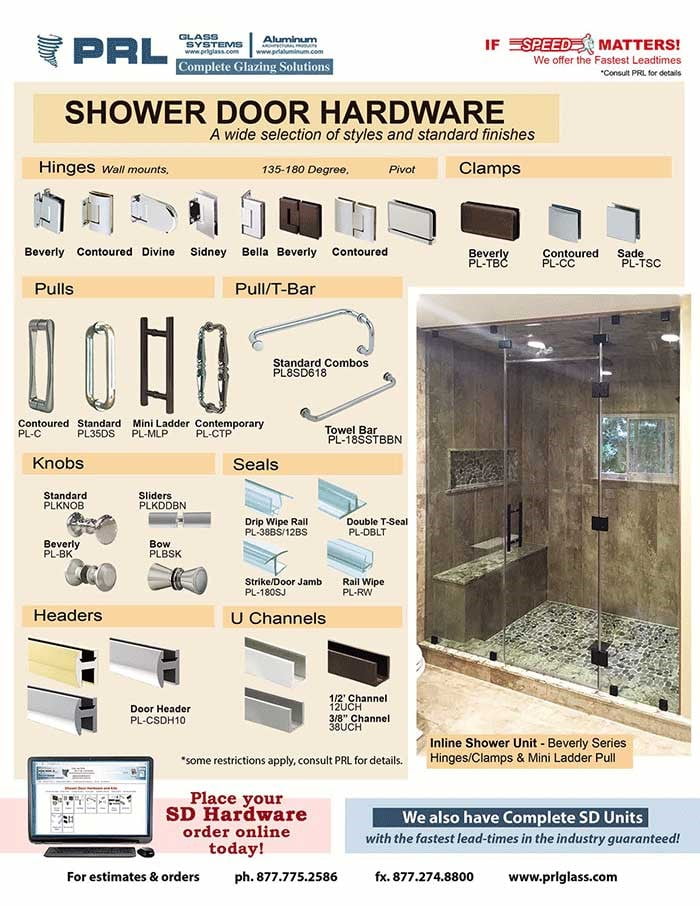
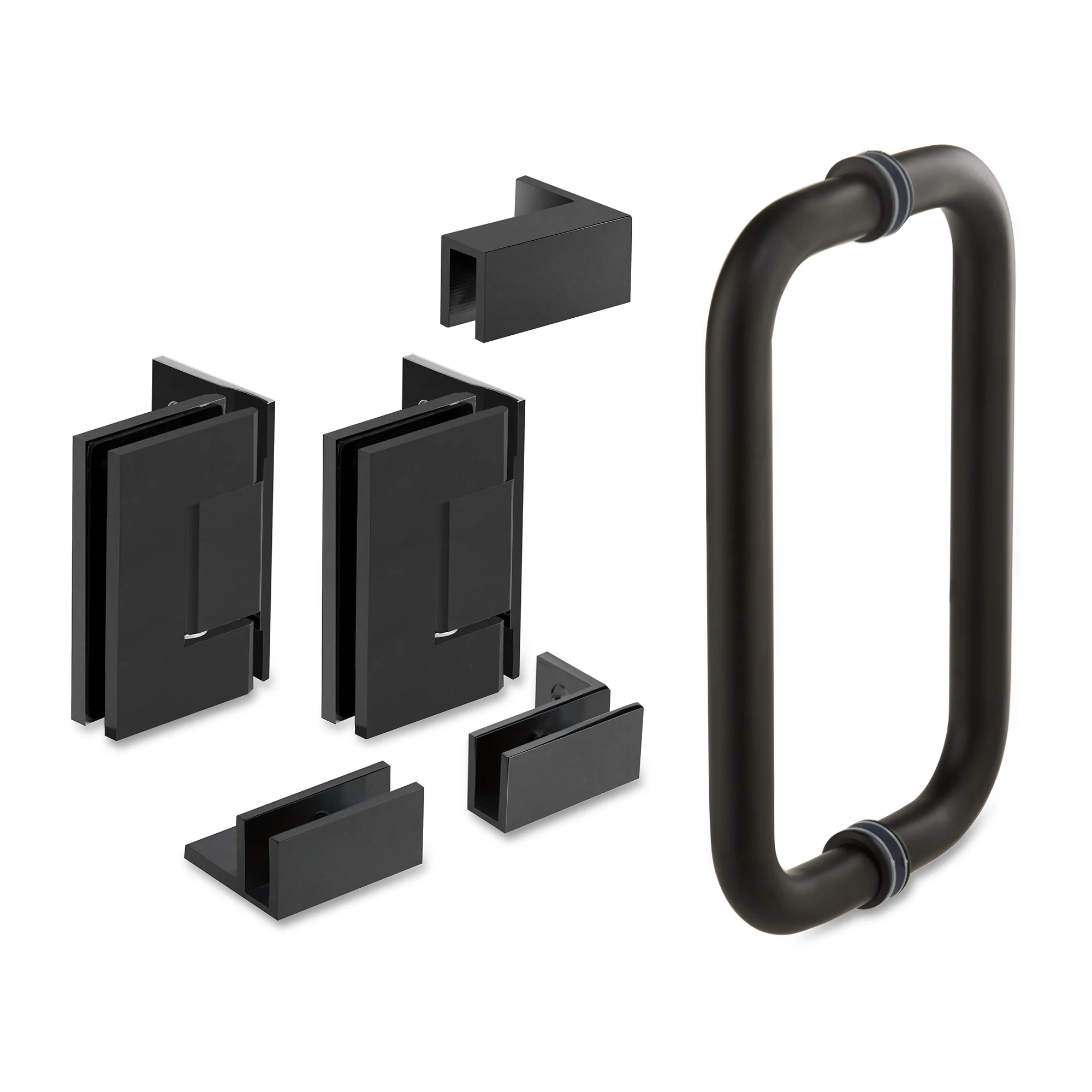
Hinges and pivots
Glass-to-glass or glass-to-wall. The fitting that carries a moving panel, and the one whose hole pattern matters most. A pivot places the rotation point inboard of the panel edge rather than on it — the difference is described on the hinged page.
Clamps and brackets
What holds a frameless fixed panel without a frame. Position and quantity follow panel size and weight, and the clamp is the reason a frameless panel can stand at all.
Rollers and tracks
The moving parts of a sliding system, and the components with the most defined service life. Roller size and rating follow the weight of the door leaf they carry.
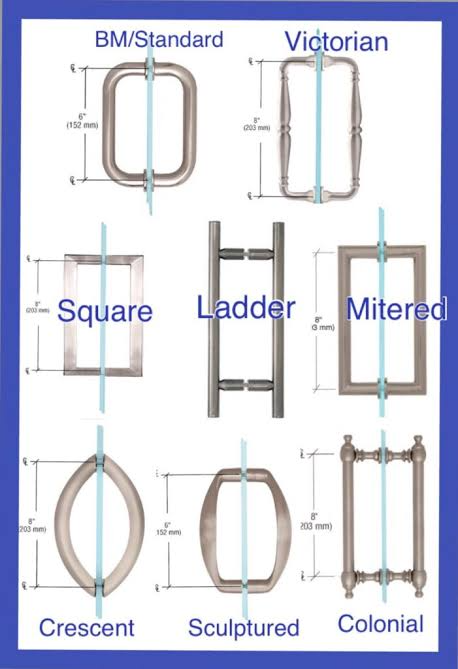
Handles, knobs and bars
Small parts that carry the finish, and the ones a user judges daily. A handle in a metal that does not match the hinge is the most common visible mismatch in a multi-supplier enclosure.
Stabiliser bars
What stops a tall frameless panel flexing at its free corner. Frequently removed as visually unnecessary, and frequently missed afterwards.
Seals and closures
Not strictly hardware, but they live on it — magnetic door closures, fin seals and wiper strips. The parts that wear out first and cost the least to specify correctly.
Two of these six carry more of the search and more of the specification risk than the rest. They are set out in detail below — shower door hinges and shower door rollers.
Shower Door Hinges
The hinge carries the full weight of a moving glass panel and passes it into whatever is behind it. Nothing else is holding the door up, which is why hinge selection is a structural decision rather than a finishing one.
Three Ways a Hinge Can Fix
Glass-to-glass
The hinge fixes to a moving panel on one side and a fixed panel on the other. Common in frameless corner units, where the fixed panel becomes part of the structure.
Glass-to-wall
The hinge fixes to a moving panel and directly into the wall. Simpler in principle, and entirely dependent on what the wall is made of — see below.
Pivot
The rotation point sits inboard of the panel edge rather than on it. Less outward swing, slightly narrower clear opening, and the mechanism is fixed top and bottom rather than at the edge. Set out on the hinged page.
What Decides the Hinge Specification
| Panel weight and height | Determines how many hinges, and their rating. A tall heavy door is not carried by two hinges simply because two is what a standard door uses. |
| Hole pattern | Diameter, position and edge distance — machined before tempering and unchangeable afterwards. See why the drawing has to be final. |
| Swing direction | Outward or inward, fixed at specification. Once installed it cannot be reversed, and what the door would hit is a drawing-stage question. |
| Wall substrate | A glass-to-wall hinge is only as good as what is behind the plaster. Fixing into masonry, into studwork or into tile are different jobs. |
| Glass thickness | Follows the configuration. Frameless 10/12 mm · semi-frameless 8/10 mm · framed 6/8 mm.
|
Two points that cost nothing to get right and a great deal to get wrong. First, outward swing is the default for a reason that is not stylistic — if someone collapses inside, an outward-opening door can still be pushed clear from within, while an inward-opening one is blocked by the person behind it. Second, hinge count is a calculation, not a convention: it follows the panel, and a door that has begun to drop has usually been under-hinged rather than badly made.
Shower Door Rollers
A sliding door leaf does not rest on its track — it hangs from two or three rollers. That is the whole arrangement, and it has three consequences that are worth understanding before specifying one.
The Whole Weight Is on the Rollers
A 10 mm frameless sliding panel is a heavy object, and all of it is transferred through the roller assemblies into the track. There is no second load path and no frame sharing the work.
This is why roller rating has to be checked against the actual panel weight at quotation rather than discovered in use. Panel area and thickness together determine that weight — not thickness alone.
Two Track Arrangements
Top-hung
The leaf hangs from rollers running in a top track. The floor below is clear, which matters for level-access and accessible bathrooms, and the top track carries the full load.
Bottom-rolling
Rollers run on a bottom track, with guidance above. The floor track becomes a cleaning item and a trip consideration, and it is what collects soap and hair.
Rollers Wear — Plan for It
Rollers work several thousand cycles in a wet, soapy environment. They will not last as long as a hinge, and that is not a defect — it is what makes a sliding door possible.
The question worth asking is not how long they will last. It is whether they can be replaced without dismantling the whole enclosure — some systems let the panel be lifted free and the roller reached directly; others require the track to come off, which in a finished bathroom may mean removing the unit. That is fixed when the system is chosen. See service life and replacement access.
- Wear gives warning. Catching, noise, or a door that no longer runs true are roller symptoms, and they appear well before anything fails.
- The track is a maintenance item. It needs cleaning, and a track a cloth cannot reach will not get cleaned.
Where there is no wall run for a sliding panel to travel along, the answer is usually a different door rather than a different roller — see bifold.
Why the Drawing Has to Be Final First
This is the single most expensive thing to get wrong in an enclosure order, and it is entirely avoidable.
Tempering is the last major step in processing glass, and it is irreversible. Once a panel has been through the furnace it cannot be drilled, cut, notched or re-worked in any way. That rule is set out on the tempered shower
glass page, along with the production sequence it imposes.Every hole, cut-out and shaped corner has to be machined beforehand.
So the hinge selection and the glass drawing are locked together:
| What is fixed before tempering | Why it cannot change afterwards |
|---|
| Hole diameter | Set by the fitting's bolt or bush. A different hinge may need a different diameter, which cannot be opened up in tempered glass. |
| Hole position | Set by the fitting's backplate. There is no adjustment once the hole exists. |
| Edge distance | The distance from hole centre to glass edge. Too small and the edge is weak; too large and the fitting will not seat. It is a structural dimension, not a cosmetic one. |
| Cut-out shape | Notches and shaped corners for clamps or pivots. Machined before tempering like everything else.
|
What this means commercially. A change of hinge after the glass has been made is not a parts change — it is a new panel, and one that has already passed through the most expensive stage of the process. There is one useful exception worth planning for: where a long programme may change fitting supplier partway through, say so at the start. Known in advance, hole patterns can sometimes be made compatible across more than one fitting.
Rated Load: The Question to Ask, and When
Fittings carry real weight. A 10 mm frameless door panel is a heavy object, and in a sliding system the whole leaf hangs on two or three rollers rather than sitting on a track.
Load ratings are not published on this page, because they differ by fitting and by manufacturer. What matters more than a number is when the question gets asked.
What determines the load
Panel area and thickness together, not thickness alone. A tall wide 10 mm panel is heavier than a small 12 mm one.
Where the weight goes
On a hinged door, through the hinges into the wall or the adjacent panel. On a sliding door, onto the rollers. On a fixed panel, onto the clamps and the channel.
Why frameless is harder on fittings
With no frame, there is no secondary load path. The fittings are the structure, which is why frameless uses 10 or 12 mm glass rather than because thinner glass is unavailable.
When to ask
At quotation, not at installation. Panel size and thickness are what the check is made against, which is why the form below asks for both.
The honest position. We do not publish a single load figure for all fittings, because no such figure exists. What we do is check the rated load of the fitting supplied against the actual panel weight for the project — and we would rather be asked that question at quotation stage than have it discovered on site.One construction note: a laminated build-up weighs more than a monolithic pane of the same nominal thickness, so it changes the number this check is made against — see laminated shower glass.
Service Life and Replacement Access
Hinges and rollers are the only moving parts in an enclosure, and they work in the least friendly environment in a building — wet, soapy, and used daily.
Rollers wear out. This is not a defect; it is the trade-off that makes a sliding door possible. A hinge is a static component and can be expected to outlast one that rolls several thousand times in a wet environment.
The question worth asking is not “how long will they last”. It is:
Can the roller be replaced without dismantling the whole enclosure?
Some systems let the panel be lifted free and the roller reached directly. Others require the track to come off, which in a finished bathroom may mean removing the enclosure. This is decided when the system is specified — and it cannot be changed later, any more than the hole pattern can.
Three further points that only appear after handover:
- Wear gives warning. Catching, noise, or a door that no longer runs true are roller symptoms. They appear long before anything fails.
- Hinge tension can need adjustment on a heavy door over time, particularly one that is opened from the same point every day.
- Seals are the cheapest parts and the first to go. Specifying the right seal costs almost nothing and avoids the most common maintenance complaint.
Material and Finish
Shower hardware is stainless steel, chosen for strength and corrosion resistance in a permanently wet environment. The specific grade is confirmed for the fitting actually supplied rather than asserted here, because it differs by component and by manufacturer.
Why stainless
It is the standard material for shower fittings for a reason: it holds a finish, it takes a thread, and it resists the environment.
Finish range
Matte black, brushed brass, brushed nickel, gunmetal and polished chrome — the standard range described on the finishes page.
Profiles are a different metal
Aluminium profiles and stainless steel fittings take the same finish name differently. The effect is real and unavoidable, and it is described in full on the finishes page.
Buy the set together
Hardware sourced as one set, confirmed against one sample, from one batch, is the single most effective control on finish mismatch. Three suppliers each matching “brushed nickel” will produce three different metals.
How a Project Is Matched to Hardware
Worth being plain about how this works, because it shapes what can be promised.
Stainless steel shower fittings are produced in volume by specialist manufacturers, and the types described here are the standard ones the market offers. They cover essentially all shower work. Fittings are matched to each project from what is available, and supplied through the group's component partners.
What that means in practice:
- Selection, not manufacture. The usual case is choosing the fitting whose type, load rating and finish suit the project. The fittings described here are market types, not a proprietary range.
- What is guaranteed is the match. The commitment that matters is that the fitting's hole pattern suits the glass, its rated load suits the panel, its finish matches the profiles, and the whole assembly fits the opening.
- That commitment holds regardless of who made the fitting. It is a system responsibility rather than a manufacturing claim — and it is the part that determines whether an enclosure actually goes together on site.
Why state it. A buyer who assumes a supplier machines its own hinges will eventually ask about the alloy, the testing or the tooling, and the answer will reveal otherwise. Saying it first costs nothing, and what is genuinely on offer — glass processed in-house, fittings coordinated to match it, and the assembly made to suit the opening — is more useful than a claim of vertical integration would be.
Where Hardware Meets the Rest of the System
No fitting works alone. Four interfaces decide whether an enclosure assembles cleanly.
Hardware and glass
The hole pattern is machined into the glass before tempering. Fitting selection is therefore a glass specification — see the hinged and frameless pages.
Hardware and profiles
Fittings fix to or into the section. Fixing pattern has to suit the section's geometry, which is why hardware and profiles are chosen together rather than in sequence.
Hardware and configuration
Hinged, sliding, bifold and walk-in each use a different subset of fittings. The configuration determines the set, not the other way round.
Hardware and the wall
A glass-to-wall hinge is only as good as what is behind the wall. Fixing into a stud, a board or a tile is a different job from fixing into masonry, and worth confirming before the fitting is chosen.
Read the overview of how a shower enclosure system fits together →
Specifying Hardware: The Sequence
- Choose the configuration first. Hinged, sliding, bifold or walk-in determines which fittings are needed at all.
- Then fix the fitting types — and hold them. The hole pattern follows, and it cannot be changed after tempering.
- Check rated load against actual panel weight. Panel size plus thickness, at quotation stage.
- Ask how a roller gets replaced. The answer is fixed by the system, and it is much cheaper to ask now.
- Confirm finish across fittings and profiles together. Two metals, one sample, one batch.
Technical Specifications
| Material | Stainless steel. Grade confirmed for the fitting actually supplied |
| Fitting types | Hinges and pivots, clamps and brackets, rollers and tracks, handles, stabiliser bars, seals and closures |
| Hinge fixing | Glass-to-glass, glass-to-wall, or pivot. Count and rating follow panel weight and height, not convention |
| Hinge swing | Outward or inward, fixed at specification and not reversible after installation. Outward-opening is the default for a safety reason, not a stylistic one |
| Track arrangements | Top-hung — clear floor below, track carries the load. Bottom-rolling — floor track becomes a cleaning and trip consideration |
| Roller load | The full weight of a sliding leaf hangs on the rollers. Checked against actual panel weight at quotation |
| Hole pattern | Fixed before tempering. Diameter, position and edge distance are machined into the glass before it enters the furnace |
| Change after tempering | Not possible. A change of fitting means a new panel, not a new part |
| Rated load | Checked against actual panel weight at quotation. Not published as a single figure, because it differs by fitting |
| Service life | Rollers are the wearing parts. No cycle figures are published; the useful question is replacement access |
| Replacement access | Differs by system. Some allow the panel to be lifted free; others require the track to be removed. Decided at specification |
| Finishes | Matte black, brushed brass, brushed nickel, gunmetal, polished chrome. See hardware finishes |
| Finish matching | Aluminium profiles and stainless steel fittings take the same finish name differently. One sample, one batch |
| Sourcing | Matched to each project from the fittings available on the market, supplied through the group's component partners |
| Interfaces | Glass hole pattern, profile geometry, configuration, wall substrate |
Request hardware samples →
Request Shower Enclosure Hardware
Tell us the configuration and the panel size. The fitting set follows from the first, and the load check follows from the second.
Name
Business email
Company
Configuration
Please select…
Hinged
Sliding
Bifold
Walk-in
Framed
Semi-frameless
Frameless
Not decided — please advise
The configuration determines which fittings are needed at all.
Which fittings do you need?
Please select…
Hinges or pivots
Clamps and brackets
Rollers and tracks
Handles, knobs and bars
Stabiliser bars
A complete set
Not sure — please advise
Glass thickness
Please select…
6 mm
8 mm
10 mm
12 mm
Not decided — please advise
Needed for the load check, together with panel size.
Panel size
Area plus thickness is what determines panel weight, and weight is what the load check is made against.
Does roller replacement access matter?
Please select…
Not applicable — no sliding panels
Yes — needs to be serviceable in situ
Standard practice is fine
Not sure — please advise
Decided by the system, and cannot be changed later.
Finish required
Please select…
Matte black
Brushed brass
Brushed nickel
Gunmetal
Polished chrome
Not decided — please advise
Confirmed against one sample, across fittings and profiles together.
Quantity
Destination country
Drawing upload (optional)
PDF, DWG, DXF, SKP, JPG or PNG. An elevation with panel sizes is useful.
Project notesRequest a Quote
We use your details to respond to this enquiry only. See our privacy policy.
Fix the Fittings Before the Glass Is Made
Hole patterns are machined before tempering, and cannot be changed afterwards. Choosing the fitting early is the cheapest decision in the whole order.
Request Hardware SamplesView Hardware Finishes
© Jumbo Glass Group · Showerspace — decorative shower glass and custom shower enclosure systems