Home › Showerspace › Custom Design › Custom Shower Glass
Custom Design
Custom Shower Glass — What Can Be Developed, What Can Only Be Selected
Two of these we make to your drawing. Two of them nobody makes to order.
“Custom” covers two very different things in shower glass. Printing and etching are developed — your artwork, produced for the first time when you order it. Rolled patterns and body tints are selected from the ranges China's original glass manufacturers already make, because developing a new one requires a production campaign no shower programme can absorb. Knowing which of the two you need is the first question, and it is the one this page exists to answer.
The Capability MatrixHow the Two Work Together
The Capability Matrix
Four ways to put something of yours onto shower glass. Two are developed, two are selected, and the difference is not a matter of preference — it is set by how the glass is made.
| Capability | Developed or selected | What that means in practice |
|---|
Printing
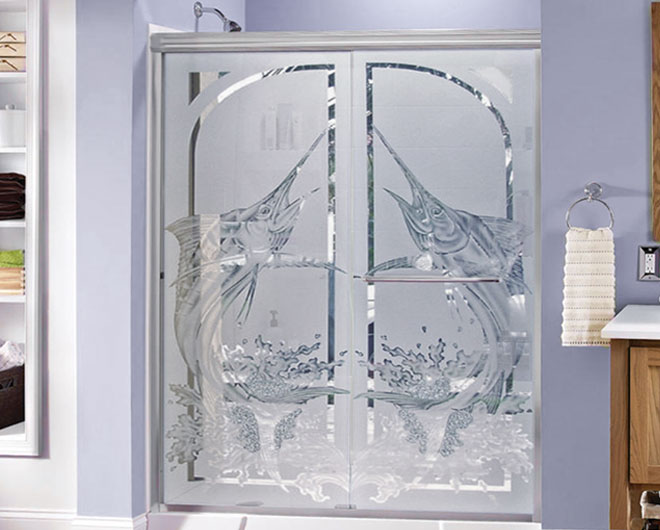
digital and screen | Developed | Your artwork, in ceramic ink, fired into the glass during tempering. Digital takes any design with no minimum; screen suits flat single colours at 300 m² and above. |
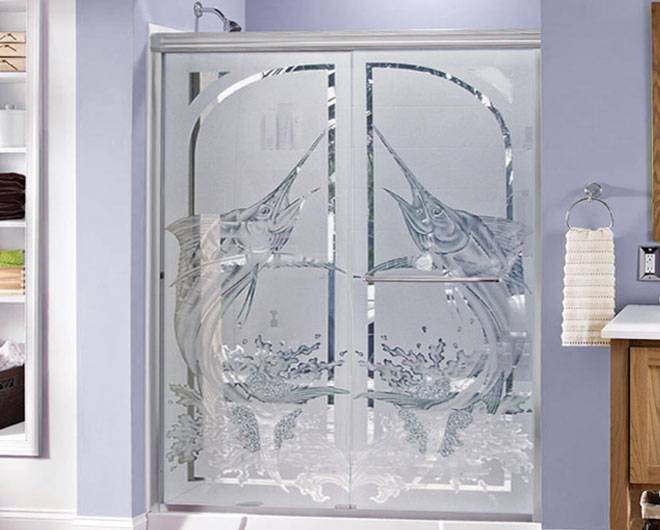
| Etching | Developed | Your design etched into the surface — a screen is made, resist ink is printed, the glass is etched, and it is then tempered. 300 m² minimum, 20–30 days in total. |
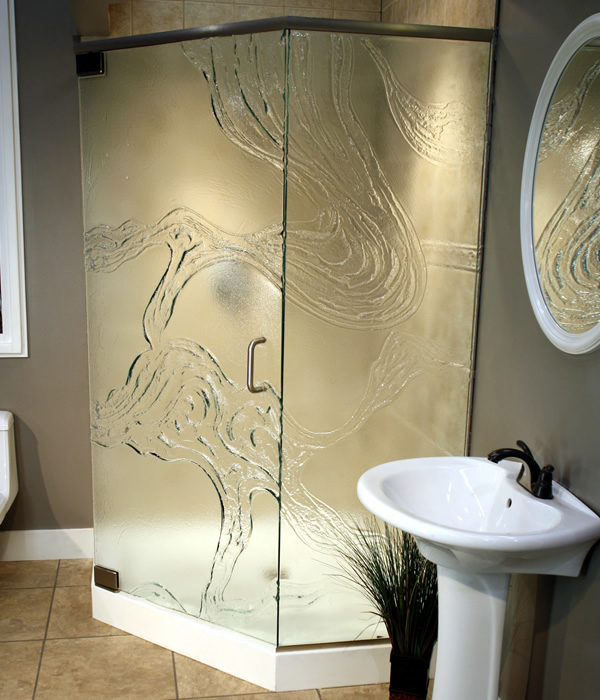
| Rolled patterns | Selected | The texture is pressed in by an engraved roller belonging to the original glass manufacturer. A new roller requires a campaign of 100,000–1,000,000 m². |
| Body tints | Selected | Colour throughout the glass, made by the original manufacturer. Four colours — grey, bronze, green, blue — each in light and deep versions.
|
Why this matters before anything else. A buyer who spends three weeks developing a new texture or a new tint will be told, eventually, that it cannot be made. Saying so at the start costs nothing and saves the whole exercise. The two things that can be developed are more flexible than most people expect — which is where the interesting work happens.
What “Cannot Be Developed” Actually Means
It is worth seeing the number, because it is not a policy or a preference.
Both rolled patterns and body tints are created at the point the glass itself is made. A new pattern needs a new engraved roller. A new tint needs the manufacturer to run a dedicated campaign. Either way, the production run has to be large enough to justify stopping the line.
| Manufacturer minimum | 100,000 – 1,000,000 m² |
| One shower panel (roughly 1.0 × 2.0 m) | about 2 m² |
| So 100,000 m² is about | 50,000 panels |
| And 1,000,000 m² is about | 500,000 panels |
A new pattern or a new tint means committing to around fifty thousand shower panels before the first one is made. No shower programme of realistic size absorbs that. Which is why the pattern is chosen and the tint is chosen — and why the two things that can be developed are the two that happen after the glass exists.
The Two That Are Developed
Printing and etching both work on glass that has already been made. That is the whole reason they can be developed, and it is why they are where originality lives.
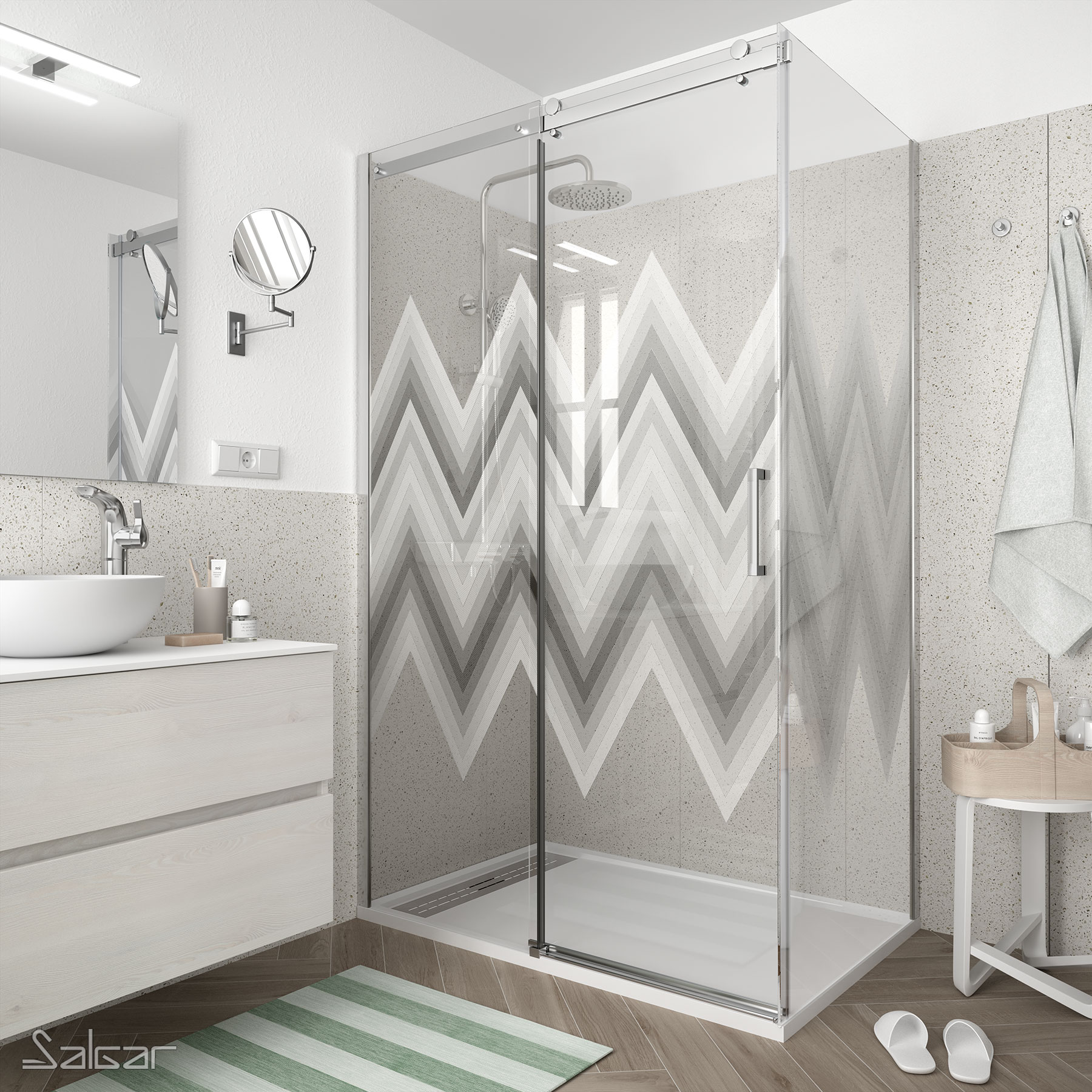
Ceramic ink applied to the glass, then fused into the surface during tempering. Handles patterns, graphics, gradients and photography — anything where colour is a design rather than a flat field.
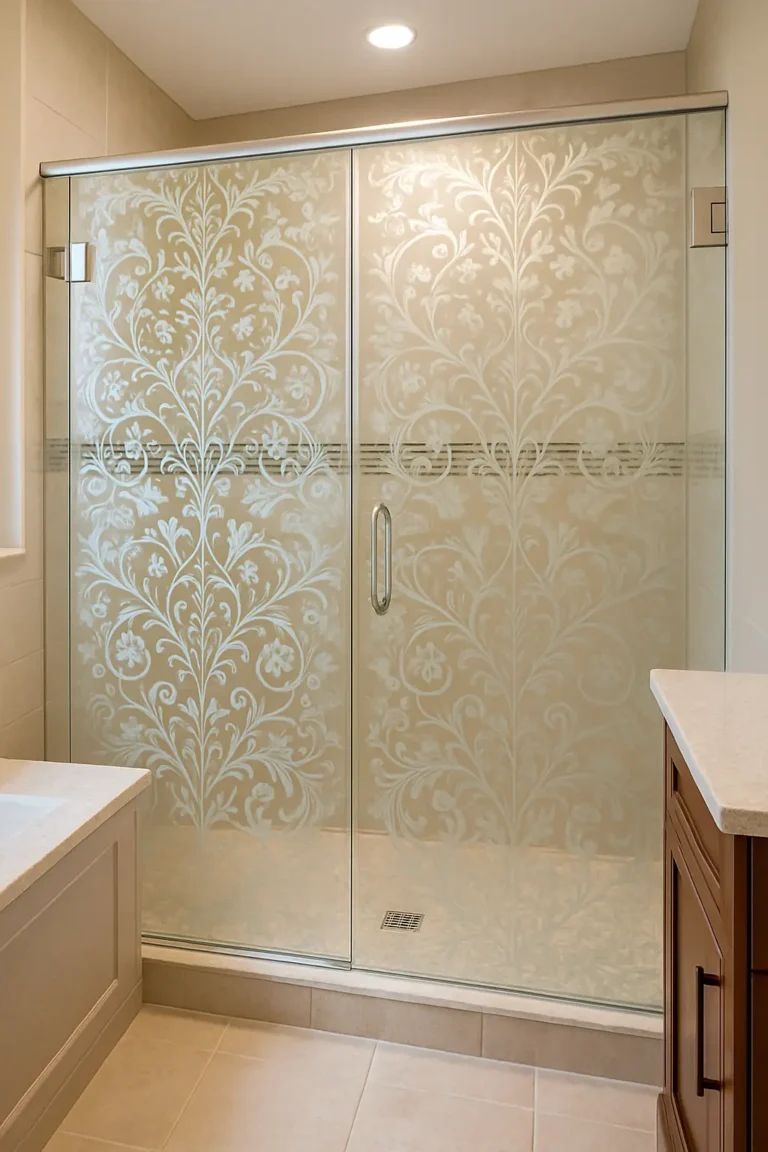
A design worked into the glass surface itself. Suited to borders, bands, single motifs and gradients — and the one option that can make a standard rolled pattern into something proprietary.
Both share a threshold
Both begin with a screen, which is a fixed cost. So both sit at 300 m², and both get cheaper per unit as quantity rises.
Both happen before tempering
Neither can be applied afterwards. The furnace is what fixes ceramic ink; tempered glass cannot be etched. This is a sequence, not a choice.
Read the full technical detail on etched shower glass →
The Two That Are Selected
Selection is not a lesser outcome — it is a different one, and it comes with an advantage worth naming: what you are selecting already exists, is already in production, and is already proven.
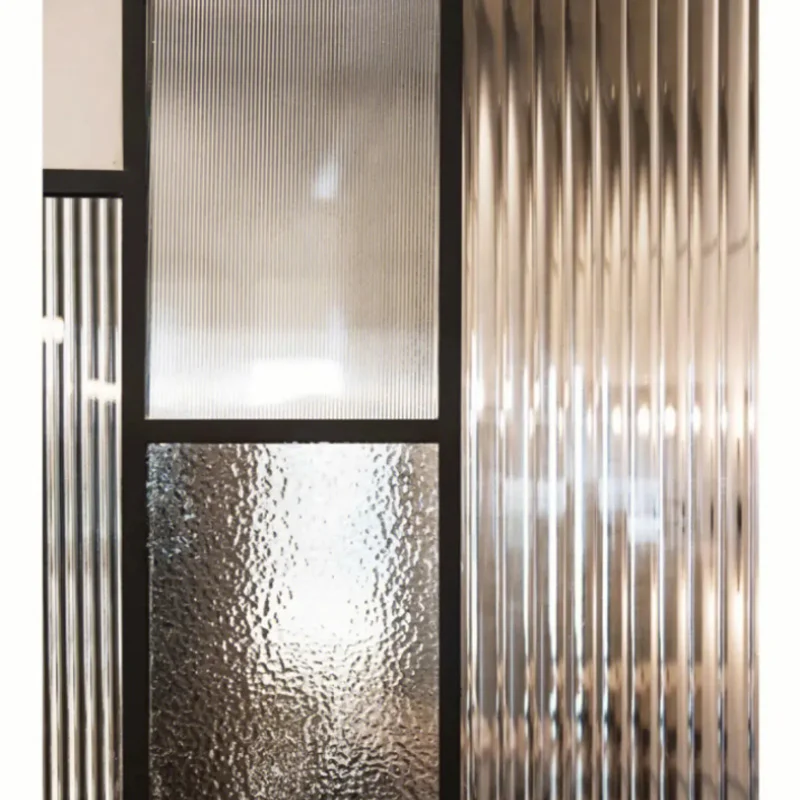
The ranges published by China's original glass manufacturers, in four families — classic textures, Chinese style, modern geometric and a premium range. Twenty-seven named patterns, and several exist in more than one version.
Four colours — grey, bronze, green and blue — each in a light and a deep version. Colour throughout the glass, so cutting and drilling do not expose a different material.
What selection buys
Availability, proven performance, and no development cycle. For a programme on a fixed timeline, choosing from what exists is often the correct decision rather than the compromised one.
What it does not buy
Exclusivity. Anyone can order the same pattern or the same tint. If the scheme needs something nobody else can supply, it has to come from printing or etching.
How the Two Work Together
The most useful thing on this page, and the answer to “we want something distinctive but we do not have fifty thousand panels to commit to”.
A selected rolled pattern gives the glass its texture and its behaviour with light. Etched artwork on top gives it something nobody else stocks. The texture underneath is in every catalogue; the finished panel is in none of them.
Pattern + etching
Choose a rolled pattern for how it handles light, then have your own artwork etched onto it. This is the route to a proprietary patterned panel at ordinary volumes.
Tint + texture
A body tint reduces contrast; a reeded or fluted surface obscures. Together they do considerably more than either alone — which is the usual answer when both colour and privacy are wanted.
Colour outside the four
Body tint cannot do it, but printing or back painting can. The route changes; the outcome is achievable.
The honest limit
Combinations add steps, and every step is a place where the sequence has to be right. What can be combined is confirmed for the specific pair, not assumed in general.
One practical warning about combinations. Each decorative process occupies a position in the sequence before tempering, and they are not freely interchangeable. Adding a second process is not simply an extra line on the order — it changes what has to be confirmed, and in what order. This is worth establishing at enquiry rather than discovering in production.
Safety Glass: A Precondition, Not an Option
This page covers all custom shower glass, decorative and otherwise. On safety, one point is worth making clearly and then leaving alone.
Shower glass is safety glass. It is not an upgrade, a specification choice, or a customisation option — it is what the product is. Every custom option on this page is applied to glass that is tempered, and the decorative work is sequenced around that rather than instead of it.
That statement has a counterpart which sounds like a contradiction and is not. Tempering is a precondition; the panel itself is made to order. Every panel is cut to the dimensions for that project, drilled to the drawing for the fittings chosen, and edged to the finish specified. The safety property is not optional. The glass underneath it is entirely bespoke.
- Requirements are confirmed for the destination market at enquiry stage, because they differ by country and by application.
- The decorative process does not replace the safety process. Printing and etching happen before tempering; the panel is tempered afterwards regardless.
- Nothing happens after the furnace. Cutting, drilling, notching, edge work and decorative processing are all completed first, because tempered glass cannot be worked afterwards. This single rule is what makes the drawing more important than the deadline — see tempered shower glass.
- Heat soak testing is available where specified. It substantially reduces the likelihood of spontaneous breakage from nickel sulphide inclusions, and it cannot be added after tempering. Detail on heat soak testing.
- Detail lives on the individual glass pages. Browse the decorative glass range for the technical specifications of each type.
The practical consequence for a custom enquiry is simple: a decorative idea is only viable if it can be produced within the processing sequence the glass requires. Most can. Establishing that early is the difference a supplier with in-house processing makes.
What a Custom Enquiry Needs
Custom work goes wrong for predictable reasons, and almost all of them are settled at the start. Four things make the difference.
- Know whether you are developing or selecting. Everything downstream depends on this, and it takes one sentence to establish.
- Have a physical reference where colour or texture matters. A description is not a specification. A sample, a RAL reference or a photograph gives production something to be measured against.
- Fix the panel size and thickness early. Artwork is laid out for the panel as delivered, and a body tint cannot be approved before its thickness is known — thickness is part of the colour.
- Sign artwork off once, properly. For printed and etched work, the screen is made from the approved artwork. A change after that restarts the cycle.
Where to Go Next
Twenty-seven rolled patterns in four families, and how etched artwork on top makes one of them yours.
Four body tints, light and deep, why thickness changes the colour, and the routes to any other shade.
Digital or screen, how to choose between them, artwork requirements, and why fired colour differs from printed colour.
Where the glass sits — frameless, semi-frameless, framed, hinged, sliding, walk-in, bifold and corner.
Five standard finishes across aluminium profiles and stainless steel fittings, and how they are matched.
The full range, including the patterns, tints and printed options available without development.
Technical Specifications
| Developed to drawing | Printing — digital and screen — and etching |
| Selected from manufacturer ranges | Rolled patterns and body tints |
| Pattern and tint development | Not available. Requires a manufacturer campaign of 100,000–1,000,000 m² — roughly 50,000 panels at minimum |
| Printed minimum | Digital: none. Screen: 300 m² |
| Etching minimum | 300 m² — shared with screen printing, because both begin with a screen |
| Etching cycle | 20–30 days in total, covering screen, sampling and production |
| Sequence | Decorative work is applied before tempering, never after |
| Safety glass | Tempered. A precondition of the product, not an option. Requirements confirmed for the destination market |
| Body tints available | Grey, bronze, green and blue — each in light and deep versions |
| Combinations | Confirmed for the specific pair, not assumed. Each process occupies a fixed position in the sequence |
| Samples | Physical samples provided — fired samples for printed work, samples at the specified thickness for tints |
Request samples →
Request Custom Shower Glass
Start with whether you are developing or selecting. That single answer routes the enquiry correctly, and it is the one we ask first.
Name
Business email
Company
Are you developing or selecting?
Please select…
Developing — printing or etching to our artwork
Selecting — a rolled pattern or a body tint
Combining a selected base with etched artwork
Not sure — please advise
This routes the enquiry, and it is the first thing we ask.
Which capability?
Please select…
Printing — digital
Printing — screen
Etching
Rolled pattern
Body tint
A combination
Not decided — please advise
Do you have a physical reference?
Please select…
Yes — a sample we can send
Yes — a RAL or colour reference
Yes — a photograph or drawing
No — describing the requirement only
A description is not a specification. A physical reference is far more useful.
Panel size
Glass thickness
Please select…
6 mm
8 mm
10 mm
12 mm
More than one thickness in this scheme
Not decided — please advise
Needed early. Artwork is laid out for the final panel size, and thickness is part of a tint's colour.
Quantity
Screen printing and etching both carry a 300 m² minimum. Digital has none.
Destination country
Safety requirements are confirmed for the destination market.
Reference or artwork upload (optional)
AI, EPS, SVG, PDF, DWG, DXF, SKP, PSD, TIFF, JPG or PNG. A photo of a reference sample is genuinely useful.
Project notesRequest a Quote
We use your details to respond to this enquiry only. See our privacy policy.
Tell Us What You Are Trying to Achieve
Not which process you think you need. The outcome you want, the quantity, and the timeline — and we will tell you whether it is a development job, a selection job, or a combination of both.
Request a QuoteRequest Samples
© Jumbo Glass Group · Showerspace — decorative shower glass and custom shower enclosure systems