Home › Showerspace › Custom Design › Custom Pattern Shower Glass
Custom Design
Custom Pattern Shower Glass — Select the Pattern, Then Make It Yours
Rolled patterns are chosen. Originality is etched.
A rolled pattern is pressed into the glass by an engraved roller, and the rollers belong to the original glass manufacturers. Their patterns can be selected; a new one cannot be developed for a shower programme. What can be developed is the etched artwork layered on top — which means the pattern you ship is a combination nobody else stocks, even though the texture underneath is one anyone can buy.
Selection or DevelopmentThe Pattern Catalogue
Two Different Things Called “Custom Pattern”
The request almost always means one of two things, and they have completely different answers. Establishing which one is being asked for is the first step, and it takes one question.
| | Selecting a rolled pattern | Developing etched artwork |
|---|
| What it is | A texture pressed into the glass during manufacture | A design etched into the surface afterwards |
| Where it comes from | The existing ranges of China's original glass manufacturers | Your drawing |
| Can it be new? | No — see the roller problem below | Yes — this is where originality lives |
| Minimum | Manufacturer's own, measured in hundreds of thousands of square metres | 300 m² |
| Exclusive to you? | No — the same pattern is in anyone's catalogue | Yes — your artwork, your screen |
| Cycle | Whatever the manufacturer's stock position allows | 20–30 days, covering screen, sampling and production
|
The combination is the answer. Choose a rolled pattern for its texture and light behaviour, then have your own artwork etched onto it. The texture is standard; the finished panel is not. This is the only route to a genuinely proprietary patterned panel at shower-programme volumes, and it is the reason this page exists.
Why a New Rolled Pattern Cannot Be Developed
This is not a question of willingness. It is arithmetic, and it is worth seeing the number.
A rolled pattern is made by engraving a design onto a round roller and pressing it into the glass as it forms. The roller is the tooling. To create a new pattern, a new roller has to be engraved, and the glass has to be run in a quantity that justifies stopping the line to fit it.
| Manufacturer minimum | 100,000 – 1,000,000 m² |
| One shower panel (roughly 1.0 × 2.0 m) | about 2 m² |
| So 100,000 m² equals | about 50,000 panels |
| And 1,000,000 m² equals | about 500,000 panels |
Developing a new rolled pattern means committing to sell fifty thousand shower panels first. No shower programme of realistic size absorbs that, which is why the pattern is selected rather than developed — and why the same conclusion holds regardless of which manufacturer is asked.
Two consequences follow from this, and both are useful to know before specifying:
- Availability follows the manufacturers' production. A pattern in regular production is straightforward; one that has been discontinued is not, however good the drawing looks.
- Sample first, always. The pattern that matches a requirement is the one that has been held up and looked at, not the one whose name sounds right.
The Pattern Catalogue
The patterns available are those in the published ranges of China's original glass manufacturers — including the ranges published by Jinjing, a company involved in drafting national industry standards for patterned glass. They group into four families.
Pattern names are product identifiers. They are given here in Chinese with pinyin and a plain-English description, because that is how they appear in the manufacturers' own catalogues and how a buyer will find them. [[CONFIRM: how many patterns can be shown to a
Classic textures
雨花 Yǔhuā — Rain Flower
Fine scattered floral marks, even across the sheet. The most widely used of the classic patterns.
水纹 Shuǐwén — Water Ripple
Flowing horizontal movement. Reads as water rather than as a drawn motif.
冰花 Bīnghuā — Ice Flower
Crystalline, angular marks. More contrast than the soft patterns.
木纹 Mùwén — Wood Grain
A linear grain that reads as timber rather than glass.
钻石 Zuànshí — Diamond
Faceted geometric marks that catch light at an angle.
布纹 Bùwén — Cloth Weave
A fine woven texture, the most understated of the classic group.
香梨 Xiānglí — Fragrance Pear
Small repeated motifs. Sits between classic and decorative.
Chinese style
海棠花 Hǎitánghuā — Crabapple Blossom
A floral motif from the classical repertoire.
龙凤 Lóngfèng — Dragon and Phoenix
The traditional paired motif. Strongly directional, and a design decision in its own right.
福字 Fúzì — Fortune Character
The character itself as the pattern. Reads as a statement rather than a texture.
珠联璧合 Zhūliánbìhé — Joined Jade Discs
Linked circular forms, from the same classical vocabulary.
金丝 Jīnsī — Gold Thread
Fine threading across the surface.
春龙 Chūnlóng — Spring Dragon
A flowing dragon motif. The largest-scale pattern in this family.
Modern geometric
七巧板 Qīqiǎobǎn — Tangram
Interlocking angular shapes. The most graphic of the geometric group.
双方格 Shuāngfānggé — Double Square
A paired grid. Orderly, and reads well at scale.
千喜格 Qiānxǐgé — Thousand Joy Grid
A finer grid, more decorative than structural.
四季虹 Sìjìhóng — Four Season Rainbow
Arc forms. The only pattern here with curves.
竹编 Zhúbiān — Bamboo Weave
A woven structure. Related to textured effects but fixed at the roller.
小灯芯纹 Xiǎodēngxīnwén — Small Lampwick
A fine vertical rib, the narrowest of the linear patterns.
Premium range
银霞 Yínxiá — Silver Cloud at Dawn
Soft, diffuse. The quietest of the premium patterns.
银珠 Yínzhū — Silver Pearl
Fine repeated beads, evenly distributed.
银河 Yínhé — Silver River
A flowing directional band. Works with the rib direction of the panel.
知音 Zhīyīn — Kindred Spirit
A refined decorative motif.
五月花 Wǔyuèhuā — Mayflower
A floral pattern at premium scale.
万元 Wànyuán — Ten Thousand
A dense repeated motif, from the traditional repertoire.
雪山岩 Xuěshānyán — Snow Mountain Rock
A stone-like surface. The most tactile of the premium group.
丝路 Sīlù — Silk Road
A flowing, directional pattern with a long repeat.
One pattern, several versions
A pattern name is not a complete specification. 雨花 Yǔhuā, for example, exists in versions distinguished as “雨花1号” and “雨花Ⅲ” — different scales or depths under the same name. The same is true across the catalogue.
So the rule when specifying is simple: name the pattern and confirm against a physical sample or the manufacturer's own model number. A drawing that says only “rain flower” is not a specification, and a panel made to a different version of the same name is a legitimate supply of an incomplete order.
What a Rolled Pattern Does to Light
Worth understanding before choosing, because it is the reason a pattern is specified at all.
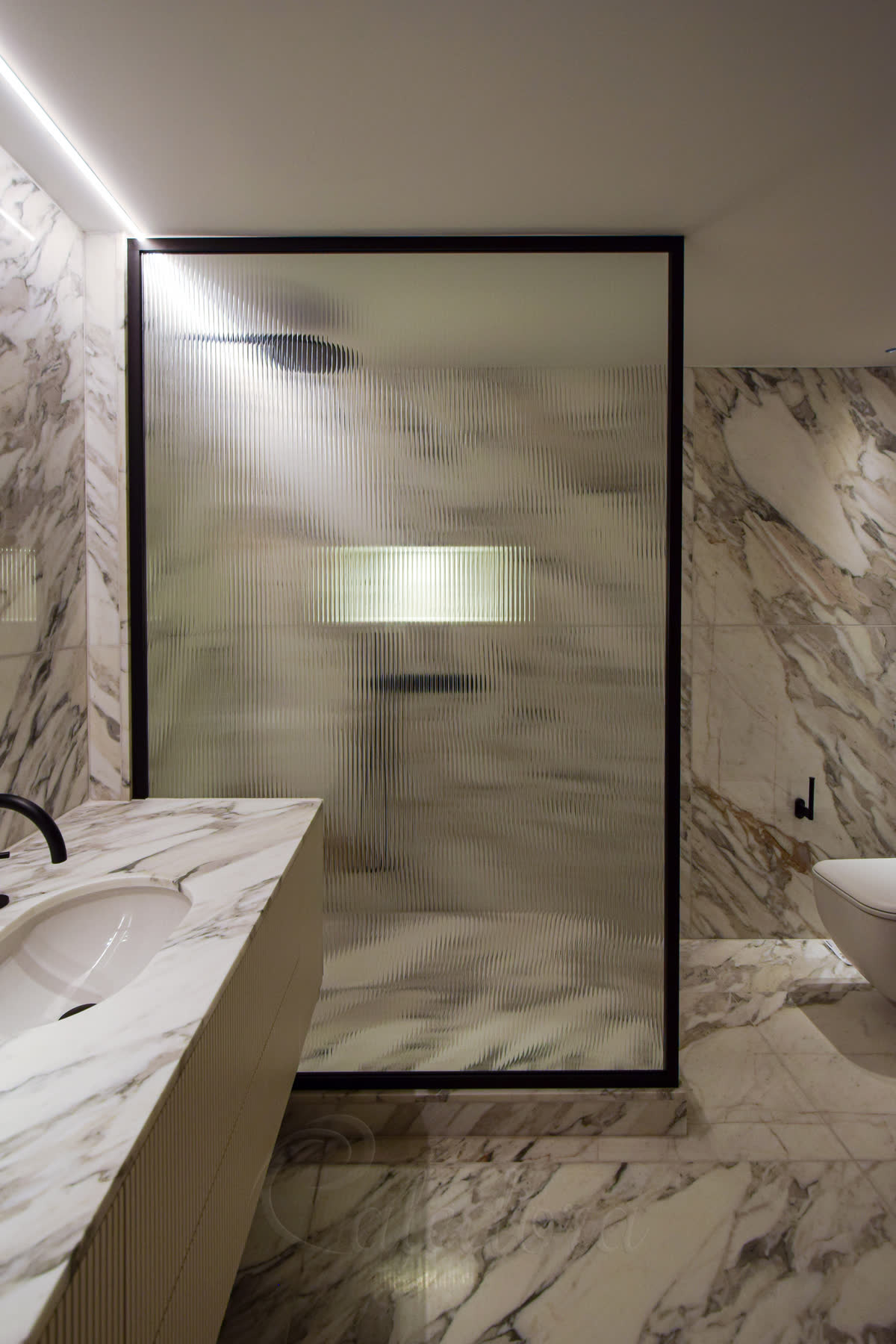
A rolled pattern transmits light without allowing a clear view through — the relief at the surface scatters what passes. The manufacturers describe the effect in the same terms: the patterned surface softens light and tempers the space, and at the right angle it also blocks the line of sight.
Softening
The relief breaks up direct light. The same fitting reads softer through a patterned panel than through clear glass.
Obscuring
How much a pattern obscures depends on its depth and scale, not only on its name. Deep, small-scale relief obscures more than shallow, large-scale.
Wet behaviour
A film of water flattens the optical effect of a shallow pattern. Deep relief holds up when wet; fine shallow patterns can lose much of their look in use.
Cleaning
Relief holds water and soap residue more than a flat surface. The deeper the relief, the more the panel asks of the cleaning routine.
These four are the trade-off. A pattern that obscures well is deeper, and a deeper pattern is harder to keep clean and holds its look better when wet. There is no pattern that wins all four, which is why the choice is made against how the bathroom is actually used rather than against a photograph.
Making It Yours: Etched Artwork on Top
The rolled pattern gives the surface its texture and its light behaviour. Etching adds the part that is yours.
Etching is a development process, not a selection. It runs in a fixed order:
| 1. Screen | A screen is made from the approved artwork |
| 2. Resist | Resist ink is screen-printed onto the glass, covering everything that is not to be etched |
| 3. Etch | The exposed glass is etched to the specified depth |
| 4. Clean | The resist ink is removed |
| 5. Temper | The panel is then tempered. Etching always happens before tempering, never after. |
This is why etching shares its economics with screen printing. Both begin with a screen, and a screen has a fixed cost whether it prints one panel or a thousand. So the minimum sits at the same place — 300 m² — and the same curve applies: the more that is ordered, the less the screen costs per unit.
The point in the sequence that costs the most. Artwork is signed off after the screen has been made. A change to the artwork after that point means a new screen and a fresh run through the whole chain — which is why a late artwork change is the most common cause of a slipped etching delivery, and why it is entirely avoidable at the sampling stage.
Cycle: 20–30 days in total, covering the screen, sampling and production. [[CONFIRM: whether this can be split into sampling and production stages]]
Three formats are usual, and they behave differently on a patterned surface:
All-over artwork
A design repeating across the whole panel. Works with the pattern underneath rather than against it.
A band or border
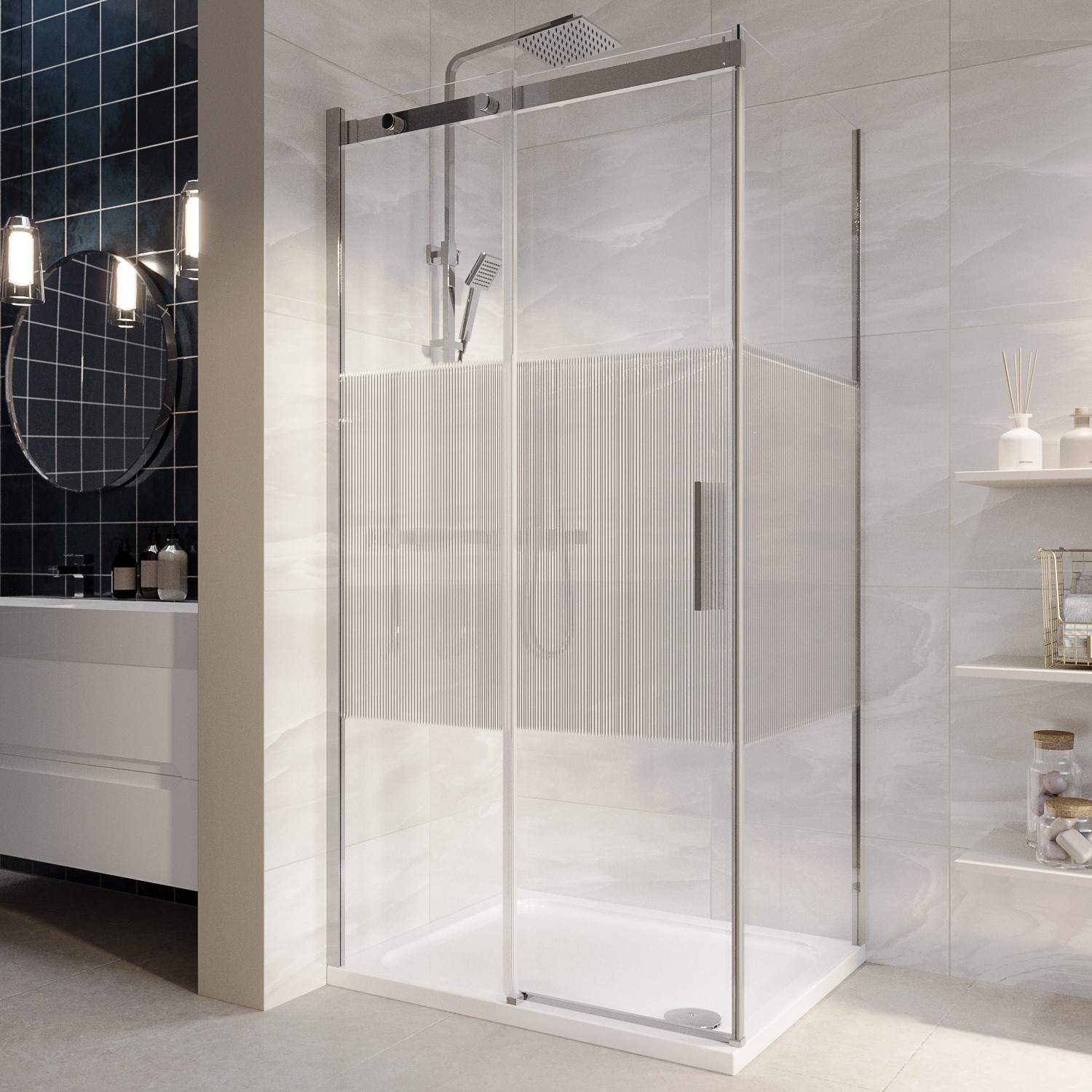
A defined zone, usually at eye level or along one edge. The most common choice, and the clearest way to put a mark on a standard pattern.
A single motif
One placement — a logo, a mark, a figure. Small etched area, and the least effect on how the panel reads overall.
Gradient
Depth varying across the panel, from clear to fully etched. Etching can do this; printing cannot.
Read the full technical detail on etched glass →
How the Combination Is Specified
- Choose the rolled pattern for light and texture. Use the four trade-offs above — obscuring, wet behaviour, cleaning, softening. This choice is about how the bathroom works.
- Confirm it against a physical sample. Include the version number. A pattern name alone is not a specification.
- Then design the etched artwork onto that specific pattern. A design that reads well on 布纹 Bùwén may disappear on 冰花 Bīnghuā. The artwork is drawn for the texture, not in isolation.
- Sign the artwork off once, properly. After that the screen is made, and a change costs the whole 20–30 day chain.
Where Patterned Glass Fits
Patterned glass and the ribbed families do the same job by different means, and the choice between them changes what the enclosure can do.
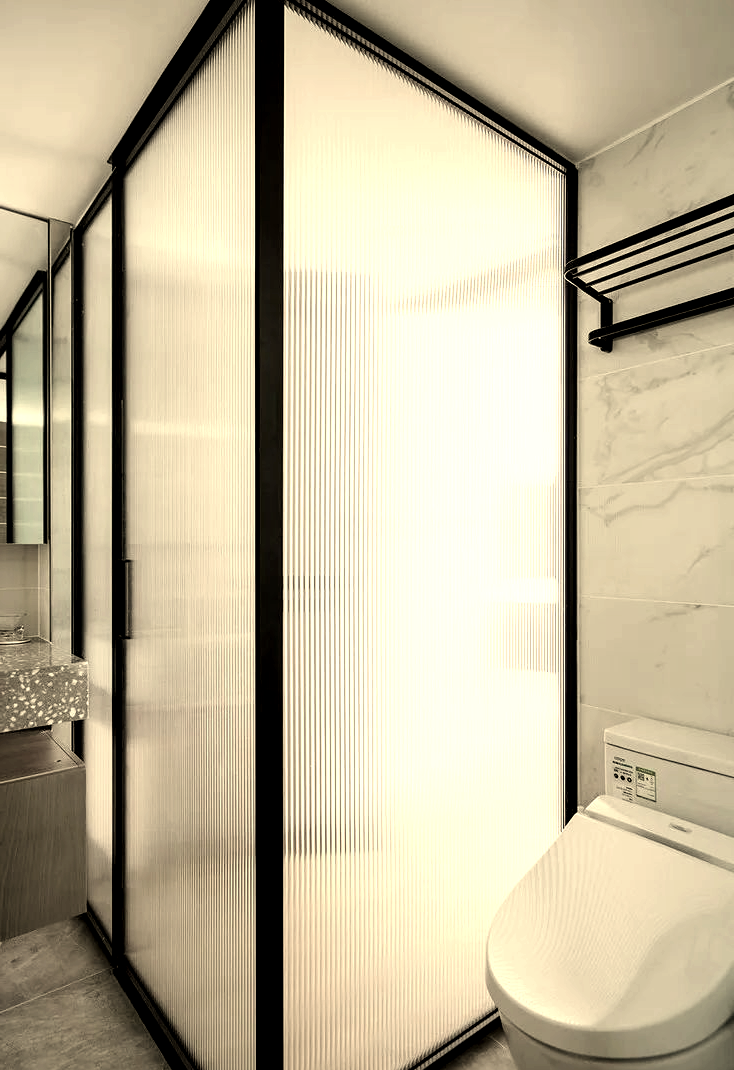
The family a rolled pattern belongs to. Chosen from the catalogue here; the ribbed options are developed under our own pattern IDs.
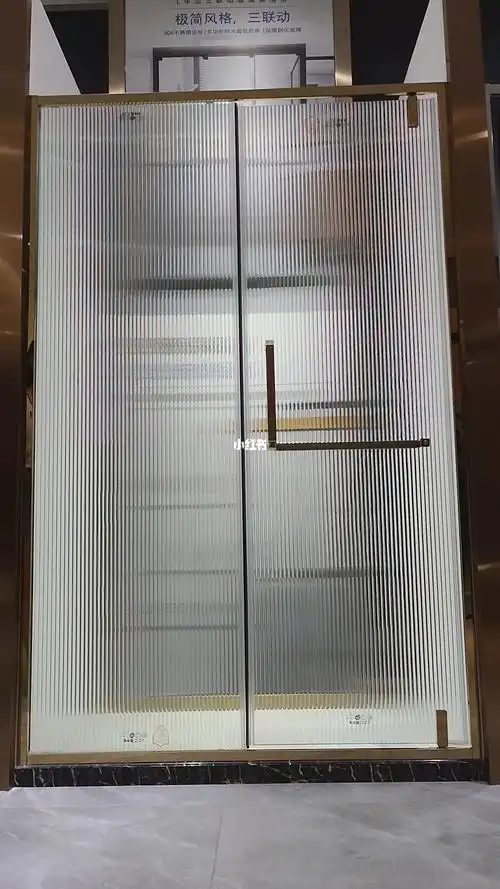
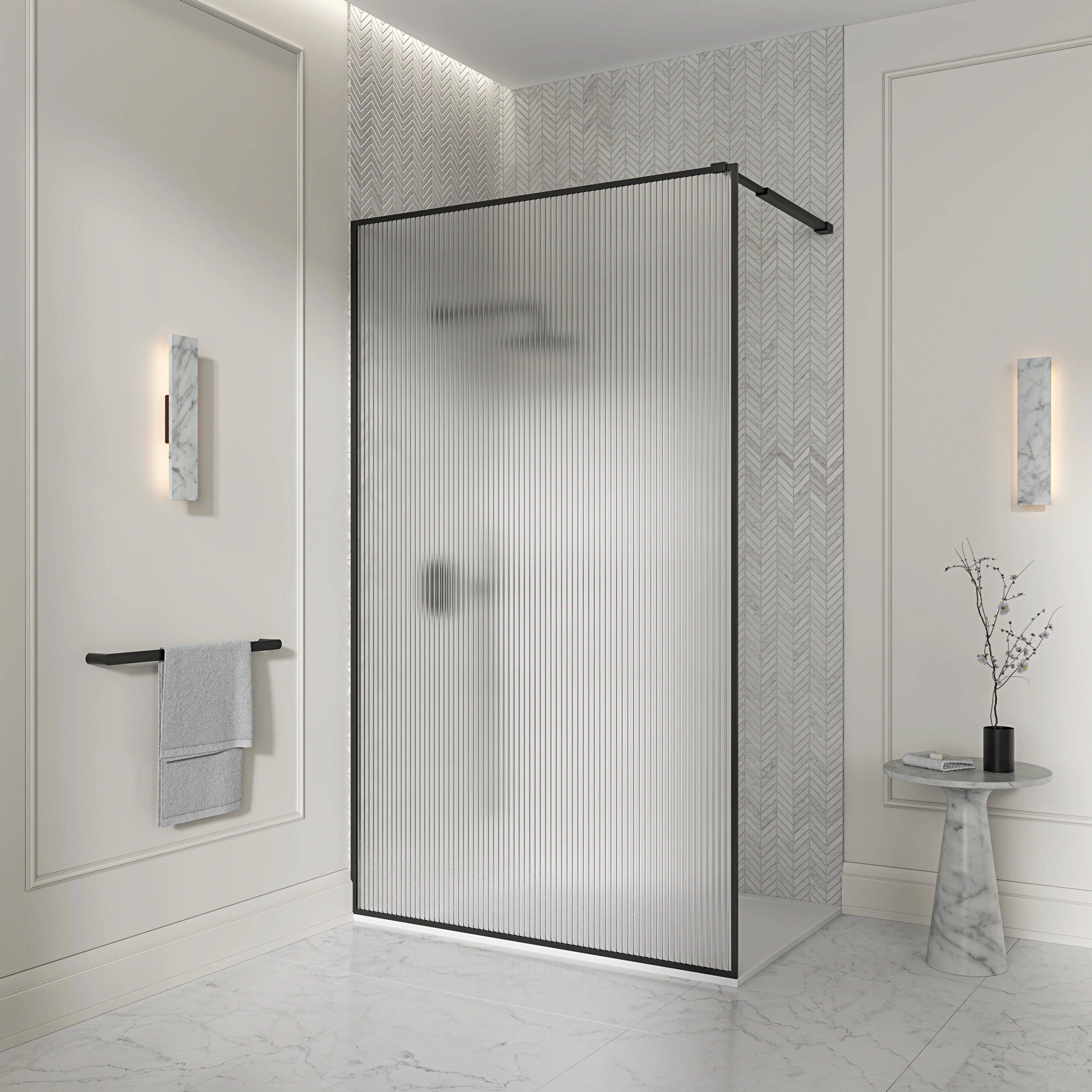
A defined groove with flat land between ribs. Sharper light contrast than a rolled pattern, and directional.
Rounded ribs meeting without a flat gap. Softer and more even than fluted, and slightly more obscuring.
A surface finish rather than a rolled texture. This is the layer that makes a selected pattern proprietary.
Browse the full decorative glass range →
Technical Specifications
| Rolled patterns | Selected from the published ranges of China's original glass manufacturers, in four families: classic textures, Chinese style, modern geometric, premium range |
| Pattern development | Not available. A new engraved roller requires a manufacturer order of 100,000–1,000,000 m² — roughly 50,000 panels at minimum |
| Pattern specification | Name plus version, confirmed against a physical sample or the manufacturer's model number |
| Etched artwork | Developed to your drawing — all-over, band or border, single motif, or gradient |
| Etching sequence | Screen → resist ink → etch → resist removed → temper |
| Etching minimum | 300 m². Screen cost is fixed, so unit cost falls as quantity rises |
| Etching cycle | 20–30 days total, covering screen, sampling and production |
| Artwork sign-off | Required before the screen is made. Changes after that restart the sequence. |
| Glass processing | Tempered as safety glass; decorative processing applied in the sequence each type requires |
| Applications | Hotel and apartment programmes wanting a proprietary look at standard volumes; branded developments; schemes matching an existing design language |
| Samples | Physical pattern samples provided for confirmation before specification |
Request pattern samples →
Request Custom Pattern Shower Glass
Tell us whether you are choosing a pattern, developing artwork, or both. The second answer is the one that starts the 20–30 day chain.
Name
Business email
Company
What are you looking for?
Please select…
Select a pattern from the existing catalogue
Select a pattern and add etched artwork
Match a pattern from a competitor's sample
Develop a new rolled pattern
Not sure — please advise
“Develop a new rolled pattern” is not possible at shower volumes — the page explains why.
Pattern family of interest
Please select…
Classic textures
Chinese style
Modern geometric
Premium range
Not decided — please send samples
Add etched artwork?
Please select…
Yes — all-over design
Yes — band or border
Yes — single motif
Yes — gradient
No — pattern only
Not decided — please advise
Is the artwork final?
Please select…
Yes — final and signed off
Close — minor changes possible
Still being designed
No artwork yet
Artwork is signed off before the screen is made. A change after that restarts the cycle.
Quantity
Etching carries a 300 m² minimum.
Application
Please select…
Hotel programme
Apartment development
Residential project
Branded commercial scheme
Other
Destination country
Artwork or reference upload (optional)
AI, EPS, SVG, DWG, DXF, PDF, SKP, JPG or PNG. A photo of a reference sample is genuinely useful here.
Project notesRequest a Quote
We use your details to respond to this enquiry only. See our privacy policy.
Start with a Physical Sample
Patterns are chosen by looking at them, not by reading their names. Ask for samples of the families you are considering — and if you are planning etched artwork, ask for a sample of the combination.
Request Pattern SamplesBrowse Decorative Glass
© Jumbo Glass Group · Showerspace — decorative shower glass and custom shower enclosure systems