Home / Projects / Flagship Dealership Case Study
Published · Build-up disclosedAuto ShowroomLow-Iron · Reflective · Jumbo
Flagship Dealership: Low-Iron & Reflective Showroom Glass
A flagship car dealership façade built from jumbo low-iron and reflective glass — optimising true vehicle colour under showroom and daylight, daytime privacy and a strong brand-façade presence without breaking the glazed elevation into joints.
① Project overview
A flagship dealership where the entire retail proposition is built around displaying vehicles through glass. The design had to solve three competing goals at once: colour fidelity (the cars must read their true paint colour), daytime privacy (glare and street view), and brand identity (a uniform reflective façade). All of this had to be delivered in jumbo panels to preserve an uninterrupted elevation.
12 mm
Low-iron toughened (display wall)
Δa/Δb ≤2
Colour shift target (low-iron)
Neutral
Reflective coating saturation
② The challenge
- Colour fidelity: standard clear glass has a green edge tint that shifts paint appearance; low-iron substrate is the baseline, not an upgrade.
- Daytime privacy + brand: reflective coating needed to be neutral — oversaturated coatings undo the low-iron colour goal.
- Uninterrupted elevation: jumbo sheets eliminate vertical joints across the showroom front.
- Thermal performance: where local code demands it, the same aesthetic had to be delivered as an IGU without losing the visual standard.
- Lighting interplay: the façade is viewed under both showroom artificial light and direct daylight; colour must hold under both.
③ Build-up & specification
| Zone | Construction | Driver |
|---|
| Display wall (primary) | 12 mm low-iron toughened | Colour fidelity, jumbo single sheet |
| Brand façade | Low-iron + neutral reflective coating | Daytime privacy + identity |
| High thermal zones | Low-E IGU (double-glazed, argon) | Energy code compliance |
| Canopy / soffit | 12.76 PVB laminated (HST) | Overhead safety |
| Executive / secure zones | Laminated upgrade | Retention & security |
Thickness and build (12 / 15 mm monolithic, or IGU) are a design starting point; final specification follows the showroom elevation drawing, coating selection and local thermal requirements.
Why low-iron is the baseline, not an option
Standard clear glass carries a measurable green cast from iron content, most visible at edges and across large sheets. For a space built to display vehicles, that shift is unacceptable. Low-iron (ultra-clear) substrate removes the cast so the displayed colour is the vehicle colour — under both showroom lighting and daylight.
④ Reflective & tinted coating
The brand-façade coating was selected for neutrality: a reflective layer that reads as a uniform mirror from the street without a strong blue or grey saturation. This matters because an oversaturated coating changes the apparent colour of the cars behind it — directly working against the low-iron objective.
- Coating placement: surface #2 for IGU builds; applied after tempering for off-line soft-coat.
- Neutrality check: colour measured under D65 and direct light, with a target shift of Δa/Δb ≤2.
- Edge deletion: 8–10 mm coating removed from the perimeter (off-line) to prevent seal contact.
- Tint independence: any tint is selected separately from coating performance, for appearance and additional solar control.
⑤ Thermal performance (where specified)
| Build | U-value | SHGC | Note |
|---|
| 6T + 16Ar + 6T (double Ag) | ~1.0 W/m²K | ~0.32 | Standard jumbo façade IGU |
| 6T + 16Kr + 6T (double Ag) | 0.7–0.9 W/m²K | ~0.30 | Premium (krypton) |
| Triple-glazed + krypton | 0.5–0.6 W/m²K | ~0.22 | Passive / extreme climate |
U-value / SHGC are configuration-dependent. Where the project required an IGU, the same low-iron / neutral-reflective aesthetic was carried across the insulating build; final values are declared per the agreed schedule.
⑥ Fabrication & processing
- Low-iron substrate cut & edgeworked before tempering: final dimensions locked — jumbo panels cannot be re-cut after.
- Tempering: EN 12150 / ASTM C1048, surface stress ≥95 MPa, furnace uniformity ±9°F.
- Coating: off-line soft-coat applied after tempering; edge deletion 8–10 mm; neutral-saturation verified.
- Heat soak test (HST): 554°F (290°C) × 4 hrs for overhead/canopy lites; verified batches target <0.01% field-break risk, achieved breakage rate ≤0.08%.
- Lamination (canopy / secure zones): PVB interlayer, post-breakage retention, HST prior to laminating.
- Frit / branding: ceramic frit for signage or canopy soffit fired before IGU assembly where applicable.
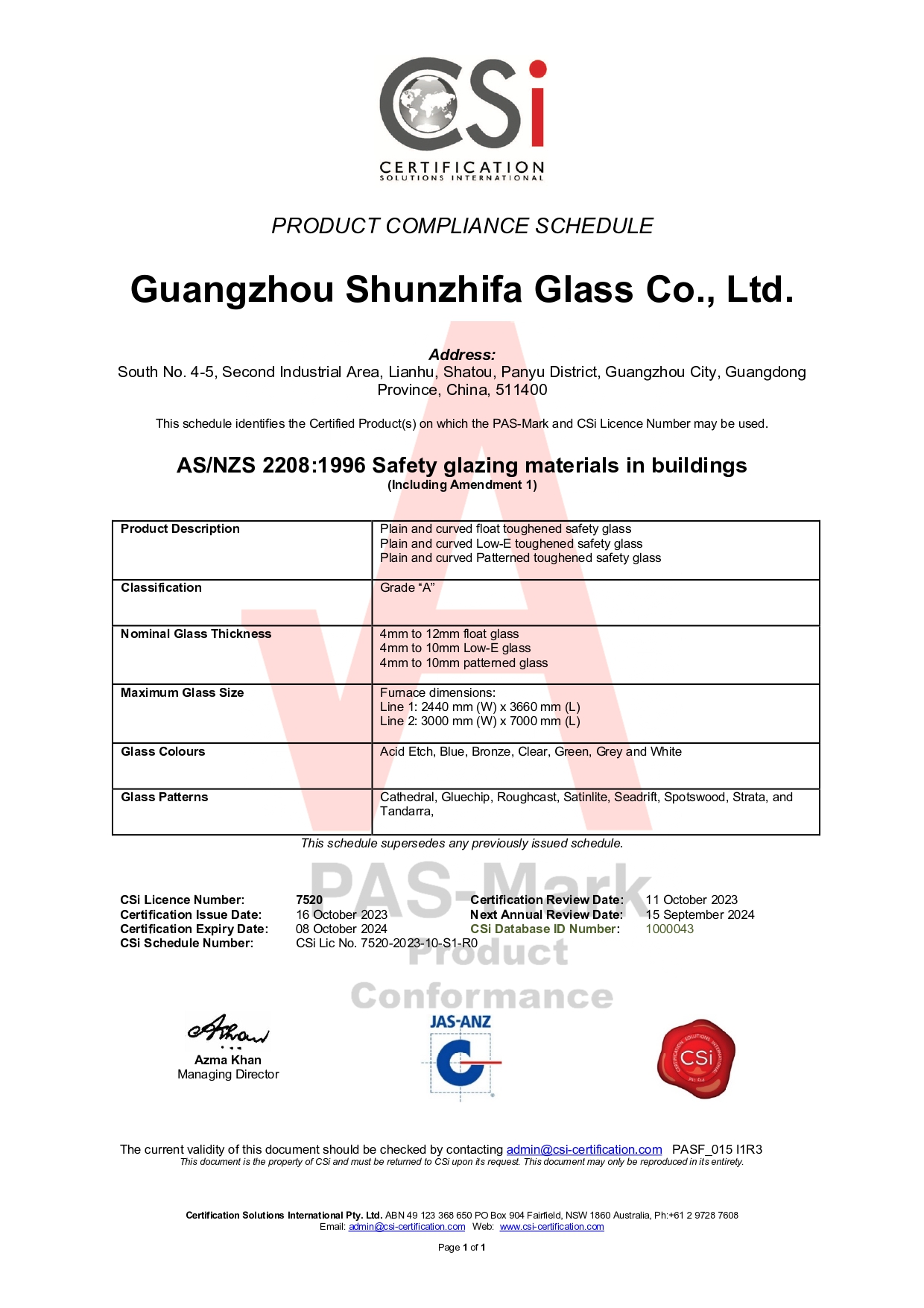
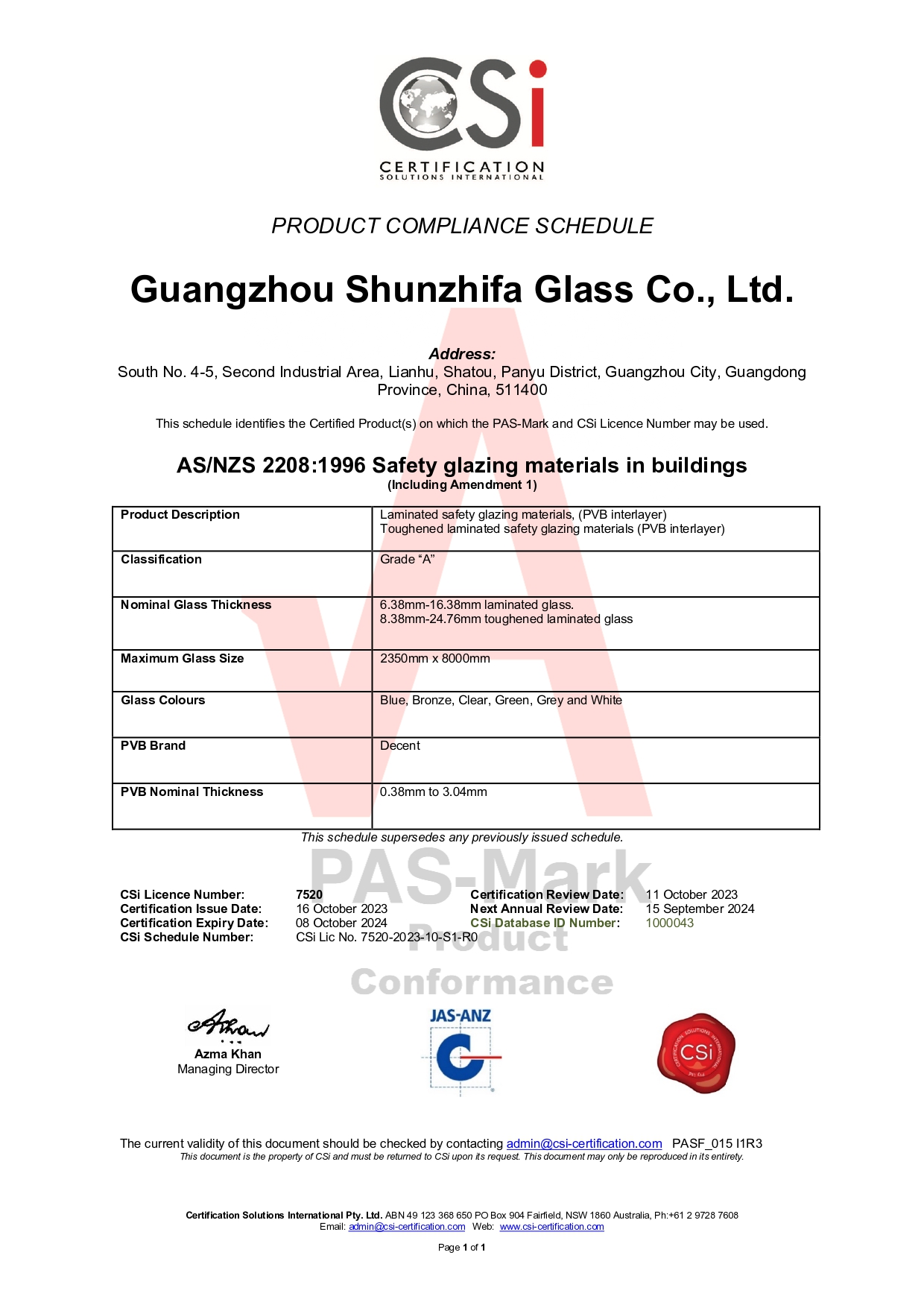
⑦ Compliance
| Standard | Market | Scope |
|---|
| EN 12150-1 | EU/UK | Toughened soda-lime glass |
| EN 14449 | EU/UK | Laminated safety glass |
| EN 1096 | EU/UK | Coated glass classification |
| EN 1279 | EU/UK | Insulating glass units (where IGU) |
| ASTM C1048 | USA | Heat-treated flat glass |
| ASTM C1376 | USA | Coated glass |
| ASTM E2190 | USA | IGU specification (where IGU) |
Applicable standard and local building-code provisions must be confirmed for the project jurisdiction before specification.
⑧ Outcome
- Low-iron display walls delivered true vehicle colour with no green shift under showroom or daylight viewing.
- Neutral reflective coating gave a consistent brand façade with daytime privacy.
- Jumbo single sheets preserved an uninterrupted showroom elevation.
- Where thermal performance was required, the aesthetic was maintained through a low-iron IGU build.
Quantified outcomes (energy performance, colour-measurement report, installation programme) are project-specific and available on request under NDA.
⑨ Why jumbo / oversize mattered
A showroom façade is a branding surface first and a thermal assembly second. The fewer joints, the stronger the visual statement — so the largest single low-iron and reflective sheets the line could produce were the objective. Because the primary element is monolithic glass, it is governed only by manufacturing and handling limits.
Size distinction: a monolithic jumbo lite can reach 3300×20000 mm. Where the specification called for an insulating unit (IGU) for thermal performance, the sealed unit is limited to 3300×12000 mm by handling and long-term seal integrity. The company maximum is a capability figure; the actual panel size for this project was set by the elevation design and engineering.
⑩ Jumbo capability
| Parameter | Capacity |
|---|
| Max flat panel (monolithic) | 3300 × 20000 mm (11 × 65.6 ft) |
| Max flat panel (IGU) | 3300 × 12000 mm |
| Max curved panel | 2800 × 7500 mm, R≥32″ |
| Thickness range | 3–25 mm monolithic; laminates built up from plies |
| Cutting | Bystronic CNC, ±0.01″ |
| Tempering | Surface stress ≥95 MPa; furnace uniformity ±9°F |
| HST | 554°F × 4 hrs; breakage rate ≤0.08% |
| Wave distortion | ≤0.004″/ft |
These are company-level capacities. A project's actual maximum panel is always the smaller of the capacity limit and the dimension dictated by engineering.
⑪ Decision flow
Display wall?→Low-iron substrate (baseline)→Neutral reflective coating?→Colour check (D65 + daylight)→Thermal need? → IGU or monolithic→HST for overhead→Engineering sign-off
⑫ Frequently asked questions
Why use low-iron glass for a car showroom?
Standard clear glass carries a green edge tint that shifts the colour of displayed vehicles. Low-iron (ultra-clear) substrate removes that cast, so the cars read their true colour under both showroom and daylight — the entire point of a glazed showroom.
How large can a showroom glass panel be?
A monolithic jumbo lite can reach 3300×20000mm. Where the specification calls for an insulating unit (IGU) for thermal performance, the sealed unit is limited to 3300×12000mm by handling and long-term seal integrity.
Does a reflective coating change the car colour?
It can. An oversaturated reflective coating shifts apparent colour, which is why a neutral coating is essential in a showroom — it preserves the low-iron colour fidelity objective.
Is an IGU needed for a showroom?
Only where local energy code or comfort requires it. The same low-iron / neutral-reflective aesthetic can be delivered in an IGU, at the cost of the smaller sealed-unit size limit.
⑬ Request a project-matched specification
For a showroom façade, share elevation drawings, panel dimensions, desired reflectivity / privacy level, low-iron requirement, coating neutrality target, whether an IGU is needed, HST requirement, and standard (EN / ASTM). We return a feasibility review, build proposal and FOB quotation within 48 hours.
Required fields: panel W × H · quantity · low-iron (yes/no) · reflectivity % · tint · IGU required (U/SHGC target) · coating surface · HST · edgework · frit/branding · standard · destination port & incoterm · target delivery.
📧 tomron1688@gmail.com | 🌐 Upload drawings at www.jumbotemperedglass.com
Designing a flagship showroom?
Share your elevation and colour-fidelity requirements for a low-iron + reflective jumbo specification.Request specification Back to Projects
Continue reading
Selection Guide
Auto Showroom Glass Guide
Low-iron, reflective coating, colour fidelity and IGU options for dealerships.Read guide →
Product
Ultra Clear Tempered Glass
Low-iron, water-white toughened glass for true-colour display applications.View product →
Application
Storefront & Retail Glass
High-clarity retail façades and showroom glazing across the jumbo range.Explore application →
Jumbo Glass Group · Projects Case Study — Flagship Dealership (Low-Iron & Reflective Showroom Glass).
Company capability figures are not project-specific claims; all project dimensions and performance values must be confirmed by engineering.